Decentralized Infrastructure for (Neuro)science
Or, Kill the Cloud in Your Mind
With gratitude to...
This document is in-progress, feedback welcome!
If you are reading this, at this point please do not redistribute this link! As you'll see it is still *very* drafty <3
This page embeds hypothes.is, which allows you to annotate the text! Existing annotations should show up highlighted like this, and you can make a new annotation by highlighting an area of the text and clicking the 'annotate' button that appears! You can see all annotations by opening the sidebar on the right.
Unfortunately, hypothes.is causes the page to freeze on load currently (especially on mobile). I've submitted an issue: https://github.com/hypothesis/client/issues/3919
If you do work that you think is relevant here but I am not citing it, it's 99% likely that's because I haven't read it, not that I'm deliberately ignoring you! Feel free to annotate any missing citations, odds are I'd love to read & cite your work, and if you're working in the same space try and join efforts!
Current Document Status (21-12-06):
We've made it to the end of the document! There are plenty of places with placeholder text and extra plenty editing to do, but we're almost there!
If we can make something decentralised, out of control, and of great simplicity, we must be prepared to be astonished at whatever might grow out of that new medium.
Tim Berners-Lee (1998): Realising the Full Potential of the Web
A good analogy for the development of the Internet is that of constantly renewing the individual streets and buildings of a city, rather than razing the city and rebuilding it. The architectural principles therefore aim to provide a framework for creating cooperation and standards, as a small “spanning set” of rules that generates a large, varied and evolving space of technology.
In building cyberinfrastructure, the key question is not whether a problem is a “social” problem or a “technical” one. That is putting it the wrong way around. The question is whether we choose, for any given problem, a primarily social or a technical solution
Bowker, Baker, Millerand, and Ribes (2010): Toward Information Infrastructure Studies [1]
The critical issue is, how do actors establish generative platforms by instituting a set of control points acceptable to others in a nascent ecosystem? [2]
Introduction
We work in an archipelago of technical islands, researchers, labs, consortia, and a few well-funded institutions reinventing the wheel in parallel. Our knowledge dissemination systems are as nimble as the static pdfs and ephemeral conference talks that they have been for decades1. Experimental instrumentation except for that at the polar extremes of technological complexity or simplicity is designed and built custom, locally, and on-demand2. Software for performing experiments is a patchwork of libraries that satisfy some of the requirements of the experiment, sewn together by some uncommented script written years ago by a grad student who left the lab long-since. The technical knowledge to build both instrumentation and software is fragmented and unavailable as it sifts through the funnels of word-limited methods sections and never-finished documentation. And O Lord Let Us Pray For The Data, born into this world without coherent form to speak of, indexable only by passively-encrypted notes in a paper lab notebook, dressed up for the analytical ball once before being mothballed in ignominy on some unlabeled external drive.
The idiosyncratic and improvised ways we use and relate to computers may be unique in each instance, but all are symptomatic of a broader deficit in digital infrastructure for science. Every routine need that requires heavy technical development or yet another platform subscription is an indicator that infrastructural deficits define the daily reality of science. We should be able to easily store, share, and search for data; be able to organize and communicate with each other; be able to write and review our work, but we are hemmed in on all sides by looming tech profiteers and chasms of underdevelopment.
If the term infrastructure conjures images of highways and plumbing, then surely digital infrastructure would be flattered at the association. Roughly following Star and Ruhleder’s (1996) dimensions [3], by analogy they illustrate many of its promises and challenges: when designed to, it can make practically impossible things trivial, allowing the development of cities by catching water where it lives and snaking it through tubes and tunnels sometimes directly into your kitchen. Its absence or failure is visible and impactful, as in the case of power outages. There is no guarantee that it “optimally” satisfies some set of needs for the benefit of the greatest number of people, as in the case of the commercial broadband duopolies. It exists not only as its technical reality, but also as an embodied and shared set of social practices, and so even when it does exist its form is not inevitable or final; as in the case of bottled water producers competing with municipal tap water on a behavioral basis despite being dramatically less efficient and more costly. Finally it is not socially or ethically neutral, and the impact of failure to build or maintain it is not equally shared, as in the expression of institutional racism that was the Flint, Michigan water crisis [4].
Infrastructural deficits are not our inevitable and eternal fate, but the course of infrastructuring is far from certain. It is not the case that “scientific digital infrastructure” will rise from the sea monolithically as a natural result of more development time and funding, but instead has many possible futures[5], each with their own advocates and beneficiaries. Without concerted and strategic development based on a shared and liberatory ethical framework, science will follow the same path as other domains of digital technology down the dark road of platform capitalism. The prize of owning the infrastructure that the practice of science is built on is too great, and it is not hard to imagine tech behemoths buying out the emerging landscape of small scientific-software-as-a-service startups and selling subscriptions to Science Prime. The possibility of future capture is still too naive a framing: operating as obligate brokers of (usually surveillance) data[6, 7, 8], prestige, and computational resources naturally relies on displacing the possibility of alternative infrastructure. Our predicament is doubly difficult: we both have digital infrastructural defits, but are also being actively deinfrastructured.
This paper is an argument that decentralized digital infrastructure is the best means of alleviating the harms of infrastructural deficits and building a digital landscape that supports, rather than extracts from science. I will draw from several disciplines and knowledge communities, across and outside academia to articulate a vision of an infrastructure in three parts: shared data, shared tools, and shared knowledge. These domains reflect three of the dominant modes of digital enclosure prerequisite for platform capture: storage, computation, and communication. The systems we will describe are in conversation with and a continuation of a long history of reimagining the relationship between these domains for a healthier web (see eg. [9, 10]). We depart from it to describe a system of fluid, peer-to-peer social affiliation and folksonomic linked data with lessons primarily from early wikis and Wikipedia, the fissures of the semantic web and linked data communities, the social structure of private bittorrent trackers, and the federation system of ActivityPub and the Fediverse. Approaching this problem from science has its constraints — like the structuring need to rebuild systems of credit assignment — as well as the powerful opportunity of one of the last systems of labor largely not driven by profit developing technology and seeding communities that could begin to directly address the dire, societywide need for digital freedom.
The problems we face are different than they were at the dawn of the internet, but we can learn from its history: we shouldn’t be waiting for a new journal-like platform, software package, or subscription to save us. We need to build protocols for communication, interoperability, and self-governance (see, recently [11]).
I will start with a brief description of what I understand to be the state of our digital infrastructure and the structural barriers and incentives that constrain its development. I will then propose a set of design principles for decentralized infrastructure and possible means of implementing it informed by prior successes and failures at building mass digital infrastructure. I will close with contrasting visions of what science could be like depending on the course of our infrastructuring, and my thoughts on how different actors in the scientific system can contribute to and benefit from decentralization.
I insist that what I will describe is not utopian but is eminently practical — the truly impractical choice is to do nothing and continue to rest the practice of science on a pyramid scheme [12] of underpaid labor. With a bit of development to integrate and improve the tools, every class of technology I propose here already exists and is widely used. A central principle of decentralized systems is embracing heterogeneity: harnessing the power of the diverse ways we do science instead of constraining them. Rather than a patronizing argument that everyone needs to fundamentally alter the way they do science, the systems that I describe are specifically designed to be easily incorporated into existing practices and adapted to variable needs. In this way I argue decentralized systems are more practical than the dream that any one system will be capable of expanding to the scale of all science — and as will hopefully become clear, inarguably more powerful than a disconnected sea of centralized platforms and services.
An easy and common misstep is to categorize this as solely a technical challenge. Instead the challenge of infrastructure is also social and cultural — it involves embedding any technology in a set of social practices, a shared belief that such technology should exist, that its form is not neutral, and a sense of communal valuation and purpose that sustains it [13].
The social and technical perspectives are both essential, but make some conflicting demands on the construction of the piece: Infrastructuring requires considering the interrelatedness and mutual reinforcement of the problems to be addressed, rather than treating them as isolated problems that can be addressed piecemeal with a new package. Such a broad scope trades off with a detailed description of the relevant technology and systems, but a myopic techno-zealotry that does not examine the social and ethical nature of scientific practice risks reproducing or creating new sources of harm. That, and techno-solutionism never works anyway. As a balance I will not be proposing a complete technical specification or protocol, but describing the general form of the tools and some existing examples that satisfy them; I will not attempt a full history or treatment of the problem of infrastructuring, but provide enough to motivate the form of the proposed implementations.
My understanding of this problem is, of course, uncorrectably structured by my training largely centered in systems neuroscience and my position as an early career researcher (ECR). While the core of my argument is intended to be a sketch compatible with sciences and knowledge systems generally, my examples will sample from, and my focus will skew to my experience. In many cases, my use of “science” or “scientist” could be “neuroscience” or “neuroscientist,” but I will mostly use the former to avoid the constant context switches. This document is also an experiment in public collaboration on a living scientific document: to try and ease our way out of disciplinary tunnelvision, we invite annotation and contribution with no lower bound — if you’d like to add or correct a sentence or two (or a page or ten), you’re welcome as coauthor. I ask the reader for a measure of patience for the many ways this argument requires elaboration and modification for distant fields.
The State of Things
The Costs of Infrastructure Deficits
An infrastructure deficit framing gives a shared etiology to many technical and social harms in scientific work that are typically treated separately, and allows us to problematize other symptoms have become embedded as norms.
I will list some of the present costs to give a sense of the scale of need, as well as scope for the problems we intend to address here. These lists are grouped into rough and overlapping categories, but make no pretense at completeness and have no particular order.
Impacts on the daily experience of researchers include:
- A prodigious duplication and dead-weight loss of labor as each lab, and sometimes each person within each lab, will reinvent basic code, tools, and practices from scratch. Literally it is the inefficiency of the Harberger’s triangle in the supply and demand system for scientific infrastructure caused by inadequate supply. Labs with enough resources are forced to pay from other parts of their grants to hire professional programmers and engineers to build the infrastructure for their lab3, but most just operate on a purely amateur basis. Many PhD students will spend the first several years of their degree re-solving already-solved problems, chasing the tails of the wrong half-readable engineering whitepapers, in their 6th year finally discovering the technique that they actually needed all along. That’s not an educational or training model, it’s the effect of displacing the undone labor of unbuilt infrastructure on vulnerable graduate workers almost always paid poverty wages.
- At least the partial cause of the phenomenon where “every scientist needs to be a programmer now” as people who aren’t particularly interested in being programmers — which is fine and normal — need to either suffer through code written by some other unlucky amateur or learn an entire additional discipline in order to do the work of the one they chose.
- A great deal of pain and alienation for early- career researchers not previously trained in programming before being thrown in the deep end. Learning data hygeine practices like backup, annotation, etc. “the hard way” through some catastrophic loss is accepted myth in much of science. At some scale all the very real and widespread pain, guilt, and shame felt by people who had little choice but to reinvent their own data management system must be recognized as an infrastructural, rather than a personal problem.
- The high cost of “openness” and the dearth of data transparency. It is still rare to publish full, raw data and analysis code, often because the labor of cleaning it is too great. The “Open science” movement, roughly construed, has reached a few hard limits from present infrastructure that have forced its energy to leak from the sides as bullying leaderboards or sets of symbols that are mere signifiers of cultural affiliation to openness. “Openness” is not a uniform or universal goal for all science, but for those for whom it makes sense, we need to provide the appropriate tooling before insisting on a change in scientific norms. We can’t expect data transparency from researchers while it is still so hard.
Impacts on the system of scientific inquiry include:
- A profoundly leaky knowledge acquisition system where entire PhDs worth of data can be lost and rendered useless when a student leaves a lab and no one remembers how to access the data or how it’s formatted.
- The inevitability of continual replication crises because it is often literally impossible to replicate an experiment that is done on a rig that was built one time, used entirely in-lab code, and was never documented
- Reliance on communication platforms and knowledge systems that aren’t designed to, and don’t come close to satisfying the needs of scientific communication. In the absence of some generalized means of knowledge organization, scientists ask the void4 for advice or guidance from anyone that algorithmically stumbles by. Often our best recourse is to make a Slack about it, which is incapable of producing a public, durable, and cumulative resource: and so the same questions will be asked again… and again…
- A perhaps doomed intellectual endeavor5 as we attempt to understand the staggering complexity of the brain by peering at it through the camera obscura of just the most recent data you or your lab have collected rather than being able to index across the many measurements of the same phenomena. The unnecessary reduplication of experiments becomes not just a methodological limitation, but an ethical catastrophe as researchers have little choice but to abandon the elemental principle of sacrificing as few animals as possible.
- A near-absence of semantic or topical organization of research that makes cumulative progress in science proabilistic at best, and subject to the malformed incentives of publication and prestige gathering at worst. Since engaging with prior literature is a matter of manually reconstructing a caricature of a field of work in every introduction, continuing lines of inquiry or responding to conflicting results is strictly optional.
- A hierarchy of prestige that devalues the labor of many groups of technicians, animal care workers, and so on. Authorship is the coin of the realm, but many workers that are fundamental to the operation of science only receive the credit of an acknowledgement. We need a system to value and assign credit for the immense amount of technical and practical knowledge and labor they contribute.
Impacts on the relationship between science and society:
- An insular system where the inaccessibility of all the “contextual” knowledge [14, 15] that doesn’t have a venue for sharing but is necessary to perform experiments, like “how to build this apparatus,” “what kind of motor would work here,” etc. is a force that favors established and well-funded labs who can rely on local knowledege and hiring engineers/etc. and excludes new, lesser-funded labs at non-ivy institutions. The concentration of technical knowledge magnifies the inequity of strongly skewed funding distributions such that the most well-funded labs can do a completely different kind of science than the rest of us, turning the positive-feedback loop of funding begetting funding ever faster.
- An absconscion with the public resources we are privileged enough to receive, where rather than returning the fruits of the many technical challenges we are tasked with solving to the public in the form of data, tools, collected practical knowledge, etc. we largely return papers. Since those papers are often impenetrable outside of their discipline or paywalled outside of academia, we multiply the above impacts of labor duplication and knowledge inaccessibility by the scale of society.
- The complicity of scientists in rendering our collective intellectual heritage nothing more than another regiment in the ever-advancing armies of platform capitalism. If our highest aspirations are to shunt all our experiments, data, and analysis tools onto Amazon Web Services, our failure of imagination will be responsible for yet another obligate funnel of wealth into the system of extractive platforms that dominate the flow of global information. For ourselves, we stand to have the practice of science filleted at the seams into a series of mutually incompatible subscription services. For society, we squander the chance for one of the very few domains of non-economic labor to build systems to recollectivize the basic infrastrucutre of the internet: rather than providing an alternative to the information overlords and their digital enclosure movement, we will be run right into their arms.
Considered separately, these are serious problems, but together they are a damning indictment of our role as stewards of our corner of the human knowledge project.
We arrive at this situation not because scientists are lazy and incompetent, but because we are embedded in a system of mutually reinforcing disincentives to cumulative infrastructure development. Our incentive systems are, in turn, coproductive with a raft of economically powerful entities that would really prefer owning it all themselves, thanks. Put bluntly, “we are dealing with a massively entrenched set of institutions, built around the last information age and fighting for its life” [1]
There is, of course, an enormous amount of work being done by researchers and engineers on all of these problems, and a huge amount of progress has been made on them. My intention is not to shame or devalue anyone’s work, but to try and describe a path towards integrating it and making it mutually reinforcing.
Before proposing a potential solution to some of the above problems, it is important to motivate why they haven’t already been solved, or why their solution is not necessarily imminent. To do that, we need a sense of the social and technical challenges that structure the development of our tools.
(Mis)incentives in Scientific Software
The incentive systems in science are complex, subject to infinite variation everywhere, so these are intended as general tendencies rather than statements of irrevocable and uniform truth.
Incentivized Fragmentation
Scientific software development favors the production of many isolated, single-purpose software packages rather than cumulative work on shared infrastructure. The primary means of evaluation for a scientist is academic reputation, primarily operationalized by publications, but a software project will yield a single paper (if any). Traditional publications are static units of work that are “finished” and frozen in time, but software is never finished: the thousands of commits needed to maintain and extend the software are formally not a part of the system of academic reputation.
Howison & Herbsleb described this dynamic in the context of BLAST6
In essence we found that BLAST innovations from those motivated to improve BLAST by academic reputation are motivated to develop and to reveal, but not to integrate their contributions. Either integration is actively avoided to maintain a separate academic reputation or it is highly conditioned on whether or not publications on which they are authors will receive visibility and citation. [16]
For an example in Neuroscience, one can browse the papers that cite the DeepLabCut paper [17] to find hundreds of downstream projects that make various extensions and improvements that are not integrated into the main library. While the alternative extreme of a single monolithic ur-library is also undesirable, working in fragmented islands makes infrastructure a random walk instead of a cumulative effort.
After publication, scientists have little incentive to maintain software outside of the domains in which the primary contributors use it, so outside of the most-used libraries most scientific software is brittle and difficult to use [18, 19].
Since the reputational value of a publication depends on its placement within a journal and number of citations (among other metrics), citation practices for scientific software are far from uniform and universal, and relatively few “prestige” journals publish software papers at all, the incentive to write scientific software in the first place is low compared to its near-universal use [20].
Domain-Specific Silos
When funding exists for scientific infrastructure development, it typically comes in the form of side effects from, or administrative supplements to research grants. The NIH describes as much in their Strategic Plan for Data Science [21]:
from 2007 to 2016, NIH ICs used dozens of different funding strategies to support data resources, most of them linked to research-grant mechanisms that prioritized innovation and hypothesis testing over user service, utility, access, or efficiency. In addition, although the need for open and efficient data sharing is clear, where to store and access datasets generated by individual laboratories—and how to make them compliant with FAIR principles—is not yet straightforward. Overall, it is critical that the data-resource ecosystem become seamlessly integrated such that different data types and information about different organisms or diseases can be used easily together rather than existing in separate data “silos” with only local utility.
The National Library of Medicine within the NIH currently lists 122 separate databases in its search tool, each serving a specific type of data for a specific research community. Though their current funding priorities signal a shift away from domain-specific tools, the rest of the scientific software system consists primarily of tools and data formats purpose-built for a relatively circumscribed group of scientists without any framework for their integration. Every field has its own challenges and needs for software tools, but there is little incentive to build tools that serve as generalized frameworks to integrate them.
“The Long Now” of Immediacy vs. Idealism
Digital infrastructure development takes place at multiple timescales simultaneously — from the momentary work of implementing it; through longer timescales of planning, organization, and documenting; to the imagined indefinite future of its use — what Ribes and Finholt call “The Long Now. [22]” Infrastructural projects constitutively need to contend with the need for immediately useful results vs. general and robust systems; the need to involve the effort of skilled workers vs. the uncertainty of future support; the balance between stability and mutability; and so on. The tension between hacking something together vs. building something sustainable for future use is well-trod territory in the hot-glue and exposed wiring of systems neuroscience rigs.
Deinfrastructuring divides the incentives and interests of junior and senior researchers. ECRs might be interested in developing tools they’ll use throughout their careers, but given the pressure to establish their reputation with publications rarely have the time to develop something fully. The time pressure never ends, and established researchers also need to push enough publications through the door to be able to secure the next round of funding. The time preference of scientific software development is thus very short: hack it together, get the paper out, we’ll fix it later.
The constant need to produce software that does something in the context of scientific programming which largely lacks the institutional systems and expert mentorship needed for well-architected software means that most programmers never have a chance to learn best practices commonly accepted in software engineering. As a consequence, a lot of software tools are developed by near-amateurs with no formal software training, contributing to their brittleness [23].
The problem of time horizon in development is not purely a product of inexperience, and a longer time horizon is not uniformly better. We can look to the history of the semantic web, a project that was intended to bridge human and computer-readable content on the web, for cautionary tales. In the semantic web era, thousands of some of the most gifted programmers and some of the original architects of the internet worked with an eye to the indefinite future, but the raw idealism and neglect of the pragmatic reality of the need for software to do something drove many to abandon the effort (bold is mine, italics in original):
But there was no use of it. I wasn’t using any of the technologies for anything, except for things related to the technology itself. The Semantic Web is utterly inbred in that respect. The problem is in the model, that we create this metaformat, RDF, and then the use cases will come. But they haven’t, and they won’t. Even the genealogy use case turned out to be based on a fallacy. The very few use cases that there are, such as Dan Connolly’s hAudio export process, don’t justify hundreds of eminent computer scientists cranking out specification after specification and API after API.
When we discussed this on the Semantic Web Interest Group, the conversation kept turning to how the formats could be fixed to make the use cases that I outlined happen. “Yeah, Sean’s right, let’s fix our languages!” But it’s not the languages which are broken, except in as much as they are entirely broken: because it’s the mentality of their design which is broken. You can’t, it has turned out, make a metalanguage like RDF and then go looking for use cases. We thought you could, but you can’t. It’s taken eight years to realise. [24]
Developing digital infrastructure must be both bound to fulfilling immediate, incremental needs as well as guided by a long-range vision. The technical and social lessons run in parallel: We need software that solves problems people actually have, but can flexibly support an eventual form that allows new possibilities. We need a long-range vision to know what kind of tools we should build and which we shouldn’t, and we need to keep it in a tight loop with the always-changing needs of the people it supports.
In short, to develop digital infrastructure we need to be strategic. To be strategic we need a plan. To have a plan we need to value planning as work. On this, Ribes and Finholt are instructive:
“On the one hand, I know we have to keep it all running, but on the other, LTER is about long-term data archiving. If we want to do that, we have to have the time to test and enact new approaches. But if we’re working on the to-do lists, we aren’t working on the tomorrow-list” (LTER workgroup discussion 10/05).
The tension described here involves not only time management, but also the differing valuations placed on these kinds of work. The implicit hierarchy places scientific research first, followed by deployment of new analytic tools and resources, and trailed by maintenance work. […] While in an ideal situation development could be tied to everyday maintenance, in practice, maintenance work is often invisible and undervalued. As Star notes, infrastructure becomes visible upon breakdown, and only then is attention directed at its everyday workings (1999). Scientists are said to be rewarded for producing new knowledge, developers for successfully implementing a novel technology, but the work of maintenance (while crucial) is often thankless, of low status, and difficult to track. How can projects support the distribution of work across research, development, and maintenance? [22]
“Neatness” vs “Scruffiness”
Closely related to the tension between “Now” and “Later” is the tension between “Neatness” and “Scruffiness.” Lindsay Poirier traces its reflection in the semantic web community as the way that differences in “thought styles” result in different “design logics” [25]. On the question of how to develop technology for representing the ontology of the web – the system of terminology and structures with which everything should be named – there were (very roughly) two camps. The “neats” prioritized consistency, predictability, uniformity, and coherence – a logically complete and formally valid System of Everything. The “scruffies” prioritized local systems of knowledge, expressivity, “believing that ontologies will evolve organically as everyday webmasters figure out what schemas they need to describe and link their data. [25]”
This tension is as old as the internet, where amidst the dot-com bubble a telecom spokesperson lamented that the internet wasn’t controllable enough to be profitable because “it was devised by a bunch of hippie anarchists.” [26] The hippie anarchists probably agreed, rejecting “kings, presidents and voting” in favor of “rough consensus and running code.” Clearly, the difference in thought styles has an unsubtle relationship with beliefs about who should be able to exercise power and what ends a system should serve [27].
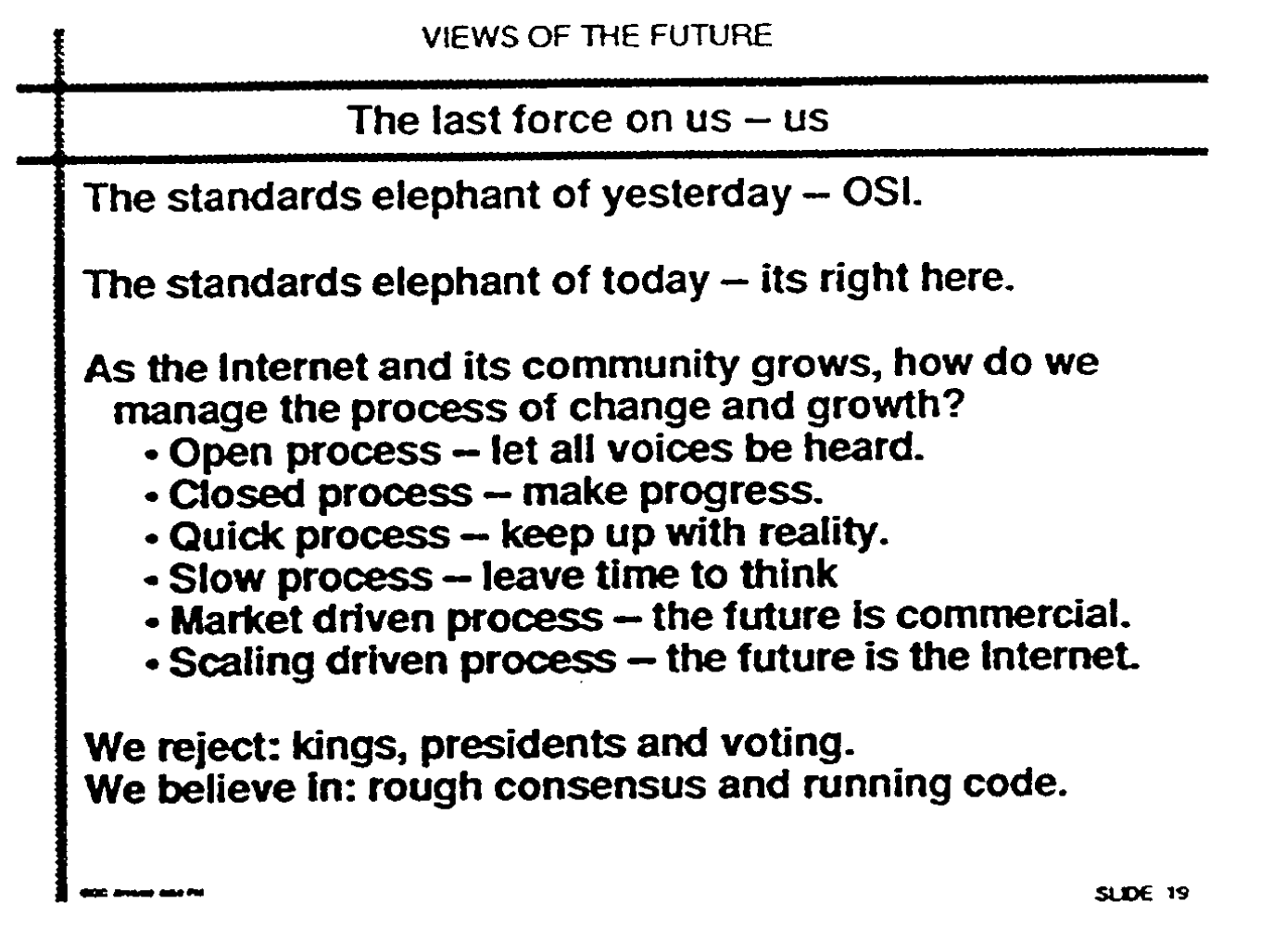 A slide from David Clark’s 1992 “Views of the Future”[28] that contrasts differing visions for the development process of the future of the internet. The struggle between engineered order and wild untamedness is summarized forcefully as “We reject: kings, presidents and voting. We believe in: rough consensus and running code”
Practically, the differences between these thought communities impact the tools they build. Aaron Swartz put the approach of the “neat” semantic web architects the way he did:
Instead of the “let’s just build something that works” attitude that made the Web (and the Internet) such a roaring success, they brought the formalizing mindset of mathematicians and the institutional structures of academics and defense contractors. They formed committees to form working groups to write drafts of ontologies that carefully listed (in 100-page Word documents) all possible things in the universe and the various properties they could have, and they spent hours in Talmudic debates over whether a washing machine was a kitchen appliance or a household cleaning device.
With them has come academic research and government grants and corporate R&D and the whole apparatus of people and institutions that scream “pipedream.” And instead of spending time building things, they’ve convinced people interested in these ideas that the first thing we need to do is write standards. (To engineers, this is absurd from the start—standards are things you write after you’ve got something working, not before!) [29]
The outcomes of this cultural rift are subtle, but the broad strokes are clear: the “scruffies” largely diverged into the linked data community, which has taken some of the core semantic web technology like RDF, OWL, and the like, and developed a broad range of downstream technologies that have found purchase across information sciences, library sciences, and other applied domains7. The linked data developers, starting by acknowledging that no one system can possibly capture everything, build tools that allow expression of local systems of meaning with the expectation and affordances for linking data between these systems as an ongoing social process.
The vision of a totalizing and logically consistent semantic web, however, has largely faded into obscurity. One developer involved with semantic web technologies (who requested not be named), captured the present situation in their description of a still-active developer mailing list:
I think that some people are completely detached from practical applications of what they propose. […] I could not follow half of the messages. these guys seem completely removed from our plane of existence and I have no clue what they are trying to solve.
This division in thought styles generalizes across domains of infrastructure, though outside of the linked data and similar worlds the dichotomy is more frequently between “neatness” and “people doing whatever” – with integration and interoperability becoming nearly synonymous with standardization. Calls for standardization without careful consideration and incorporation of existing practice have a familiar cycle: devise a standard that will solve everything, implement it, wonder why people aren’t using it, funding and energy dissipiates, rinse, repeat. The difficulty of scaling an exacting vision of how data should be formatted, the tools researchers should use for their experiments, and so on is that they require dramatic and sometimes total changes to the way people do science. The alternative is not between standardization and chaos, but a potential third way is designing infrastructures that allow the diversity of approaches, tools, and techniques to be expressed in a common framework or protocol along with the community infrastructure to allow the continual negotiation of their relationship.
Taped-on Interfaces: Open-Loop User Testing
The point of most active competition in many domains of commercial software is the user interface and experience (UI/UX), and to compete software companies will exhaustively user-test and refine them with pixel precision to avoid any potential customer feeling even a thimbleful of frustration. Scientific software development is largely disconnected from usability testing, as what little support exists is rarely tied to it. This, combined with the preponderance of semi-amateurs and above incentives for developing new packages – and thus reduplicating the work of interface development – make it perhaps unsurprising that most scientific software is hard to use!
I intend the notion of “interface” in an expansive way: In addition to the graphical user interface (GUI) exposed to the end-user, I am referring generally to all points of contact with users, developers, and other software. Interfaces are intrinsically social, and include the surrounding documentation and experience of use — part of using an API is being able to figure out how to use it! The typical form of scientific software is a black box: I implemented an algorithm of some kind, here is how to use it, but beneath the surface there be dragons.
Ideally, software would be designed with programming interfaces and documentation at multiple scales of complexity to enable clean entrypoints for developers with differing levels of skill and investment to contribute. Additionally, it would include interfaces for use and integration with other software. Without care given to either of these interfaces, the community of co-developers is likely to remain small, and the labor they expend is less likely to be useful outside that single project. This, in turn, closes the loop with incentives to develop new packages and makes another vicious cycle reinforcing fragmentation8.
Platforms, Industry Capture, and the Profit Motive
Publicly funded science is an always-irresistable golden goose for private industry. The fragmented interests of scientists and the historically light touch of funding agencies on encroaching privatization means that if some company manages to capture and privatize a corner of scientific practice they are likely to keep it. Industry capture has been thoroughly criticized in the context of the journal system (eg. recently, [11]), and that criticism should extend to the rest of our infrastructure as information companies seek to build a for-profit platform system that spans the scientific workflow (eg. [30]). The mode of privatization of scientific infrastructure follows the broader software market as a proliferation of software as a service (SaaS), from startups to international megacorporations, that rent access to some, typically proprietary software without selling the software itself.
While in isolation SaaS can make individual components of the infrastructural landscape easier to access — and even free!!* — the business model is fundamentally incompatible with integrated and accessible infrastructure. The SaaS model derives revenue from subscription or use costs, often operating as “freemium” models that make some subset of its services available for free. Even in freemium models, though, the business model requires that some functionality of the platform is enclosed and proprietary. To keep the particular domain of enclosure viable as a profit stream, the proprietor needs to actively defend against competitors as well as any technology that might fill the need for the proprietary technology9 (See a more thorough treatment of platform capitalism in science in [5])
As isolated services, one can imagine the practice of science devolving along a similar path as the increasingly-fragmented streaming video market: to do my work I need to subscribe to a data storage service, a cloud computing service, a platform to host my experiments, etc. For larger software platforms, however, vertical integration of multiple complementary services makes their impact on infrastructure more insidious. Locking users into more and more services makes for more and more revenue, which encourages platforms to be as mutually incompatible as they can get away with [31]. To encourage adoption, platforms that can offer multiple services may offer one of the services – say, data storage – for free, forcing the user to use the adjoining services – say, a cloud computing platform.
Since these platforms are often subsidiaries of information industry monopolists, scientists become complicit in their often profoundly unethical behavior of by funneling millions of dollars into them. Longterm, unconditional funding of wildly profitable journals has allowed conglomerates like Elsevier to become sprawling surveillance companies [32, 6] that are sucking as much data up as they can to market derivative products like algorithmic ranking of scientific productivity [33] and making data sharing agreements with ICE [34]. Or our reliance on AWS and the laundry list of human rights abuses by Amazon [35]. In addition to lock-in, dependence on a constellation of SaaS allows the opportunity for platform-holders to take advantage of their limitations and sell us additional services to make up for what the other ones purposely lack — for example Elsevier has taken advantage of our dependence on the journal system and its strategic disorganization to sell a tool for summarizing trending research areas for tailoring maximally-fundable grants [36].
Funding models and incentive structures in science are uniformly aligned towards the platformatization of scientific infrastructure. Aside from the corporate doublespeak “technology transfer” rhetoric that pervades the neoliberal university, the relative absence of major funding opportunities for scientific software developers competitive with the profit potential from “industry” often leaves it as the only viable career path. The preceding structural constraints on local infrastructural development strongly incentivize labs and researchers to rely on SaaS that provides a readymade solution to specific problems. Distressingly, rather than supporting infrastructural development that would avoid obligate payments to platform-holders, funding agencies seem all too happy to lean into them (emphases mine):
NIH will leverage what is available in the private sector, either through strategic partnerships or procurement, to create a workable Platform as a Service (PaaS) environment. […] NIH will partner with cloud-service providers for cloud storage, computational, and related infrastructure services needed to facilitate the deposit, storage, and access to large, high-value NIH datasets. […]
NIH’s cloud-marketplace initiative will be the first step in a phased operational framework that establishes a SaaS paradigm for NIH and its stakeholders. (-NIH Strategic Plan for Data Science, 2018 [21])
The articulated plan being to pay platform holders to house data while also paying for the labor to maintain those databases veers into parody, haplessly building another triple-pay industry [37] into the economic system of science — one can hardly wait until they have the opportunity to rent their own data back with a monthly subscription. This isn’t a metaphor: the STRIDES program, with the official subdomain cloud.nih.gov, has been authorized to pay $85 million to cloud providers since 2018. In exchange, NIH hasn’t received any sort of new technology, but “extramural” scientists receive a maximum discount of 25% on cloud storage and “data egress” fees as well as plenty of training on how to give control of the scientific process to platform giants [38]10. With platforms, without exaggeration we pay them to let us pay for something that makes it so we need to pay them more later.
It is unclear to me whether this is the result of the cultural hegemony of platform capitalism narrowing the space of imaginable infrastructures, industry capture of the decision-making process, or both, but the effect is the same in any case.
Protection of Institutional and Economic Power
Aside from information industries, infrastructural deficits are certainly not without beneficiaries within science — those that have already accrued power and status.
Structurally, the adoption of SaaS on a wide scale necessarily sacrifices the goals of an integrated mass infrastructure as the practice of research is carved into small, marketable chunks within vertically integrated technology platforms. Worse, it stands to amplify, rather than reduce, inequities in science, as the labs and institutes that are able to afford the tolls between each of the weigh stations of infrastructure are able to operate more efficiently — one of many positive feedback loops of inequity.
More generally, incentives across infrastructures are often misaligned across strata of power and wealth. Those at the top of a power hierarchy have every incentive to maintain the fragmentation that prevents people from competing — hopefully mostly unconsciously via uncritically participating in the system rather than maliciously reinforcing it.
This poses an organizational problem: the kind of infrastructure that unwinds platform ownership is not only unprofitable, it’s anti-profitable – making it impossible to profit from its domain of use. That makes it difficult to rally the kind of development and lobbying resources that profitable technology can, requiring organization based on ethical principles and a commitment to sacrifice control in order to serve a practical need.
The problem is not insurmountable, and there are strategic advantages to decentralized infrastructure and its development within science. Centralized technologies and companies might have more concerted power, but we have numbers and can make tools that let us combine small amounts of labor from many people. We often start (and end) our dreams of infrastructure with the belief that they will necessarily cost a lot of money, but that’s propaganda. Of course development isn’t free, but the cost of decentralized technologies is far smaller than the vast sums of money funnelled into industry profits, labor hours spent compensating for the designed inefficiencies of the platform model, and the development of a fragmented tool ecosystem built around them.
Science, as one of few domains of non-economic labor, has the opportunity to be a seed for decentralized technologies that could broadly improve not only the health of scientific practice, but the broader information ecosystem. We can develop a plan and mobilize to make use of our collective expertise to build tools that have no business model and no means of development in commercial domains — we just need to realize what’s at stake and agree that the health of science is more important than the convenience of the cloud11 or which journal our papers go into.
The Ivies, Institutes, and “The Rest of Us”
Given these constraints, who can build new digital infrastructure? Constraints, motivations, and strategies all depend on the circumstance of those doing the development. The undone work of infrastructure is being nibbled at around the edges12 by several different kinds of organization already ranging in scale and structure. A short survey to give us some notion of how we should seek to organize infrastructure building:
Institutional Core Facilities
Centralized “core” facilities are maybe the most typical form of infrastructure development and resource sharing at the level of departments and institutions. These facilities can range from minimal to baroque extravagance depending on institutional resources and whatever complex web of local history brought them about.
A subproject within a PNI Systems Core grant echoes a lot of the thoughts here, particularly regardling effort duplication13:
Creating an Optical Instrumentation Core will address the problem that much of the technical work required to innovate and maintain these instruments has shifted to students and postdocs, because it has exceeded the capacity of existing staff. This division of labor is a problem for four reasons: (1) lab personnel often do not have sufficient time or expertise to produce the best possible results, (2) the diffusion of responsibility leads people to duplicate one another’s efforts, (3) researchers spend their time on technical work at the expense of doing science, and (4) expertise can be lost as students and postdocs move on. For all these reasons, we propose to standardize this function across projects to improve quality control and efficiency. Centralizing the design, construction, maintenance, and support of these instruments will increase the efficiency and rigor of our microscopy experiments, while freeing lab personnel to focus on designing experiments and collecting data.
While core facilities are an excellent way of expanding access, reducing redundancy, and standardizing tools within an instutition, as commonly structured they can displace work spent on those efforts outside of the institution. Elite institutions can attract the researchers with the technical knowledge to develop the instrumentation of the core and infrastructure for maintain it, but this development is only occasionally made usable by the broader public. The Princeton data science core is an excellent example of a core facility that does makes its software infrastructure development public14, which they should be applauded for, but also illustrative of the problems with a core-focused infrastructure project. For an external user, the documentation and tutorials are incomplete – it’s not clear to me how one would set this up for my institute, lab, or data, and there are several places of hard-coded princeton-specific values that I am unsure how exactly to adapt15. I would consider this example a high-water mark, and the median openness of core infrastructure falls far below it. I was unable to find an example of a core facility that maintained publicly-accessible documentation on the construction and operation of its experimental infrastructure or the management of its facility.
This might be unsurprising given the economic structure of most core facilities: an institution pays for a core to benefit the institution, and downstream public benefits are a nice plus but not high up in the list of concerns (if present at all). Core facilities are thus unlikely to serve as the source of mass infrastructure, but they do serve as a point of local coordination within institutions, and so given some larger means of coordination may still be useful.
Centralized Institutes
Outside of universities, the Allen Brain Institute is perhaps the most impactful reflection of centralization in neuroscience. The Allen Institute has, in an impressively short period of time, created several transformative tools and datasets, including its well-known atlases [40] and the first iteration of its Observatory project which makes a massive, high-quality calcium imaging dataset of visual cortical activity available for public use. They also develop and maintain software tools like their SDK and Brain Modeling Toolkit (BMTK), as well as a collection of hardware schematics used in their experiments. The contribution of the Allen Institute to basic neuroscientific infrastructure is so great that, anecdotally, when talking about scientific infrastructure it’s not uncommon for me to hear something along the lines of “I thought the Allen was doing that.”
Though the Allen Institute is an excellent model for scale at the level of a single organization, its centralized, hierarchical structure cannot (and does not attempt to) serve as the backbone for all neuroscientific infrastructure. Performing single (or a small number of, as in its also-admirable OpenScope Project) carefully controlled experiments a huge number of times is an important means of studying constrained problems, but is complementary with the diversity of research questions, model organisms, and methods present in the broader neuroscientific community.
Christof Koch, its director, describes the challenge of centrally organizing a large number of researchers:
Our biggest institutional challenge is organizational: assembling, managing, enabling and motivating large teams of diverse scientists, engineers and technicians to operate in a highly synergistic manner in pursuit of a few basic science goals [41]
These challenges grow as the size of the team grows. Our anecdotal evidence suggests that above a hundred members, group cohesion appears to become weaker with the appearance of semi-autonomous cliques and sub-groups. This may relate to the postulated limit on the number of meaningful social interactions humans can sustain given the size of their brain [42]
These institutes too are certainly helpful in building core technologies for the field, but they aren’t necessarily organized for developing mass-scale infrastructure. They reflect the capabilities and needs of the institute itself, which are likely to be radically different than a small lab. They can build technologies on a background of expensive cloud storage and computation and rely on a team of engineers to implement and maintain them. So while the tools they make are certainly useful we shouldn’t count on them to build the systems we need for scientists at large.
Meso-scale collaborations
Given the diminishing returns to scale for centralized organizations, many have called for smaller, “meso-scale” collaborations and consortia that combine the efforts of multiple labs [43]. The most successful consortium of this kind has been the International Brain Laboratory [44, 14], a group of 22 labs spread across six countries. They have been able to realize the promise of big team neuroscience, setting a new standard for performing reproducible experiments performed by many labs [45] and developing data management infrastructure to match [46] (seriously, don’t miss their extremely impressive data portal). Their project thus serves as the benchmark for large-scale collaboration and a model from which all similar efforts should learn from.
Critical to the IBL’s success was its adoption of a flat, non-hierarchical organizational structure, as described by Lauren E. Wool:
IBL’s virtual environment has grown to accommodate a diversity of scientific activity, and is supported by a flexible, ‘flattened’ hierarchy that emphasizes horizontal relationships over vertical management. […] Small teams of IBL members collaborate on projects in Working Groups (WGs), which are defined around particular specializations and milestones and coordinated jointly by a chair and associate chair (typically a PI and researcher, respectively). All WG chairs sit on the Executive Board to propagate decisions across WGs, facilitate operational and financial support, and prepare proposals for voting by the General Assembly, which represents all PIs. [14]
They should also be credited with their adoption of a form of consensus decision-making, sociocracy, rather than a majority-vote or top-down decisionmaking structure. Consensus decision-making systems are derived from those developed by Quakers and some Native American nations, and emphasize, perhaps unsurprisingly, the value of collective consent rather than the will of the majority.
The central lesson of the IBL, in my opinion, is that governance matters. Even if a consortium of labs were to form on an ad-hoc basis, without a formal system to ensure contributors felt heard and empowered to shape the project it would soon become unsustainable. Even if this system is not perfect, with some labor still falling unequally on some researchers, it is a promising model for future collaborative consortia.
The infrastructure developed by the IBL is impressive, but its focus on a single experiment makes it difficult to expand and translate to widescale use. The hardware for the IBL experimental apparatus is exceptionally well-documented, with a complete and detailed build guide and library of CAD parts, but the documentation is not modularized such that it might facilitate use in other projects, remixed, or repurposed. The experimental software is similarly single-purpose, a chimeric combination of Bonsai [47] and PyBpod scripts. It unfortunately lacks the API-level documentation that would facilitate use and modification by other developers, so it is unclear to me, for example, how I would use the experimental apparatus in a different task with perhaps slightly different hardware, or how I would then contribute that back to the library. The experimental software, according to the PDF documentation, will also not work without a connection to an alyx database. While alyx was intended for use outside the IBL, it still has IBL-specific and task-specific values in its source-code, and makes community development difficult with a similar lack of API-level documentation and requirement that users edit the library itself, rather than temporary user files, in order to use it outside the IBL.
My intention is not to denigrate the excellent tools built by the IBL, nor their inspiring realization of meso-scale collaboration, but to illustrate a problem that I see as an extension of that discussed in the context of core facilities — designing infrastructure for one task, or one group in particular makes it much less likely to be portable to other tasks and groups. This argument is much more contingent on the specific circumstances of the consortium than the prior arguments about core facilities and institutes: when organized with mass-infrastructure in mind, collaborations between semi-autonomous groups across institutions could be a powerful mode of tool development.
It is also unclear how replicable these consortia are, and whether they challenge, rather than reinforce technical inequity in science. Participating in consortia systems like the IBL requires that labs have additional funding for labor hours spent on work for the consortium, and in the case of graduate students and postdocs, that time can conflict with work on their degrees or personal research which are still far more potent instruments of “remaining employed in science” than collaboration. In the case that only the most well-funded labs and institutions realize the benefits of big team science without explicit consideration given to scientific equity, mesoscale collaborations could have the unintended consequence of magnifying the skewed distribution of access to technical expertise and instrumentation.
The rest of us…
Outside of ivies with rich core facilities, institutes like the Allen, or nascent multi-lab consortia, the rest of us are largely on our own, piecing together what we can from proprietary and open source technology. The world of open source scientific software has plenty of energy and lots of excellent work is always being done, though constrained by the circumstances of its development described briefly above. Anything else comes down to whatever we can afford with remaining grant money, scrape together from local knowledge, methods sections, begging, borrowing, and (hopefully not too much) stealing from neighboring labs.
The state of broader scientific deinfrastructuring is perhaps to be expected given its dependence on informational monopolies that in some part depend on it, but unlike many other industries or professions there is reason for hope in science. Science is packed with people with an enormous diversity of skills, resources, and perspectives. Publicly funded science is relatively unique as a labor system that does not strictly depend on profit. There is widespread discontent with the systems of scientific practice, and so the question becomes how we can organize our skill, labor, and energy to rebuild the systems that constrain us.
A third option from the standardization offered by centralization and the blooming, buzzing, beautiful chaos of disconnected open-source development is that of decentralized systems, and with them we might build the means by which the “rest of us” can mutually benefit by capturing and making use of each other’s knowledge and labor.
A Draft of Decentralized Scientific Infrastructure
What should we build?
The decentralized infrastructure I will describe here is similar to previous notions of “grass-roots” science articulated within systems neuroscience [43], “small tech” in the web development world [48], and shares some of the motivations of the Solid project [49], but has broad and deep history in many domains of computing. My intention is to provide a more prescriptive scaffolding for its design and potential implementation as a way of painting a picture of what science could be like. This sketch is not intended to be final, but a starting point for further negotiation and refinement.
Throughout this section, when I am referring to any particular piece of software I want to be clear that I don’t intend to be dogmatically advocating that software in particular, but software like it that shares its qualities — no snake oil is sold in this document. Similarly, when I describe limitations of existing tools, without exception I am describing a tool or platform I love, have learned from, and think is valuable — learning from something can mean drawing respectful contrast!
Design Principles
I won’t attempt to derive a definition of decentralized systems from base principles here, but from the systemic constraints described above, some design principles that illustrate the idea emerge naturally. For the sake of concrete illustration, in some of these I will additionally draw from the architectural principles of the internet protocols: the most successful decentralized digital technology project to date.
Protocols, not Platforms
Much of the basic technology of the internet was developed as protocols that describe the basic attributes and operations of a process. A simple and common example is email over SMTP (Simple Mail Transfer Protocol) [50]. SMTP describes a series of steps that email servers must follow to send a message: the sender initiates a connection to the recipient server, the recipient server acknowledges the connection, a few more handshake steps ensue to describe the senders and receivers of the message, and then the data of the message is transferred. Any software that implements the protocol can send and and receive emails to and from any other. The protocol basis of email is the reason why it is possible to send an email from a gmail account to a hotmail account (or any other hacky homebrew SMTP client) despite being wholly different pieces of software.
In contrast, platforms provide some service with a specific body of code usually without any pretense of generality. In contrast to email over SMTP, we have grown accustomed to not being able to send a message to someone using Telegram from WhatsApp, switching between multiple mutually incompatible apps that serve nearly identical purposes. Platforms, despite being theoretically more limited than associated protocols, are attractive for many reasons: they provide funding and administrative agencies a single point of contracting and liability, they typically provide a much more polished user interface, and so on. These benefits are short-lived, however, as the inevitable toll of lock-in and shadowy business models is realized.
Integration, not Invention
At the advent of the internet protocols, several different institutions and universities had already developed existing network infrastructures, and so the “top level goal” of IP was to “develop an effective technique for multiplex utilization of existing interconnected networks,” and “come to grips with the problem of integrating a number of separately administered entities into a common utility” [51]. As a result, IP was developed as a ‘common language’ that could be implemented on any hardware, and upon which other, more complex tools could be built. This is also a cultural practice: when the system doesn’t meet some need, one should try to extend it rather than building a new, separate system — and if a new system is needed, it should be interoperable with those that exist.
This point is practical as well as tactical: to compete, an emerging protocol should integrate or be capable of bridging with the technologies that currently fill its role. A new database protocol should be capable of reading and writing existing databases, a new format should be able to ingest and export to existing formats, and so on. The degree to which switching is seamless is the degree to which people will be willing to switch.
This principle runs directly contrary to the current incentives for novelty and fragmentation and the dominant economic model of software platforms, which must be counterbalanced by design choices elsewhere.
Embrace Heterogeneity, Be Uncoercive
A reciprocal principle to integration with existing systems is to design the system to be integratable with existing practice. Decentralized systems need to anticipate unanticipated uses, and can’t rely on potential users making dramatic changes to their existing practices. For example, an experimental framework should not insist on a prescribed set of supported hardware and rigid formulation for describing experiments. Instead it should provide affordances that give a clear way for users to extend the system to fit their needs [52]. In addition to integrating with existing systems, it must be straightforward for future development to be integrated. This idea is related to “the test of independent invention”, summarized with the question “if someone else had already invented your system, would theirs work with yours?” [53].
This principle also has tactical elements. An uncoercive system allows users to gradually adopt it rather than needing to adopt all of its components in order for any one of them to be useful. There always needs to be a benefit to adopting further components of the system to encourage voluntary adoption, but it should never be compulsory. For example, again from experimental frameworks, it should be possible to use it to control experimental hardware without needing to use the rest of the experimental design, data storage, and interface system. To some degree this is accomplished with a modular system design where designers are mindful of keeping the individual modules independently useful.
A noncoercive architecture also prioritizes the ease of leaving. Though this is somewhat tautological to protocol-driven design, specific care must be taken to enable export and migration to new systems. Making leaving easy also ensures that early missteps in development of the system are not fatal to its development, preventing lock-in to a component that needs to be restructured.
Empower People, not Systems
Because IP was initially developed as a military technology by DARPA, a primary design constraint was survivability in the face of failure. The model adopted by internet architects was to move as much functionality as possible from the network itself to the end-users of the network — rather than the network itself guaranteeing a packet is transmitted, the sending computer will do so by requiring a response from the recipient [51].
For infrastructure, we should make tools that don’t require a central team of developers to maintain, a central server-farm to host data, or a small group of people to govern. Whenever possible, data, software, and hardware should be self-describing16, so one needs minimal additional tools or resources to understand and use it. It should never be the case that funding drying up for one node in the system causes the entire system to fail.
Practically, this means that the tools of digital infrastructure should be deployable by individual people and be capable of recapitulating the function of the system without reference to any central authority. Researchers need to be given control over the function of infrastructure: from controlling sharing permissions for eg. clinically sensitive data to assurance that their tools aren’t spying on them. Formats and standards must be negotiable by the users of a system rather than regulated by a central governance body.
Infrastructure is Social
The alternative to centralized governing and development bodies is to build the tools for community control over infrastructural components. This is perhaps the largest missing piece in current scientific tooling. On one side, decentralized governance is the means by which an infrastructure can be maintained to serve the ever-evolving needs of its users. On the other, a sense of community ownership is what drives people to not only adopt but contribute to the development of an infrastructure. In addition to being a source of all the warm fuzzies of socially affiliative “community-ness,” any collaborative system needs a way of ensuring that the practice of maintaining, building, and using it is designed to visibly and tangibly benefit those that do, rather than be relegated to a cabal of invisible developers and maintainers [54, 55].
Governance and communication tools also make it possible to realize the infinite variation in application that infrastructures need while keeping them coherent: tools must be built with means of bringing the endless local conversations and modifications of use into a common space where they can become a cumulative sense of shared memory.
I will return to this idea in Archives Need Communities in the context of social dynamics of private bittorrent trackers, as well as propose a set of basic communication and governance tools in Rebuilding Scientific Communication.
Usability Matters
It is not enough to build a technically correct technology and assume it will be adopted or even useful, it must be developed embedded within communities of practice and be useful for solving problems that people actually have. We should learn from the struggles of the semantic web project. Rather than building a fully prescriptive and complete system first and deploying it later, we should develop tools whose usability is continuously improved en route to a (flexible) completed vision.
The adage from RFC 195817 “nothing gets standardized until there are multiple instances of running code” [52] captures the dual nature of the constraint well. Workable standards don’t emerge until they have been extensively tested in the field, but development without an eye to an eventual protocol won’t make one.
We should read the gobbling up of open protocols into proprietary platforms that defined “Web 2.0” as instructive (in addition to a demonstration of the raw power of concentrated capital) [56]. Why did Slack outcompete IRC?18 The answer is relatively simple: it was relatively simple to use. Using a contemporary example, to set up a Synapse server to communicate over Matrix one has to wade through dozens of shell commands, system-specific instructions, potential conflicts between dependent packages, set up an SQL server… and that’s just the backend, we don’t even have a frontend client yet! In contrast, to use Slack you download the app, give it your email, and you’re off and running.
The control exerted by centralized systems over their system design does give certain structural advantages to their usability, and their for-profit model gives certain advantages to their development process. There is no reason, however, that decentralized systems must be intrinsically harder to use, we just need to focus on user experience to a comparable degree that centralized platforms: if it takes a college degree to turn the water on, that ain’t infrastructure.
People are smart, they just get frustrated easily and have other things to do on a deadline. We have to raise our standards of design such that we don’t expect users to have even a passing familiarity with programming, attempting to build tools that are truly general use. We can’t just design a peer-to-peer system, we need to make the data ingestion and annotation process automatic and effortless. We can’t just build a system for credit assignment, it needs to happen as an automatic byproduct of using the system. We can’t just make tools that work, they need to feel good to use.
Centralized systems also have intrinsic limitations that provide openings for decentralized systems, like cost, incompatibility with other systems, inability for extension, and opacity of function. The potential for decentralized systems to capture the independent development labor of all of its users, rather than just that of a core development team, is one means of competition. If a system is sufficiently easy to adopt, at least comparable to prior tooling, and gives people a satisfying means of having their work accepted and valued, the social and technical joy might be enough to outweigh the inertia of change and the convenience of centralized systems.
With these principles in mind, and drawing from other knowledge communities solving similar problems: internet infrastructure, library/information science, peer-to-peer networks, and radical community organizers, I conceptualize a system of distributed infrastructure for systems neuroscience as three objectives: shared data, shared tools, and shared knowledge.
Shared Data
Formats as Onramps
The shallowest onramp towards a generalized data infrastructure is to make use of existing discipline-specific standardized data formats. As will be discussed later, a truly universal pandisciplinary format is effectively impossible, but to arrive at the alternative we should first congeal the wild west of unstandardized data into a smaller number of established formats.
Data formats consist of some combination of an abstract specification, an implementation in a particular storage medium, and an API for interacting with the format. I won’t dwell on the particular qualities that a particular format needs, assuming that most that would be adopted would abide by FAIR principles. For now we assume that the particular constellation of these properties that make up a particular format will remain mostly intact with an eye towards semantically linking specifications and unifying their implementation.
There are a dizzying number of scientific data formats [57], so a comprehensive treatment is impractical here and I will use the Neurodata Without Borders:N (NWB)[58] as an example. NWB is the de facto standard for systems neuroscience, adopted by many institutes and labs, though far from universally. NWB consists of a specification language, a schema written in that language, a storage implementation in hdf5, and an API for interacting with the data. They have done an admirable job of engaging with community needs [59] and making a modular, extensible format ecosystem.
The major point of improvement for NWB, and I imagine many data standards, is the ease of conversion and use. The conversion API requires extensive programming, knowledge of the format, and navigation of several separate tutorial documents. This means that individual labs, if they are lucky enough to have some partially standardized format for the lab, typically need to write (or hire someone to write) their own software library for conversion.
Without being prescriptive about its form, substantial interface development is needed to make mass conversion possible. It’s usually untrue that unstandardized data had no structure, and researchers are typically able to articulate it – “the filenames have the data followed by the subject id,” and so on. Lowering the barriers to conversion mean designing tools that match the descriptive style of folk formats, for example by prompting them to describe where each of an available set of metadata fields are located in their data. It is not an impossible goal to imagine a piece of software that can be downloaded and with minimal recourse to reference documentation allow someone to convert their lab’s data within an afternoon. The barriers to conversion have to be low and the benefits of conversion have to outweigh the ease of use from ad-hoc and historical formats.
NWB also has an extension interface, which allows, for example, common data sources to be more easily described in the format. These are registered in an extensions catalogue, but at the time of writing it is relatively sparse. The preponderance of lab-specific conversion packages relative to extensions is indicative of an interface and community tools problem: presumably many people are facing similar conversion problems, but because there is not a place to share these techniques in a human-readable way, the effort is duplicated in dispersed codebases. We will return to some possible solutions for knowledge preservation and format extension when we discuss tools for shared knowledge.
For the sake of the rest of the argument, let us assume that some relatively trivial conversion process exists to subdomain-specific data formats and we reach some reasonable penetrance of standardization. The interactions with the other pieces of infrastructure that may induce and incentivize conversion will come later.
Peer-to-peer as a Backbone
We should adopt a peer-to-peer system for storing and sharing scientific data. There are, of course many existing databases for scientific data, ranging from domain-general like figshare and zenodo to the most laser-focused subdiscipline-specific. The notion of a database, like a data standard, is not monolithic. As a simplification, they consist of at least the hardware used for storage, the software implementation of read, write, and query operations, a formatting schema, some API for interacting with it, the rules and regulations that govern its use, and especially in scientific databases some frontend for visual interaction. For now we will focus on the storage software and read-write system, returning to the format, regulations, and interface later.
Centralized servers are fundamentally constrained by their storage capacity and bandwidth, both of which cost money. In order to be free, database maintainers need to constantly raise money from donations or grants19 in order to pay for both. Funding can never be infinite, and so inevitably there must be some limit on the amount of data that someone can upload and the speed at which it can serve files20. In the case that a researcher never sees any of those costs, they are still being borne by some funding agency, incurring the social costs of funneling money to database maintainers. Centralized servers are also intrinsically out of the control of their users, requiring them to abide whatever terms of use the server administrators set. Even if the database is carefully backed up, it serves as a single point of infrastructural failure, where if the project lapses then at worst data will be irreversibly lost, and at best a lot of labor needs to be expended to exfiltrate, reformat, and rehost the data. The same is true of isolated, local, institutional-level servers and related database platforms, with the additional problem of skewed funding allocation making them unaffordable for many researchers.
Peer-to-peer (p2p) systems solve many of these problems, and I argue are the only type of technology capable of making a database system that can handle the scale of all scientific data. There is an enormous degree of variation between p2p systems21, but they share a set of architectural advantages. The essential quality of any p2p system is that rather than each participant in a network interacting only with a single server that hosts all the data, everyone hosts data and interacts directly with each other.
For the sake of concreteness, we can consider a (simplified) description of Bittorrent [61], arguably the most successful p2p protocol. To share a collection of files, a user creates a .torrent file with their Bittorrent client which consists of a cryptographic hash, or a string that is unique to the collection of files being shared; and a list of “trackers.” A tracker, appropriately, keeps track of the .torrent files that have been uploaded to it, and connects users that have or want the content referred to by the .torrent file. The uploader (or seeder) then leaves a torrent client open waiting for incoming connections. Someone who wants to download the files (a leecher) will then open the .torrent file in their client, which will then ask the tracker for the IP addresses of the other peers who are seeding the file, directly connect to them, and begin downloading. So far so similar to standard client-server systems, but say another person wants to download the same files before the first person has finished downloading it: rather than only downloading from the original seeder, the new leecher downloads from both the original seeder and the first leecher by requesting pieces of the file from each until they have the whole thing. Leechers are incentivized to share among each other to prevent the seeders from spending time reuploading the pieces that they already have, and once they have finished downloading they become seeders themselves.
From this very simple example, a number of qualities of p2p systems become clear.
- First, the system is extremely inexpensive to maintain since it takes advantage of the existing bandwidth and storage space of the computers in the swarm, rather than dedicated servers. Near the height of its popularity in 2009, The Pirate Bay, a notorious bittorrent tracker, was estimated to cost $3,000 per month to maintain while serving approximately 20 million peers [62]. According to a database dump from 2013 [63], multiplying the size of each torrent by the number of seeders (ignoring any partial downloads from leechers), the approximate instantaneous storage size of The Pirate Bay was ~26 Petabytes. The comparison to centralized services is not straightforward, since it is hard to evaluate the distributed costs of additional storage media (as well as the costs avoided by being able to take advantage of existing storage infrastructure within labs and institutes), but for the sake of illustration: hosting 26PB would cost $546,000/month with standard AWS S3 hosting ($0.021/GB/month).
- The speed of a bittorrent swarm increases, rather than decreases, the more people are using it since it is capable of using all of the available bandwidth in the system.
- The network is extremely resilient since the data is shared across many independent peers in the system. If our goal is to make a resilient and robust data architecture, we would benefit by paying attention to the tools used in the broader archival community, especially the archival communities that especially need resilience because their archives are frequent targets of governments and intellectual property holders[64]. Despite more than 15 years of concerted effort by governments and intellectual property holders, the pirate bay is still alive and kicking22 [65]. This is because even if the entire infrastructure of the tracker is destroyed, as it was in 2006, the files are distributed across all of its users, the actual database of
.torrentmetadata is quite small, and the tracker software is extraordinarily simple to rehost [66] – The Pirate Bay was back online in 2 days. When another tracker, what.cd (which we will return to soon) was shut down, a series of successors popped up using the open source tools Gazelle and Ocelot that what.cd developers built. Within two weeks, one successor site had recovered and reindexed 200,000 of its torrents resubmitted by former users [67]. Bittorrent is also used by archival groups with little funding like Archive Team, who struggled – but eventually succeeded – to disseminate their historic preservation over a single “crappy cable modem” [68]. - The network is extremely scalable since there is no cost to connecting new peers and the users of a system expand the storage capacity of the system depending on their needs. Rather than having one extremely fast data center (or a privatized network designed to own the internet), the model of p2p systems is to leverage many approachable peer/servers.
Peer-to-peer systems are not mutually exclusive with centralized servers: servers are peers too, after all. A properly implemented p2p system will always be at least as fast and have at least as much storage as any alternative centralized centralized server because peers can use both the bandwidth of the server and that of any peers that have the file. In the bittorrent ecosystem large-bandwidth/storage peers are known as “seedboxes”[69] when they use the bittorrent protocol, and “web seeds”[70] when they use a protocol built on top of traditional HTTP. Archive.org has been distributing all of its materials with bittorrent by using its servers as web seeds since 2012 and makes this point explicitly: “BitTorrent is now the fastest way to download items from the Archive, because the Bittorrent client downloads simultaneously from two different Archive servers located in two different datacenters, and from other Archive users who have downloaded these Torrents already.” [71]
p2p systems complement centralized servers in a number of ways beyond raw download speed, increasing the efficiency and performance of the network as a whole. Spotify began as a joint client/server and p2p system [72], where when a listener presses play the central server provides the data until peers that have the song cached are found by the p2p system to download the rest of the song from. The central server is able to respond quickly and reliably to so the song is played as quickly as possible, and is the server of last resort in the case of rare files that aren’t being shared by anyone else in the network. A p2p system complements the server and makes that possible by alleviating pressure on the server for more predictable traffic.
A peer to peer system is a particularly natural fit for many of the common circumstances and practices in science, where centralized server architectures seem (and prove) awkward and inefficient. Most labs, institutes, or other organized bodies of science have some form of local or institutional storage systems. In the most frequent cases of sharing data within a lab or institute, sending it back and forth to some nationally-centralized server is like walking across the lab by going the long way around the Earth. That’s the method invoked by a Dropbox or AWS link, but in the absence of a formal one you can always revert to a low-fi p2p transfer: walking a flash drive across the lab. The system makes less sense when several people in the same place need to access the same data at the same time, as is frequently the case with multi-lab collaborations, or scientific conferences and workshops. Instead of needing to wait on the 300kb/s conference wifi bandwidth as it’s cheese-gratered across every machine, we instead could directly beam it between all computers in range simultaneously, full blast through the decrepit network switch that won’t have seen that much excitement in years.
If we take the suggestion of Andrey Andreev et al. and invest in server clusters within institutes [73, 74], their impact could be multiplied manyfold by combining them fluidly and simultaneously in a p2p swarm for file transfer and storage. While the NIH might be shy to start up another server farm for all scientific data and prefer to contract with AWS, we don’t have to be. P2p systems might also alleviate any nervous university administrators concerned about bandwidth costs: instead of needing to serve entire datasets to each person who wants them, the load can be spread out across many institutes naturally based on the use of the file.
So far I have relied on the Extraordinarily Simplified Bittorrent23 depiction of a peer to peer system, but there are many improvements and variants that can address different needs for scientific data infrastructure.
One obvious need that bittorrent can’t currently support is version control, but more recent p2p systems do. IPFS functions like “a single BitTorrent swarm, exchanging objects within one Git repository.” [75]24 Dat [76], specifically designed for data synchronization and versioning, handles versioning and more. A full description of IPFS is out of scope, and it has plenty of problems [77], but for now sufficent to say p2p systems can handle version control.
Bittorrent swarms are vulnerable to data loss if all the peers seeding a file disconnect (though the tail is longer than typically assumed, see [78]), but this too can be addressed with updated p2p system design. A first-order solution to this problem is a variant of IPFS’ notion of ‘pinning.’ Since backup to lab-level or institutional servers is already commonplace, one peer could be able to ‘pin’ another and automatically download all the data that they share. This concept could scale to institutes and national infrastructure as scientists can request the datasets they’d like to be saved permanently be pinned.
Another could be something akin to Freenet [79]. Peers could allocate a certain amount of their unused storage space to be used to automatically download, cache, and rehost shards of other datasets. Distributing chunks and encrypting them at rest so the rehoster can’t inspect their contents would make it possible to maintain privacy and network availability for sensitive data (see, for example, ERIS). IPFS has an analogous concept – BitSwap – that is makes it into a barter system. Peers who seek to download will have to ‘earn’ it by finding some chunk of data that the other peers want, download, and share them, though it seems like an empirical question whether or not a barter system works or is necessary.
Solid is a project that almost exactly meets all these needs [80, 49, 81]. Solid allows people to share data in Pods, which let them control access and distribution across storage system with a unified identity system. It is implementation-agnostic, and so can support peer-to-peer storage and transfer systems that comply with its protocol specification.
There are a number of additional requirements for a peer to peer scientific data infrastructure, but even these seemingly very technical problems of versioning and distributed storage show the clear need to consider the structure of the surrounding social system. What control do we give to researchers over the version history of their data? Should people that aren’t the originating researcher be able to issue new versions? What structure of distributed/centralized storage works? How should we incentivize sharing of excess storage and resources?
Even before considering additional social systems, a peer to peer structure in itself implies a different relationship to a generalized data infrastructure. Scientists always unavoidably make their data available to at least one person: themselves; on at least one computer: theirs, and that computer is usually connected to the internet. A peer-to-peer backbone for scientific infrastructure is the unnecessarily radical notion that everyday practices like these can make up our infrastructure, rather than having it exist exogenously as something “out there.” Subtly, it’s the notion that our infrastructure can reflect and consist of ourselves instead of something out of our control that we need to buy from someone else.
Scientists don’t need to reinvent the notion of distributed, community curated data archives from scratch. In addition to scholarly work on the social systems of digital infrastructure, we can learn from communities of practice, and there has been no more important and impactful decentralized archival project than internet piracy.
Archives Need Communities
Why do hundreds of thousands of people, completely anonymously, with zero compensation, spend their time to do something that is as legally risky as curating pirated cultural archives?
Scholarly work, particularly from Economics, tends to focus on understanding piracy in order to prevent it[82, 83], taking the moral good of intellectual property markets as an a priori imperative and investigating why people behave badly and “rend [the] moral fabric associated with the respect of intellectual property.” [83]. If we put the legality of piracy aside, we may find a wealth of wisdom and insight to draw from for building scientific infrastructure.
The world of digital piracy is massive, from entirely disorganized efforts of individual people on public sites to extraordinarily organized release groups [82], and so a full consideration is out of scope, but many of the important lessons are taught by the structure of bittorrent trackers.
An underappreciated element of the BitTorrent protocol is the effect of the separation between the data transfer protocol and the ‘discovery’ part of the system — or “overlay” — on the community structure of torrent trackers (for a more complete picture of the ecosystem, see [78]). Many peer to peer networks like KaZaA or the gnutella-based Limewire had searching for files integrated into the transfer interface. The need for torrent trackers to share .torrent files spawned a massive community of private torrent trackers that for decades have been iterating on cultures of archival, experimenting with different community structures and incentives that encourage people to share and annotate some of the world’s largest, most organized libraries.
One of these private trackers was the site of one of the largest informational tragedies of the past decade: what.cd25, which I will use as an example to describe some of these community systems.
What.cd was a bittorrent tracker that was arguably the largest collection of music that has ever existed. At the time of its destruction in 2016, it was host to just over one million unique releases, and approximately 3.5 million torrents26 [84]. Every torrent was organized in a meticulous system of metadata communally curated by its roughly 200,000 global users. The collection was built by people who cared deeply about music, rather than commercial collections provided by record labels notorious for ceasing distribution of recordings that are not commercially viable — or just losing them in a fire [85][^lostartists]. Users would spend large amounts of money to find and digitize extremely rare recordings, many of which were unavailable anywhere else and are now unavailable anywhere, period. One former user describes one example:
“I did sound design for a show about Ceaușescu’s Romania, and was able to pull together all of this 70s dissident prog-rock and stuff that has never been released on CD, let alone outside of Romania” [86]
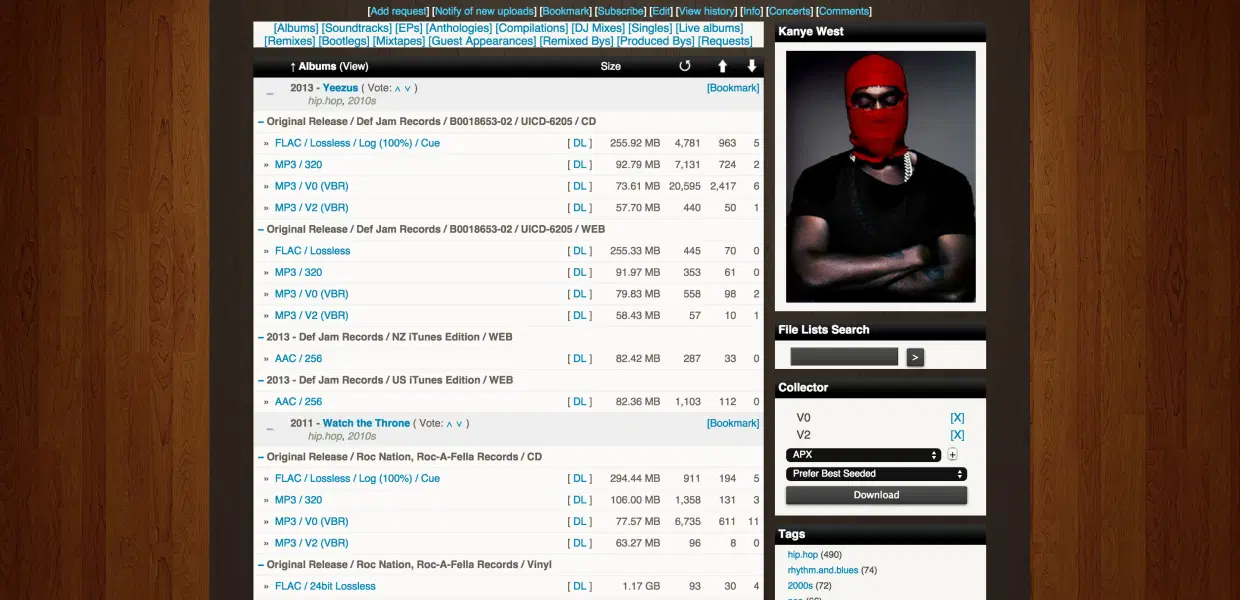 The what.cd artist page for Kanye West (taken from here in the style of pirates, without permission). For the album “Yeezus,” there are ten torrents, grouped by each time the album was released on CD and Web, and in multiple different qualities and formats (.flac, .mp3). Along the top is a list of the macro-level groups, where what is in view is the “albums” section, there are also sections for bootleg recordings, remixes, live albums, etc.
What.cd was a “private” bittorrent tracker, where unlike public trackers that anyone can access, membership was strictly limited to those who were personally invited or to those who passed an interview (for more on public and private tracker, see [87]). Invites were extremely rare, and the interview process was demanding to the point where extensive guides were written to prepare for them.
The what.cd incentive system was based on a required ratio of data uploaded vs. data downloaded [88]. Peer to peer systems need to overcome a free-rider problem where users might download a torrent (“leeching”) and turn their computer off, rather than leaving their connection open to share it to others (or, “seeding”). In order to download additional music, then, one would have to upload more. Since downloading is highly restricted, and everyone is trying to upload as much as they can, torrents had a large number of “seeders,” and even rare recordings would be sustained for years, a pattern common to private trackers [89].
The high seeder/leecher ratio made it so it was extremely difficult to acquire upload credit, so users were additionally incentivized to find and upload new recordings to the system. What.cd implemented a “bounty” system, where users with a large amount of excess upload credit would be able to offer some of it to whoever was able to upload the album they wanted. To “prime the pump” and keep the economy moving, highlight artists in an album of the week, or direct users to preserve rare recordings, moderators would also use a “freeleech” system, where users would be able to download a specified set of torrents without it counting against their download quantity [90, 91].
The other half of what.cd was the more explicitly social elements: its forums, comment sections, and moderation systems. The forum was home to roiling debates that lasted years about the structure of some tagging schema, whether one genre was just another with a different name, and so on. The structure of the community was an object of constant, public negotiation, and over time the metadata system evolved to be able to support a library of the entirety of human music output27, and the rules and incentive structures were made to align with building it. To support the good operation of the site, the forums were also home to a huge amount of technical knowledge, like guides on how to make a perfect upload, that eased new users into being able to use the system.
A critical problem in maintaining coherent databases is correcting metadata errors and departures from schemas. Finding errors was rewarded. Users were able to discuss and ask questions of the uploader in a comment section below each upload, which would allow “polite” resolution of low-level errors like typos. More serious problems could be reported to the moderation team, which caused the upload to be visibly marked as under review, and the report could then be discussed either in the comment sections or the forum. Being an anonymous, gray-area community, there was of course plenty of power that was tripped on. Rather than being a messy hodgepodge of fake, low-quality uploads, though, what.cd was always teetering just shy of perfection.
These structural considerations do not capture the most elusive but indisputably important features of what.cd’s community infrastructure: the sense of commmunity. The What.cd forums were the center of many user’s relationships to music. Threads about all the finest scales of music nichery could last for years: it was a rare place people who probably cared a little bit too much about music could talk to people with the same condition. What made it more satisfying than other music forums was that no matter what music you were talking about, everyone else in the conversation would always have access to it if they wanted to hear it. Beyond any structural incentives, people spent so much time building and maintaining what.cd because it became a source of community and a sink of personal investment.
Structural norms supported by social systems converge as a sort of reputational incentive. Uploading a new album to fill a bounty both makes the network more functional and complete, but also people respect you for it because it’s prominently displayed on your profile as well as in the bounty charts and that feels good. Becoming known on the forums for answering questions, writing guides, or even just having a good taste in music feels good and also contributes to the overall health of the system. Though there are plenty of databases, and even plenty of different communication venues for scientists, there aren’t any databases (to my knowledge) with integrated community systems.
The tracker overlay model mirrors and extends some of the recommendations made by Benedikt Fecher and colleagues in their work on the reputational economy surrounding data sharing [92]. They give three policy recommendations: Increasing reputational benefits, reducing transaction costs, and “increasing market transparency by making open access to research data more visible to members of the research community.” One way to accomplish implement them is to embed a data sharing system within a social system that is designed to reward communitarian behavior.
Many features of what.cd’s structure are undesirable for scientific infrastructure, but they demonstrate that a robust archive is not only a matter of building a database with some frontend, but by building a community [93]. Of course, we need to be careful with building the structural incentives for a data sharing system: the very last thing we want is another coercive leaderboard that turns what should be a collaborative effort punitive. In contrast to what.cd, for infrastructure we want extremely low barriers to entry, and be agnostic to resources — researchers with access to huge server farms should not be unduly favored. We should think carefully about using downloading as the “cost,” because downloading and analyzing huge amounts of data can be good and exactly what we want in some circumstances, but a threat to privacy and data governance in others.
This model has its own problems, including the lack of interoperability between different trackers, the need to recreate a new set of accounts and database for each new tracker, among others. It’s also been tried before: sharing data in specific formats (as our running example, Neurodata Without Borders) on indexing systems like bittorrent trackers amounts to something like BioTorrents [94] or AcademicTorrents [95]. Even with our extensions of version control and some model of automatic mirroring of data across the network, we still have some work to do. To address these and several other remaining needs for scientific data infrastructure, we can take inspiration from federated systems.
Linked Data or Surveillance Capitalism?
There is no shortage of databases for scientific data, but their traditional structure chokes on the complexity of representing multi-domain data. Typical relational databases require some formal schema to structure the data they contain, which have varying reflections in the APIs used to access them and interfaces built atop them. This broadly polarizes database design into domain-specific and domain-general28. This design pattern results in a fragmented landscape of databases with limited interoperability. In a moment we’ll consider federated systems as a way to resolve this dichotomy and continue developing the design of our p2p data infrastructure, but for now we need a better sense of the problem.
Domain-specific databases require data to be in one or a few specific formats, and usually provide richer tools for manipulating and querying by metadata, visualization, summarization, aggregation that are purpose-built for that type of data. For example, NIH’s Gene tool has several visualization tools and cross-referencing tools for finding expression pathways, genetic interactions, and related sequences (Figure xx). This pattern of database design is reflected at several different scales, through institutional databases and tools like the Allen brain atlases or observatory, to lab- and project-specific dashboards. This type of database is natural, expressive, and powerful — for the researchers they are designed for. While some of these databases allow open data submission, they often require explicit moderation and approval to maintain the guaranteed consistency of the database, which can hamper mass use.
 NIH’s Gene tool included many specific tools for visualizing, cross-referencing, and aggregating genetic data. Shown is the “genomic regions, transcripts, and product” plot for Mouse Cdh1, which gives useful, common summary descriptions of the gene, but is not useful for, say, visualizing reading proficiency data.
General-purpose databases like figshare and zenodo29 are useful for the mass aggregation of data, typically allowing uploads from most people with minimal barriers. Their general function limits the metadata, visualization, and other tools that are offered by domain-specific databases, however, and are essentially public, versioned, folders with a DOI. Most have fields for authorship, research groups, related publications, and a single-dimension keyword or tags system, and so don’t programmatically reflect the metadata present in a given dataset.
The dichotomy of fragmented, subdomain-specific databases and general-purpose databases makes combining information from across even extremely similar subdisciplines combinatorically complex and laborious. In the absence of a formal interoperability and indexing protocol between databases, even finding the correct subdomain-specific database can be an act of raw experience or the raw luck of stumbling across just the right blog post list of databases. It also puts researchers who want to be good data stewards in a difficult position: they can hunt down the appropriate subdomain specific database and risk general obscurity; use a domain-general database and make their work more difficult for themselves and their peers to use; or spend all the time it takes to upload to multiple databases with potentially conflicting demands on format.
What can be done? There are a few parsimonious answers from standardizing different parts of the process: If we had a universal data format, then interoperability becomes trivial. Conversely, we could make a single ur-database that supports all possible formats and tools.
Universalizing a single part of a database system is unlikely to work because organizing knowledge is intrinsically political. Every system of representation is necessarily rooted in its context: one person’s metadata is another person’s data. Every subdiscipline has conflicting representational needs, will develop different local terminology, allocate differing granularity and develop different groupings and hierarchies for the same phenomena. At mildest, differences in representational systems can be incompatible, but at their worst they can reflect and reinforce prejudices and become tools of intellectual and social power struggles. Every subdiscipline has conflicting practical needs, with infinite variation in privacy demands, different priorities between storage space, bandwidth, and computational power, and so on. In all cases the boundaries of our myopia are impossible to gauge: we might think we have arrived at a suitable schema for biology, chemistry, and physics… but what about the historians?
Matthew J Bietz and Charlotte P Lee articulate this tension better than I can in their ethnography of metagenomics databases:
“Participants describe the individual sequence database systems as if they were shadows, poor representations of a widely-agreed-upon ideal. We find, however, that by looking across the landscape of databases, a different picture emerges. Instead, each decision about the implementation of a particular database system plants a stake for a community boundary. The databases are not so much imperfect copies of an ideal as they are arguments about what the ideal Database should be. […]
When the microbial ecology project adopted the database system from the traditional genomic “gene finders,” they expected the database to be a boundary object. They knew they would have to customize it to some extent, but thought it would be able to “travel across borders and maintain some sort of constant identity”. In the end, however, the system was so tailored to a specific set of research questions that the collection of data, the set of tools, and even the social organization of the project had to be significantly changed. New analysis tools were developed and old tools were discarded. Not only was the database ported to a different technology, the data itself was significantly restructured to fit the new tools and approaches. While the database development projects had begun by working together, in the end they were unable to collaborate. The system that was supposed to tie these groups together could not be shielded from the controversies that formed the boundaries between the communities of practice.” [96]
As one ascends the scales of formalizing to the heights of the ontology designers, the ideological nature of the project is like a klaxon (emphasis in original):
An exception is the Open Biomedical Ontologies (OBO) Foundry initiative, which accepts under its label only those ontologies that adhere to the principles of ontological realism. […] Ontologies, from this perspective, are representational artifacts, comprising a taxonomy as their central backbone, whose representational units are intended to designate universals (such as human being and patient role) or classes defined in terms of universals (such as patient, a class encompassing human beings in which there inheres a patient role) and certain relations between them. […]
BFO is a realist ontology [15,16]. This means, most importantly, that representations faithful to BFO can acknowledge only those entities which exist in (for example, biological) reality; thus they must reject all those types of putative negative entities - lacks, absences, non-existents, possibilia, and the like [97]
Aside from unilateral standardization, another formulation that doesn’t require existing server infrastructure to be dramatically changed is to link existing databases. The problem of linking databases is an old one with much well-trodden ground, and in the current regime of large server farms tend to find themselves somewhere close to metadata-indexing overlays. These overlays provide some additional tool that can translate and combine data between databases with some mapping between the terminology in the overlay and that of the individual databases. The NIH articulates this as a “Biomedical Data Translator” in its Strategic plan for Data Science30 and NCATS elaborates it a bit more on the project “about” page:
As a result of recent scientific advances, a tremendous amount of data is available from biomedical research and clinical interactions with patients, health records, clinical trials and adverse event reports that could be useful for understanding health and disease and for developing and identifying treatments for diseases. Ideally, these data would be mined collectively to provide insights into the relationship between molecular and cellular processes (the targets of rational drug design) and the signs and symptoms of diseases. Currently, these very rich yet different data sources are housed in various locations, often in forms that are not compatible or interoperable with each other. - https://ncats.nih.gov/translator/about
The Translator is being developed by 28 institutions and nearly 200 team members as of 2019. They credit their group structure and flexible Other Transaction Award (OTA) funding mechanism for their successes [98]. OTA awards give the granting agency broad flexibility in to whom and for what money can be given, and consist of an initial competetive segment with possibility for indefinite noncompetitive extensions at the discretion of the agency [99].
The project appears to be in a relatively early phase, and so it’s difficult to figure out exactly what it is that has been built. The projects page is currently just a list of the leaders of different areas, but some parts of the project are visible through a bit of searching. They describe a registry of APIs for existing databases collected on their platform SmartAPI that are to be combined into a semantic knowledge graph [100]. There are many kinds of knowledge graphs, and we will return to them and other semantic web technologies in shared knowledge, but the Translator’s knowledge graph explicitly sits “on top” of the existing databases as the only source of knowledge. Specifically, the graph structure consists of the nodes and edges of the biolink model [101], and an edge is matched to a corresponding API that provides data for both elements. For each edge in the graph, then, a number of possible APIs can provide data without necessarily making a guarantee of consistency or accuracy.
They articulate a set of beliefs about the impossibility of a unified dataset or ontology31[100], although arguably create one in biolink that’s very similar to that described here, and this problem seems to have driven the focus of the project away from linking data as such towards developing a graph-powered query engine. The Translator is being designed to use machine-learning powered “autonomous relay agents” that sift through the inhomogenous data from the APIs and are able to return a human-readable response, also generated with machine-learning. The final form of the translator is still unclear, but between SmartAPI, a seemingly-preliminary description of the reasoning engine [102], and descriptions from contractors [103], the machine learning component of the system could make it quite dangerous.
The intended use of the Translator seems to not be to directly search for and use the data itself, but to use the connected data to answer directed questions [102] — an example that is used repeatedly is drug discovery. For any given query of “drugs that could treat x disease,” the system traces out the connected nodes in the graph from the disease to find its phenotypes, which are connected to genes, which might be connected to some drug, and so on. The Translator builds on top of a large number of databases and database aggregators, and so it then needs a way of comparing and ranking possible answers to the question. In a simple case, a drug that directly acted on several involved genes might be ranked higher than, say, one that acted only indirectly on phenotypes with many off-target effects.
As with any machine-learning based system, if the input data is biased or otherwise (inevitably) problematic then the algorithm can only reflect that. If it is the case that this algorithm remains proprietary (due to, for example, it being developed by a for-profit defense contractor that named it ROBOKOP [103]) harmful input data could have unpredictable long-range consequences on the practice of medicine as well as the course of medical research. Taking a very narrow sample of APIs that return data about diseases, I queried mydisease.info to see if it still had the outmoded definition of “transsexualism” as a disease [104]. Perhaps unsurprisingly, it did, and was more than happy to give me a list of genes and variants that supposedly “cause” it - see for yourself.
This is, presumably, the fragility and inconsistency the machine-learning layer was intended to putty over: if one follows the provenance of the entry for “gender identity disorder” (renamed in DSM-V), one reaches first the disease ontology DOID:1234 which seems to trace back into an entry in a graph aggregator Ontobee (Archive Link), which in turn lists this github repository maintained by a single person as its source32.
If at its core the algorithm believes that being transgender is a disease, could it misunderstand and try to “cure” it? Even if it doesn’t, won’t it influence the surrounding network of entities with its links to genes, prior treatment, and so on in unpredictable ways? Combined with the online training that updates the search model based on how it is used [100], socially problematic treatment and research practices could be built into our data infrastructure without any way of knowing their effect on unrelated treatment. In the long-run, an effort towards transparency could have precisely the opposite effect by being run through a series of black boxes.
A larger problem is reflected in the scope and evolving direction of the Translator when combined with the preceding discussion of putting all data in the hands of cloud platform holders. There is mission creep from the original NIH initiative language that essentially amounts to a way to connect different data sources — what could have been as simple as a translation table between different data standards and formats. The original funding statement from 2016 is similarly humble, and press releases through 2017 also speak mostly in terms of querying the data – though some ambition begins to creep in.
That is remarkably different than what is articulated in 2019 [100] to be much more focused on inference and reasoning from the graph structure of the linked data for the purpose of automating drug discovery. It seems like the original goal of making a translator in the sense of “translating data between formats” has morphed into “translating data to language,” with ambitions of providing a means of making algorithmic predictions for drug discovery and clinical practice rather than linking data [105] Tools like these have been thoroughly problematized elsewhere, eg. [106, 107, 108, 109].
As of September 2021, it appears there is still some work left to be done to make the Translator functional, but the early example illustrates some potential risks (emphases mine):
The strategy used by the Translator consortium in this case is to 1) identify phenotypes that are associated with [Drug-Induced Liver Injury] DILI, then 2) find genes which are correlated with these presumably pathological phenotypes, and then 3) identify drugs which target those genes’ products. The rationale is that drugs which target gene products associated with phenotypes of DILI may possibly serve as candidates for treatment options.
We constructed a series of three queries, written in the Translator API standard language and submitted to xARA to select appropriate KPs to collect responses (Figure 4). From each response, an exemplary result is selected and used in the query for the next step.
The results of the first query produced several phenotypes, one of them was ”Red blood cell count” (EFO0004305). When using this phenotype in the second step to query for genes, we identified one of the results as the telomerase reverse transcriptase (TERT) gene. This was then used in the third query (Figure 4) to identify targeting drugs, which included the drug Zidovudine.
xARA use this result to call for an explanation. The xcase retrieved uses a relationship extraction algorithm [6] fine-tuned using BioBert [7]. The explanation solution seeks previously pre-processed publications where both biomedical entities (or one of its synonyms) is found in the same article within a distance shorter than 10 sentences. The excerpt of entailing both terms is then used as input to the relationship extraction method. When implementing this solution for the gene TERT (NCBIGene:7015) and the chemical substance Zidovudine (CHEBI:10110), the solution was able to identify corroborating evidence of this drug-target interaction with the relationship types being one of: ”DOWNREGULATOR,” ”INHIBITOR,” or ”INDIRECT DOWNREGULATOR” with respect to TERT. [102]
As a recap, since I’m not including the screenshots of the queries, the researchers searched first for a phenotypic feature of DILI, then selected “one of them” — red blood cell count — to search for genes that affect the phenotype, and eventually find a drug that effects that gene: all seemingly manually (an additional $1.4 million has been allocated to unify them [110]). Zidovudine, as a nucleoside reverse transcriptase inhibitor, does inhibit telomerase reverse transcriptase [111], but can also cause anemia and lower red blood cell counts [112] – so through the extended reasoning chain the system has made a sign flip and recommended a drug that will likely make the identified phenotype (low red blood cell count) worse? The manual input will then be used to train the algorithm for future results, though how data from prior use and data from graph structure will be combined in the ranking algorithm — and then communicated to the end user — is still unclear.
Contrast this with the space-age and chromed-out description from CoVar:
ROBOKOP technology scours vast, diverse databases to find answers that standard search technologies could never provide. It does much more than simple web-scraping. It considers inter-relationships between entities, such as colds cause coughs. Then it searches for new connections between bits of knowledge it finds in a wide range of data sources and generates answers in terms of these causal relationships, on-the-fly.
Instead of providing a simple list of responses, ROBOKOP ranks answers based on various criteria, including the amount of supporting evidence for a claim, how many published papers reference a given fact, and the specificity of any particular relationship to the question.
For-profit platform holders are not incentivized to do responsible science, or even really make something that works, provided they can get access to some of the government funding that pours out for projects that are eventually canned - $75.5 million so far since 2016 for the Translator [113]. As exemplified by the trial and discontinuation of the NIH Data Commons after $84.7 million, centralized infrastructure projects can be an opportunity to “dance until the music stops.” Again, it is relatively difficult to see from the outside what work is going on and how it all fits together, but judging from RePORTER there seem to be a profusion of projects and components of the system with unclear functional overlap, and the model seems to have developed into allocating funding to develop each separate knowledge source.
The risk with this project is very real because of the context of its development. After 5 years, it still seems like the the Translator is relatively far from realizing the vision of biopolitical control through algorithmic predictions, but combined with Amazon’s aggressive expansion into health technology [114] and even literally providing health care [115], and the uploading of all scientific and medical data onto AWS with entirely unenforceable promises of data privacy [116] — the notion of spending public money to develop a system for aggregating patient data with scientific and clinical data becomes dangerous. It doesn’t require takeover by Amazon to become dangerous — once you introduce the need for data to train an algorithm, you need to feed it data, and so the translator gains the incentive to suck up as much personal and other data as it can.
Even assuming the Translator works perfectly and has zero unanticipated consequences, the development strategy still reflects the inequities that pervade science rather than challenge them. Biopharmaceutical research, followed by broader biomedical research, being immediately and extremely profitable, attracts an enormous quantity of resources and develops state of the art infrastructure, while no similar infrastructure is built for the rest of science, academia, and society.
I have no doubt that everyone working on the Translator is doing so for good reasons, and they have done useful work. Forming a consortium and settling on a development model is hard work and this group should be applauded for that. Unifying APIs with Smart-API, drafting an ontology, and making a knowledge graph, are all directly useful to reducing barriers to desiloing data and shared in the vision articulated here.
The problems here come in a few mutually reinforcing flavors, I’ll group them crudely into the constraints of existing infrastructure, centralized models of development, and a misspecification of what the purpose of the infrastructure should be.
Navigating a relationship with existing technology in new development is tricky, but there is a distinction between integrating with it and embodying its implications. Since the other projects spawned from the Data Science Initiative embraced the use of cloud storage, the constraint of using centralized servers with the need for a linking overlay was baked in the project from the beginning. From this decision immediately comes the impossibility of enforcing privacy guarantees and the rigidity of database formats and tooling. Since the project started from a place of presuming that the data would be hosted “out there” where much of its existence is prespecified, building the Translator “on top” of that system is a natural conclusion. Further, since the centralized systems proposed in the other projects don’t aim to provide a means of standardization or integration of scientific data that doesn’t already have a form, the reliance on APIs for access to structured data follows as well.
Organizing the process as building a set of tools as a relatively large, but nonetheless centralized and demarcated group pose additional challenges. I won’t speculate on the incentives and personal dynamics that led there, but I also believe this development model comes from good intention. While there is clearly a lot of delegation and distributed work, the project in its different teams takes on specific tools that they build and we use. This is broadly true of scientific tools, especially databases, and contributes to how they feel: they feel disconnected with our work, don’t necessarily help us do it more easily or more effectively, and contributing to them is a burdensome act of charity.
This is reflected in the form of the biolink ontology, where rather than a tool for scientists to build ontologies, it is intended to be built towards. There is tension between the articulated impossibility of a grand unified ontology and the eventual form of the algorithm that depends on one that, in their words, motivated the turn to machine learning to reconcile that impossibility. The compromise seems to be the use of a quasi-“neutral” meta-ontology that instantiates its different abstract objects depending on the contents of its APIs. A ranking algorithm to parse the potentially infinite results follows, and so too does the need for feedback and training and the potential for long-lived and uninterrogatable algorithmic bias.
These all contribute to the misdirection in the goal of the project. Linking all or most biomedical data in single mutually coherent system drifted into an API-driven knowledge-graph for pharmaceutical and clinical recommendations. Here we meet a bit of a reprise of the #neat mindset, which emphasizes global coherence as a basis for reasoning rather than providing a means of expressing the natural connections between things in their local usage. Put another way, the emphasis is on making something logically complete for some dream of algorithmically-perfect future rather than to be useful to do the things researchers at large want to do but find difficult. The press releases and papers of the Translator project echo a lot of the heady days of the semantic web33 and its attempt to link everything — and seems ready to follow the same path of the fledgling technologies being gobbled up by technology giants to finish and privatize.
I think the problem with the initial and eventual goals of the translator can be illustrated by problematizing the central focus on linking “all data,” or at least “all biomedical data.” Who is a system of “all (biomedical) data” for? Outside of metascientists and pharmaceutical companies, I think most people are interested primarily in the data of their colleagues and surrounding disciplines. Every infrastructural model is an act of balancing constraints, and prioritizing “all data” seems to imply “for some people.” Who is supposed to be able to upload data? change the ontology? inspect the machine learning model? Who is in charge of what? Who is a knowledge-graph query engine useful for?
Another prioritization might be building systems for all people that can embed with existing practices and help them do their work which typically involves accessing some data. The system needs to not only be designed to allow anyone to integrate their data into it, but also to be integrated into how researchers collect and use their data. It needs to give them firm, verifiable, and fine-grained control over who has access to their data and for what purpose. It needs to be pluralistic, capable of representing multiple potentially conflicting representations, governable and malleable in local communities of practice. Through the normal act of making my data available to my colleague and vice versa, we build on a cumulative and negotiable understanding of the relationship between our work and its meaning.
Without too much more prefacing, let’s return to the scheduled programming.
Federated Systems (of Language)
When last we left it, our peer-to-peer system needed some way of linking data together. Instead of a big bucket of files as is traditional in torrents and domain-general databases, we need some way of exposing the metadata of disparate data formats so that we can query for and find the particular range of datasets appropriate to our question. We’ll be playing in the world of linked data and the semantic web, but thinking about using those tools for a fluid means of expression more akin to natural language than to an engineering specification.
Each format has a different metadata structure with different names, and even within a single format we want to support researchers who extend and modify the core format. Additionally, each format has a different implementation, eg. as an hdf5 file, binary files in structured subdirectories, SQL-like databases.
That’s a lot of heterogeneity to manage, but fret not: there is hope. Researchers navigate this variability manually as a standard part of the job, and we can make that work cumulative by building tools that allow researchers to communally describe and negotiate over the structure of their data and the local relationships to other data structures. We can extend our peer-to-peer system to be a federated database system34.
Federated systems consist of distributed, heterogeneous, and autonomous agents that implement some minimal agreed-upon standards for mutual communication and (co-)operation. Federated databases were proposed in the early 1980’s [117] and have been developed and refined in the decades since as an alternative to either centralization or non-integration [118, 119, 120]. Their application to the dispersion of scientific data in local filesystems is not new [121, 122, 123], but their implementation is more challenging than imposing order with a centralized database or punting the question into the unknowable maw of machine learning.
Amit Sheth and James Larson, in their reference description of federated database systems, describe design autonomy as one critical dimension that characterizes them:
Design autonomy refers to the ability of a component DBS to choose its own design with respect to any matter, including
(a) The data being managed (i.e., the Universe of Discourse),
(b) The representation (data model, query language) and the naming of the data elements,
(c) The conceptualization or semantic interpretation of the data (which greatly contributes to the problem of semantic heterogeneity),
(d) Constraints (e.g., semantic integrity constraints and the serializability criteria) used to manage the data,
(e) The functionality of the system (i.e., the operations supported by system),
(f) The association and sharing with other systems, and
(g) The implementation (e.g., record and file structures, concurrency control algorithms).
Susanne Busse and colleagues add an additional dimension of evolvability, or the ability of a particular system to adapt to inevitable changing uses and requirements [121].
In order to support such radical autonomy and evolvability, federated systems need some means of translating queries and representations between heterogeneous components. The typical conceptualization of federated databases have five layers that implement different parts of this reconciliation process [124]:
- A local schema is the representation of the data on local servers, including the means by which they are implemented in binary on the disk
- A component schema serves to translate the local schema to a format that is compatible with the larger, federated schema
- An export schema defines permissions, and what parts of the local database are made available to the federation of other servers
- The federated schema is the collection of export schemas, allowing a query to be broken apart and addressed to different export schemas. There can be multiple federated schemas to accomodate different combinations of export schemas.
- An external schema can further be used to make the federated schema better available to external users, but in this case since there is no notion of “external” it is less relevant.
This conceptualization provides a good starting framework and isolation of the different components of a database system, but a peer-to-peer database system has different constraints and opportunities [125]. In the strictest, “tightly coupled” federated systems, all heterogeneity in individual components has to be mapped to a single, unified federation-level schema. Loose federations don’t assume a unified schema, but settle for a uniform query language, and allow multiple translations and views on data to coexist. A p2p system naturally lends itself to a looser federation, and also gives us some additional opportunities to give peers agency over schemas while also preserving some coherence across the system. I will likely make some database engineers cringe, but the emphasis for us will be more on building a system to support distributed social control over the database, rather than guaranteeing consistency and transparency between the different components.
Though there are hundreds of subtleties and choices in implementation beneath the level of detail I’ll reach here, allow me to illustrate the system by example:
Let us start with the ability for a peer to choose who they are associated with at multiple scales of organization: a peer can directly connect with another peer, but peers can also federate into groups, groups can federate into groups of groups, and so on. Within each of these grouping structures, the peer is given control over what data of theirs is shared.
Clearly, we need some form of identity in the system, let’s make it simple and flat and denote that in pseudocode as @username35. Someone would then be able to use their @namespace as a root, under which they could refer to their data, schemas, and so on, which will be denoted @name:subobject (see this notion of personal namespaces for knowledge organization discussed in early wiki culture here [126]). Let us also assume that there is no categorical difference between @usernames used by individual researchers, institutions, consortia, etc. — everyone is on the same level.
We pick up where we left off earlier with a peer who has their data in some discipline-specific format, which let us assume for the sake of concreteness has a representation as an OWL schema.
That schema could be “owned” by the @username corresponding to the standard-writing group — eg @nwb for neurodata without borders. In a turtle-ish pseudocode36, then, our dataset might look like this:
<#cool-dataset>
  a @nwb:NWBFile
  @nwb:general:experimenter @jonny
  @nwb:ElectricalSeries
    .electrodes [1, 2, 3]
    .rate 30000
    .data [...]
This indicates that me, @jonny collected a @nwb:NWBFile dataset named <#cool-dataset>, making it available as @jonny:cool-dataset that consisted of an @nwb:ElectricalSeries and the relevant attributes (where a leading . is a shorthand for the parent schema element, so @nwb:ElectricalSeries:electrodes).
- Here would be a good time to describe triplet links as the basic tech of the semantic web world.
- We can use object oriented programming as an example: attributed and methods instead of just pointers.
I have some custom field for my data, though, which I extend the format specification to represent. Say I have invented some new kind of solar-powered electrophysiological device — the SolarPhys2000 — and want to annotate its specs alongside my data.
<#SolarEphys>
  extends @nwb:NWBContainer

  UsedWith @hw:SolarPhys2000

  ManufactureDate
    a @schema:Date

  InputWattageSeries
    extends @nwb:ElectricalSeries

    sunIntensity
      a @nwb:TimeSeries
Here I create a new extension @jonny:SolarEphys that extends the @nwb:NWBContainer schema. We use extends rather than a because we are adding something new to the description of the container rather than making a container to store data. I declare that this container is UsedWith our SolarPhys2000 which we have registered in some general @hw hardware registry. I then add two new fields, ManufactureDate and InputWattageSeries, declaring types from, for example @schema:Date and @nwb.
There are many strategies for making my ontology extension available to others in a federated network. We could use a distributed hash table, or DHT, like bittorrent, which distributes references to information across a network of peers (eg. [127]). We could use a strategy like the Matrix messaging protocol, where users belong to a single home server that federates with other servers. Each server is responsible for keeping a synchronized copy of the messages sent on the servers and rooms it’s federated with, and each server is capable of continuing communication if any of the others failed. We could use ActivityPub (AP) [128], a publisher-subscriber model where users affiliated with a server post messages to their ‘outbox’ and are sent to listening servers (or made available to HTTP GET requests). AP uses JSON-LD [129], so is already capable of representing linked data, and the related ActivityStreams vocabulary [130] also has plenty of relevant action types for creating, discussing, and negotiating over links (also see cpub). We’ll return to ActivityPub later, but for now the point is to let us assume we have a system for distributing schemas/extensions/links associated with an identity publicly or to a select group of peers.
For the moment our universe is limited only to other researchers using NWB. Conveniently, the folks at NWB have set up a federating group so that everyone who uses it can share their format extensions. Since our linking system for manipulating schemas is relatively general, we can use it to “formalize” a basic configuration for a federating group that automatically Accepts request to Join and allows any schema that inherits from their base @nwb:NWBContainer schema. Let’s say @fed defines some basic properties of our federating system — it constitutes our federating “protocol” — and loosely use some terms from the ActivityStreams vocabulary as @as
<#nwbFederation>
  a @fed:Federation
  onReceive
    @as:Join @as:Accept
  allowSchema
    extensionOf @nwb:NWBContainer
Now anyone that is a part of the @nwbFederation would be able to see the schemas we have submitted, sort of like a beefed up, semantically-aware version of the existing neurodata extensions catalog. In this system, many overlapping schemas could exist simultaneously under different namespaces, but wouldn’t become a hopeless clutter because similar schemas could be compared and reconciled based on their semantic properties.
So far we have been in the realm of metadata, but how would my computer know how to read and write the data to my disk so i can use it? In a system with heterogeneous data types and database implementations, we need some means of specifying different programs to use to read and write, different APIs, etc. Why not make that part of the file schema as well? Suppose the HDF5 group (or anyone, really!) has a namespace @hdf that defines the properties of an @hdf:HDF5 file, basic operations like Read, Write, or Select. NWB could specify that in their definition of @nwb:NWBFile:
@nwb.NWBFile
  a @hdf:HDF5
    isVersion "x.y.z"
    hasDependency "libhdf5"=="x.y.z"
  usesContainer @nwb:NWBContainer
The abstraction around the file implementation makes it easier for others to consume my data, but it also makes it easier for me to use and contribute to the system. Making an extension to the schema wasn’t some act of charity, it was the most direct way for me to use the tool to do what I wanted. Win-win: I get to use my fancy new instrument and store its data by extending some existing format standard, and in the process make the standard more complete and useful. We are able to make my work useful by aligning the modalities of use and contribution.
Now that I’ve got my schema extension written and submitted to the federation, time to submit my data! Since it’s a p2p system, I don’t need to manually upload it, but I do want to control who gets it. By default, I have all my NWB datasets set to be available to the @nwbFederation , and I list all my metadata on, say the Society for Neuroscience’s @sfnFederation.
<#globalPermissions>
  a @fed:Permissions
  permissionsFor @jonny

  federatedWith
    name @nwbFederation
    @fed:shareData
      is @nwb:NWBFile

  federatedWith
    name @sfnFederation
    @fed:shareMetadata
Let’s say this dataset in particular is a bit sensitive — say we apply a set of permission controls to be compliant with @hhs.HIPAA — but we do want to make use of some public server space run by our Institution, so we let it serve an encrypted copy that those I’ve shared it with can decrypt. Since we’ve applied the @hhs.HIPAA ruleset, we would be able to automatically detect if we have any conflicting permissions, but we’re doing fine in this example.
<#datasetPermissions>
  a @fed:Permissions
  permissionsFor @jonny:cool-dataset

  accessRuleset @hhs:HIPAA
    .authorizedRecipient <#hash-of-patient-ids>

  federatedWith
    name @institutionalCloud
    @fed:shareEncrypted
Now I want to make use of some of my colleagues data. Say I am doing an experiment with a transgenic dragonfly and collaborating with a chemist down the hall. This transgene, known colloquially in our discipline as "@neuro:superstar6" (which the chemists call "@chem:SUPER6") fluoresces when the dragonfly is feeling bashful, and we have plenty of photometry data stored as @nwb:Fluorescence objects. We think that its fluorescence is caused by the temperature-dependent conformational change from blushing. They’ve gathered NMR and Emission spectroscopy data in their chemistry-specific format, say @acs:NMR and @acs:Spectroscopy.
We get tired of having our data separated and needing to maintain a bunch of pesky scripts and folders, so we decide to make a bridge between our datasets. We need to indicate that our different names for the gene are actually the same thing and relate the spectroscopy data.
Let’s make the link explicit, say we use an already-existing vocabulary like the “simple knowledge organization system” for describing logical relationships between concepts: @skos?
<#super-link-6>
  a @fed:Link

  from @neuro:superstar6
  to @chem:SUPER6
  link @skos:exactMatch
Our @nwb:Fluorescence data has the emission wavelength in its @nwb:Fluorescence:excitation_lambda property37, which is the value of their @acs:Spectroscopy data at a particular value of its wavelength. Unfortunately, wavelength isn’t metadata for our friend, but does exist as a column in the @acs:Spectroscopy:readings table, so for now the best we can do is indicate that excitation_lambda is one of the values in wavelength and pick it up in our analysis tools.
<#imaging>
 a @fed:Link

 from @nwb:Fluorescence:excitation_lambda
 to @acs:Spectroscopy:readings
 link @fed:Subset
   valueIn "wavelength"
This makes it much easier for us to index our data against each other and solves a few real practical problems we were facing in our collaboration. We don’t need to do as much cleaning when it’s time to publish the data since it can be released as a single linked entity.
Rinse and repeat our sharing and federating process from our previous schema extension, add a little bit of extra federation with the @acs namespace, and in the normal course of our doing our research we’ve contributed to the graph structure linking two common data formats. Ours is one of many, with idiosyncratic names like @jonny:super-link-638. We might not have followed the exact rules, and we only made a few links rather than a single authoratative mapping, but if someone is interested in compiling one down the line they’ll start off a hell of a lot further than if we hadn’t contributed it!
With a protocol for how queries can be forwarded and transformed between users and federations, one could access the same kind of complex query structure as traditional databases with SPARQL [131] as has been proposed for biology many times before [132, 122, 123]. Some division in the way that data and metadata are handled is necessary for the network to work in practice, since we can’t expect a search to require terabytes of data transfer. A natural solution to this is to have metadata query results point to content addressed identifiers that are served peer to peer. A mutable/changeable/human-readable name and metadata system that points to a system of permanent, unique identifiers has been one need that has hobbled IPFS, and is the direction pointed to by DataLad39 [133]. A parallel set of conversations has been happening in the broader linked data community with regard to using ActivityPub as a way to index data on Solid.
In this example I have been implicitly treating the @nwbFederation users like bittorrent trackers, keeping track of different datasets in their federation and caching for faster quaeries. There is no reason why queries couldn’t themselves be distributed across the participating peers, though I believe tracker-like federations at various intermediary scales of organization are useful and might emerge naturally. A system like this doesn’t need the radical zero trust design of, for example, some distributed ledgers, and an overlapping array of institutional, disciplinary, interest, and so on federations would be a good means of realizing the evolvable community structure needed for sustained archives.
Extend this practice across the many overlapping gradients of cooperation and collaboration in science, and on a larger scale a system like this could serve as a way to make explicit the organic, continual negotiation over meaning and practice that centralized ontologies can only capture as a snapshot. I don’t happen to know where the physicists store their data or what format it’s in, but the chemists might, and the best way to get there from here might be a dense, multiplicative web of actual practical knowledge instead of some sparsely used corporate API. We don’t make the same guarantees of consistency or support for algorithmic reasoning as a top-down system would in theory, but it would give us agency over the structure of our information and have the potential to be useful for a far broader base of researchers.
As will be developed through the rest of the piece, this system effectively functions as a protocol for protocols. The @fed:Federation notion of federation defines its own set of properties and requirements that let the people who implement it implement a variety of federation types and relationships with each other, but it is one of many. By building on the “meta-protocol” of a peer-to-peer linked data platform we can change the problem from needing to agree on a single protocol for scientific communication, data indexing, and so on to making a means of creating many protocols as fluidly as is needed. Are the rules of @fed:Federation too limited? Extend it to suit your needs.
Like the preceding description of the basic peer-to-peer system, this joint metadata/p2p system could be fully compatible with existing systems. Translating between a metadata query and a means of accessing it on heterogeneous databases is a requisite part of the system, so, for example, there’s no reason that an HTTP-based API like SmartAPI couldn’t be queried.
- close by taking a larger view on p2p: p2p systems already in use, academic torrents, biotorrents [94], libgen on IPFS
- proof of utility is in the pudding: CDNs are effectively p2p systems where they just own all the peers.
Shared Tools
Straddling our system for sharing data are the tools to gather and analyze it — two examples of the more general need for computational resources. Experimental and analytical tools are the natural point of extension for collectively developed scientific digital infrastructure, and considering them together shows the combinatoric power of integrating interoperable domains of scientific practice. In particular, in addition to benefits from their development in isolation, we can ask how a more broadly integrated system helps problems like adoption and incentives for distributed work, enables a kind of deep provenance from experiment to results, and further builds us towards reimagine the form of the community and communication tools for science.
This section will be relatively short compared to shared data. We have already introduced, motivated, and exemplified many of the design practices of the broader infrastructural system. There is much less to argue against or “undo” in the spaces of analytical and experimental tools because so much more work has been done, and so much more power has been accrued in the domain of data systems. Distributed computing does have a dense history, with huge numbers of people working on the problem, but its dominant form is much closer to the system articulated below than centralized servers are to federated semantic p2p systems. I also have written extensively about experimental frameworks before [134], and develop one of them so I will be brief at risk of repeating myself or appearing self-serving.
Integrated scientific workflows have been written about many times before, typically in the context of the “open science” movement. One of the founders of the Center for Open Science, Jeffrey Spies, described a similar ethic of toolbuilding as I have in a 2017 presentation:
Open Workflow:
- Meet users where they are
- Respect current incentives
- Respect current workflow
- We could… demonstrate that it makes research more efficient, of higher quality, and more accessible.
- Better, we could… demonstrate that researchers will get published more often.
- Even better, we could… make it easy.
- Best, we could… make it automatic [135]
To build an infrastructural system that enables “open” practices, convincing or mandating a change are much less likely to be successful and sustainable than focusing on building them to make doing work easier and openness automatic. To make this possible, we should focus on developing frameworks to build experimental and analysis tools, rather than developing more tools themselves.
Analytical Frameworks
The first natural companion of shared data infrastructure is a shared analytical framework. A major driver for the need for everyone to write their own analysis code largely from scratch is that it needs to account for the idiosyncratic structure of everyone’s data. Most scientists are (blessedly) not trained programmers, so code for loading and negotiating loading data is often intertwined with the code used to analyze and plot it. As a result it is often difficult to repurpose code for other contexts, so the same analysis function is rewritten in each lab’s local analysis repository. Since sharing raw data and code is still a (difficult) novelty, on a broad scale this makes results in scientific literature as reliable as we imagine all the private or semi-private analysis code to be.
Analytical tools (anecdotally) make up the bulk of open source scientific software, and range from foundational and general-purpose tools like numpy [136] and scipy [137], through tools that implement a class of analysis like DeepLabCut [17] and scikit-learn [138], to tools for a specific technique like MoSeq [139] and DeepSqueak [140]. The pattern of their use is then to build them into a custom analysis system that can then in turn range in sophistication from a handful of flash-drive-versioned scripts to automated pipelines.
Having tools like these of course puts researchers miles ahead of where they would be without them, and the developers of the mentioned tools have put in a tremendous amount of work to build sensible interfaces and make them easier to use. No matter how much good work might be done, inevitable differences between APIs is a relatively sizable technical challenge for researchers — a problem compounded by the incentives for fragmentation described previously. For toolbuilders, many parts of any given tool from architecture to interface have to be redesigned each time with varying degrees of success . For science at large, with few exceptions of well-annotated and packaged code, most results are only replicable with great effort.
Discontinuity between the behavior and interface of different pieces of software is, of course, overwhelming norm. Negotiating boundaries between (and even within) software and information structures is an elemental part of computing. The only time it becomes a conceivable problem to “solve” interoperability is when the problem domain coalesces to the point where it is possible to articulate its abstract structure as a protocol, and the incentives are great enough to adopt it. Thankfully that’s what we’re trying to do here.
It’s unlikely that we will solve the problem of data analysis being complicated, time consuming, and error prone by teaching every scientist to be a good programmer, but we can build experimental frameworks that make analysis tools easier to build and use.
Specifically, a shared analytical framework should be
- Modular - Rather than implementing an entire analysis pipeline as a monolith, the system should be broken into minimal, composable modules. The threshold of what constitutes “minimal” is of course to some degree a matter of taste, but the framework doesn’t need to make normative decisions like that. The system should support modularity by providing a clear set of hooks that tools can provide: eg. a clear place for a given tool to accept some input, parameters, and so on. Since data analysis can often be broken up into a series of relatively independent stages, a straightforward (and common) system for modularity is to build hooks to make a directed acyclic graph (DAG) of data transformation operations. This structure naturally lends itself to many common problems: caching intermediate results, splitting and joining multiple inputs and outputs, distributing computation over many machines, among others. Modularity is also needed within the different parts of the system itself – eg. running an analysis chain shouldn’t require a GUI, but one should be available, etc.
- Pluggable - The framework needs to provide a clear way of incorporating external analysis packages, handling their dependencies, and exposing their parameters to the user. Development should ideally not be limited to a single body of code with a single mode of governance, but should instead be relatively conservative about requirements for integrating code, and liberal with the types of functionality that can be modified with a plugin. Supporting plugins means supporting people developing tools for the framework, so it needs to make some part of the toolbuilding process easier or otherwise empower them relative to an independent package. This includes building a visible and expressive system for submitting and indexing plugins so they can be discovered and credit can be given to the developers. Reciprocal to supporting plugins is being interoperable with existing and future systems, which the reader may have assumed was a given by now.
- Deployable - For wide use, the framework needs to be easy to install and deploy locally and on computing clusters. A primary obstacle is dependency management, or making sure that the computer has everything needed to run the program. Some care needs to be taken here, as there are multiple emphases in deployability that can be in conflict. Deployable for who? A system that can be relatively challenging to use for routine exploratory data analysis but can distribute analysis across 10,000 GPUs has a very circumscribed set of people it is useful for. This is a matter of balancing design constraints, but we should prioritize broad access, minimal assumptions of technological access, and ease of use over being able to perform the most computationally demanding analyses possible when in conflict. Containerization is a common, and the most likely strategy here, but the interface to containers may need a lot of care to make accessible compared to opening a fresh .py file.
- Reproducible - The framework should separate the parameterization of a pipeline, the specific options set by the user, and its implementation, the code that constitutes it. The parameterization of a pipeline or analysis DAG should be portable such that it, for example, can be published in the supplementary materials of a paper and reproduced exactly by anyone using the system. The isolation of parameters from implementation is complementary to the separation of metadata from data and if implemented with semantic triplets would facilitate a continuous interface from our data to analysis system. This will be explored further below and in shared knowledge
Thankfully a number of existing projects that are very similar to this description are actively being built. One example is DataJoint [141], which recently expanded its facility for modularity with its recent Elements project [142]. Datajoint is a system for creating analysis pipelines built from a graph of processing stages (among other features). It is designed around a refinement on traditional relational data models, which is reflected throughout the system as most operations being expressed in its particular schema, data manipulation, and query languages. This is useful for operations that are expressed in the system, but makes it harder to integrate external tools with their dependencies — at the moment it appears that spike sorting (with Kilosort [143]) has to happen outside of the extracellular electrophysiology elements pipeline.
Kilosort is an excellent and incredibly useful tool, but its idiomatic architecture designed for standalone use is illustrative of the challenge of making a general-purpose analytic framework that can integrate a broad array of existing tools. It is built in MATLAB, which requires a paid license, making arbitrary deployment difficult, and MATLAB’s flat path system requires careful and usual manual orchestration of potentially conflicting names in different packages. Its parameterization and use are combined in a “main” script in the repository root that creates a MATLAB struct and runs a series of functions — requiring some means for a wrapping framework to translate between input parameters and the representation expected by the tool. Its preprocessing script combines I/O, preprocessing, and plotting, and requires data to be loaded from disk rather than passed as arguments to preserve memory — making chaining in a pipeline difficult.
This is not a criticism of Datajoint or Kilosort, which were both designed for different uses and with different philosophies (that are of course, also valid). I mean this as a brief illustration of the design challenges and tradeoffs of these systems.
We can start getting a better picture for the way a decentralized analysis framework might work by considering the separation between the metadata and code modules, hinting at a protocol as in the federated systems sketh above. Since we’re considering modular analysis elements, each module would need some elemental properties like the parameters that define it, its inputs, outputs, dependencies, as well as some additional metadata about its implementation (eg. this one takes numpy arrays and this one takes matlab structs). The precise implementation of a modular protocol also depends on the graph structure of the analysis system. We invoked DAGs before, but analysis graph structure of course has its own body of researchers refining them into eg. Petri nets which are graphs whose nodes necessarily alternate between “places” (eg. intermediate data) and “transitions” (eg. an analysis operation), and their related workflow markup languages (eg. WDL or [144]). In that scheme, a framework could provide tools for converting data between types, caching intermediate data, etc. between analysis steps, as an example of how different graph structures might influence its implementation.
Say we use @analysis as the namespace for our analysis protocol, and ~someone~ has provided mappings to objects in numpy. We can assume they are provided by the package maintainers, but that’s not necessary: this is my node and it takes what I want it to!
In pseudocode, I could define some analysis node for, say, converting an RGB image to grayscale under my namespace as @jonny:bin-spikes like this:
<#bin-spikes>
  a @analysis:node
    Version ">=1.0.0"

  hasDescription
    "Convert an RGB Image to a grayscale image"

  inputType
    @numpy:ndarray
      # ... some spec of shape ...

  outputType
    @numpy:ndarray
      # ... some spec of shape ...
I have abbreviated the specification of shape to not overcomplicate the pseudocode example, but say we successfully specify a 3 dimensional (width x height x channels) array with 3 channels as input, and a a 2 dimensional (width x height) array as output.
The code doesn’t run on nothing! We need to specify our node’s dependencies, say in this case we need to specify an operating system image ubuntu, a version of python, a system-level package opencv, and a few python packages on pip. We are pinning specific versions with semantic versioning, but the syntax isn’t terribly important. Then we just need to specify where the code for the node itself comes from:
  dependsOn
    @ubuntu:"^20.*":x64
    @python:"3.8"
    @apt:opencv:"^4.*.*"
    @pip:opencv-python:"^4.*.*"
    @pip:numpy:"^14.*.*"

  providedBy
    @git:repository
      .url "https://mygitserver.com/binspikes/fast-binspikes.git"
      .hash "fj9wbkl"
    @python:class "/main-module/binspikes.py:Bin_Spikes"
Here we can see the advantage of being able to mix and match different namespaces in a practical sense. Our @analysis.node protocol gives us several slots to connect different tools together, each in turn presumably provides some minimal functionality expected by that slot: eg. inputType can expect @numpy:ndarray to specify its own dependencies, the programming language it is written in, shape, data type, and so on. Coercing data between chained nodes then becomes a matter of mapping between the @numpy and, say a @nwb namespace of another format. In the same way that there can be multiple, potentially overlapping between data schemas, it would then be possible for people to implement mappings between intermediate data formats as-needed.
This node also becomes available to extend, say someone wanted to add an additional input format to my node:
<@friend#bin-spikes>
  extends @jonny:bin-spikes

  inputType
    @pandas:DataFrame

  providedBy
    ...
They don’t have to interact with my potentially messy codebase at all, but it is automatically linked to my work so I am credited. One could imagine a particular analysis framework implementation that would then search through extensions of a particular node for a version that supports the input/output combinations appropriate for their analysis pipeline, so the work is cumulative. This functions as a dramatic decrease in the size of a unit of work that can be shared.
This also gives us healthy abstraction over implementation. Since the functionality is provided by different, mutable namespaces, we’re not locked into any particular piece of software — even our @analysis namespace that gives the inputType etc. slots could be forked. We could implement the dependency resolution system as, eg. a docker container, but it also could be just a check on the local environment if someone is just looking to run a small analysis on their laptop with those packages already installed.
We use providedBy to indicate a python class which implements the node in code. We could use an Example_Framework that provides a set of classes and methods to implement the different parts of the node (a la luigi). Our Bin class inherits from Node, and we implement the logic of the function by overriding its run method and specify an output file to store intermediate data (if requested by the pipeline) with an output method. We also specify a bin_width as a Parameter for our node, as an example of how a lightweight protocol could be bidirectionally specified as an interface to the linked data format: we could receive a parameterization from our pseudocode specification, or we could write a framework with a Bin.export_schema() that constructs the pseudocode specification from code.
from Example_Framework import Node, Param, Target

class Bin(Node):
  bin_width = Param(dtype=int, default=10)

  def output(self) -> Target:
    return Target('temporary_data.pck')

  def run(self, input:'numpy.ndarray') -> 'numpy.ndarray':
    # do some stuff
    return output
Now that we have a handful of processing nodes, we could then describe some @workflow, taking some @nwb:NWBFile as input, and then returning some output as a :processed child beneath its existing namespace. We’ll only make a linear pipeline with two stages, but there’s no reason more complex branching and merging couldn’t be described as well.
<#my-analysis>
  a @analysis:workflow

  inputType
    @jonny:bin-spikes:inputType

  outputName
    .inputType:processed

  step Step1 @jonny:bin-spikes
  step Step2 @someone-else:another-step
    input Step1:output
Having kept the description of our data in particular abstract from the implementation of the code and the workflow specification, the only thing left is to apply it to our data! Since the parameters are linked from the analysis nodes, we can specify them here (or in the workflow). Assuming literally zero abstraction and using the tried-and-true “hardcoded dataset list” pattern, something like:
<#my-project>
  a @analysis:project

  hasDescription
    "I gathered some data, and it is great!"

  researchTopic
    @neuro:systems:auditory:speech-processing
    @linguistics:phonetics:perception:auditory-only

  inPaper
    @doi:10.1121:1.5091776

  workflow Analysis1 @jonny:my-analysis
    globalParams
      .Step1:params:bin_width 10

    datasets
      @jonny.mydata1:v0.1.0:raw
      @jonny.mydata2:^0.2.*:raw
      @jonny.mydata3:>=0.1.1:raw
And there we are! The missing parameters like outputName from our workflow can be filled in from the defaults filled in the workflow node. We get some inkling of where we’re going later by also being able to specify the paper this data is associated with, as well as some broad categories of research topics so that our data as well as the results of the analysis can be found.
So that’s useful, but comparable to existing technologies. The important part is in the way this hypothetical analysis framework and markup interact with our data system and emerging federated metadata system — The layers of abstraction here are worth unpacking, but we’ll hold until the end of the shared tools section and we have a chance to consider what this system might look like for experimental tools to contrast abstraction across the two domains.
Experimental Frameworks
Data that is to be analyzed has to be collected somehow. Tools to bridge the body of experimental practice are a different challenge than analyzing data, or at least so an anecdotal census of scientific software tools would suggest. Everyone needs completely different things! As practiced, we might imagine the practice of science as a cone of complexity: We can imagine the relatively few statistical outcomes from a family of tests and models. For every test statistic we can imagine a thousand analysis scripts, for every analysis script we might expect a hundred thousand data formats, and so the french-horn-bell convexity of complexity of experimental tools used to collect the data feels … different.
Beyond a narrow focus of the software for performing experiments itself, the contextual knowledge work that surrounds it largely lacks a means of communication and organization. Scientific papers have increasingly marginalized methods sections, being pushed to the bottom, abbreviated, and relegated to supplemental material. The large body of work that is not immediately germane to experimental results, like animal care, engineering instruments, lab management, etc. have effectively no formal means of communication — and so little formal means of credit assignment.
Extending our ecosystem to include experimental tools has a few immediate benefits: bridging the gap between collection and sharing of data would resolve the need for format conversion as a prerequisite for inclusion in the linked system, allowing the expression of data to be a fluid part of the experiment itself. It would also serve as a concrete means of implementing and building a body of cumulative contextual knowledge in a creditable system.
I have previously written about the design of a generalizable, distributed experimental framework in section 2, and about one modular implementation in section 3 of [134], so to avoid repeating myself, and since many of the ideas from the section on analysis tools apply here as well, I will be relatively brief.
We don’t have the luxury of a natural formalism like a DAG to structure our experimental tools. Some design constraints on experimental frameworks might help explain why:
- They need to support a wide variety of instrumentation, from off-the-shelf parts, to proprietary instruments as are common in eg. microscopy, to custom, idiosyncratic designs that might make up the existing infrastructure in a lab.
- To be supportive, rather than constraining, they need to be able to flexibly perform many kinds of experiments in a way that is familiar to patterns of existing practice. That effectively means being able to coordinate heterogeneous instruments in some “task” with a flexible syntax.
- They need to be inexpensive to implement, in terms of both money and labor, so it can’t require buying a whole new set of hardware or dramatically restructuring existing research practices.
- They need to be accessible and extensible, with many different points of control with different expectations of expertise and commitment to the framework. It needs to be useful for someone who doesn’t want to learn it to its depths, but also have a comprehensible codebase at multiple scales so that reasearchers can easily extend it when needed.
- They need to be designed to support reproducibility and provenance, which is a significant challenge given the heterogeneity inherent in the system. On one hand, being able to produce data that is clean at the time of acquisition simplifies automated provenance, but enabling experimental replication requires multiple layers of abstraction to keep the idiosyncracies of an experiment separable from its implementation: it shouldn’t require building exactly the same apparatus with exactly the same parts connected in exactly the same way to replicate an experiment.
- Ideally, they need to support cumulative labor and knowledge organization, so an additional concern with designing abstractions between system components is allowing work to be made portable and combinable with others. The barriers to contribution should be extremely minimal, not requiring someone to be a professional programmer to make a pull request to a central library, and contributions should come in many modes — code is not the only form of knowing and it’s far from the only thing needed to perform an experiment.
Here, as in the domains of data and analysis, the temptation to be universalizing is strong, and the parts of the problem that are emphasized influence the tools that are produced. A common design tactic for experimental tools is to design them as state machines, a system of states and transitions not unlike the analysis DAGs above. One such nascent project is BEADL [145] from a Neurodata Without Borders working group. BEADL is an XML-based markup for standardizing a behavioral task as an abstraction of finite state machines called statecharts. Experiments are fully abstract from their hardware implementation, and can be formally validated in simulations. The working group also describes creating a standardized ontology and metadata schema for declaring all the many variable parameters for experiments, like reward sizes, stimuli, and responses [146]. This group, largely composed of members from the Neurodata Without Borders team, understandably emphasize systematic description and uniform metadata as a primary design principle.
Personally, I like statecharts. The problem is that it’s not necessarily natural to express things as statecharts as you would want to, or in the way that your existing, long-developed local experimental code does. There are only a few syntactical features needed to understand the following statechart: blocks are states, they can be inside each other. Arrows move between blocks depending on some condition. Entering and exiting blocks can make things happen. Short little arrows from filled spots are where you start in a block, and when you get to the end of the chart you go back to the first one. See the following example of a statechart for controlling a light, described in the introductory documentation and summarized in the figure caption:
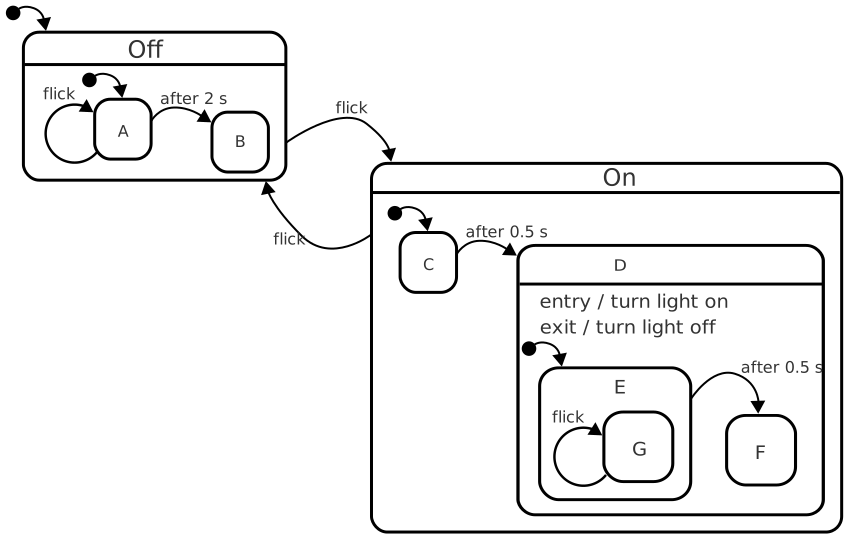 “When you flick a lightswitch, wait 0.5 seconds before turning the light on, then once it’s on wait 0.5 seconds before being able to turn it back off again. When you flick it off, wait 2 seconds before you can turn it on again.
They have an extensive set of documents that defend the consistency and readability of statecharts on their homepage, and my point here is not to disagree with them. My point is instead that tools that aspire to the status of generalized infrastructure can’t ask people to dramatically change the way they think about and do science. There are many possible realizations of this task, and each is more or less natural to every person.
The problem here is really one of emphasis, BEADL seeks to solve problems with inconsistencies in terminology by standardizing them, and in order to do that seeks to standardize the syntax for specifying experiments.
This means of standardization has many attractive qualities and is being led by very capable researchers, but I think the project is illustrative of how the differing constraints of different systems and differing goals of different approaches influence the possible space of tooling. Analysis tasks are often asynchronous, where the precise timing of each node’s completion is less important than the path dependencies between different nodes be clearly specified. Analysis tasks often have a clearly defined set of start, end, and intermediate cache points, rather than branching or cyclical decision paths that change over multiple timescales. Statecharts are a hierarchical abstraction of finite state machines, the primary advantage of which is that they are better able to incorporate continuous and history-dependent behavior, which causes state explosion in traditional finite-state machines.
Autopilot [134] approaches the problem differently by avoiding standardizing experiments themselves, instead providing smaller building blocks of experimental tools like hardware drivers, data transformations, etc. and emphasizing understanding their use in context. This approach sacrifices some of the qualities of a standardized system like being a logically complete or having guaranteed interoperability of terms in order to better support integrating with existing work patterns and making work cumulative. It is a bit more humble: because we can’t possibly predict the needs and limitations of a totalizing system, we split the problem along the different domains of tools and give facility for describing how they are used together.
For concrete example, we might imagine the lightswitch in an autopilot-like framework like this:
from autopilot.hardware.gpio import Digital_Out
from time import sleep
from threading import Lock

class Lightswitch(Digital_Out):
  def __init__(self,
    off_debounce: float = 2,
    on_delay:     float = 0.5,
    on_debounce:  float = 0.5):
    """
    Args:
      off_debounce (float):
        Time (s) before light can be turned back on
      on_delay (float):
        Time (s) before light is turned on
      on_debounce (float):
        Time (s) after turning on that light can't be turned off
    """
    self.off_debounce = off_debounce
    self.on_delay     = on_delay
    self.on_debounce  = on_debounce

    self.on = False
    self.lock = Lock()

  def switch(self):
    # use a lock to make sure if
    # called while waiting, we ignore it
    if not self.lock.acquire():
      return

    # if already on, switch off
    if self.on:
      self.on = False
      sleep(self.off_debounce)

    # otherwise switch on
    else:
      sleep(self.on_delay)
      self.on = True
      sleep(self.on_debounce)

    self.lock.release()
The terms off_debounce, on_delay, and on_debounce are certainly not part of a controlled ontology, but we have described how they are used in the docstring and how they are used is inspectable in the class itself.
The difficulty of a controlled ontology for experimental frameworks is perhaps better illustrated by considering a full experiment. In Autopilot, a full experiment can be parameterized by the .json files that define the task itself and the system-specific configuration of the hardware. An example task from our lab consists of 7 behavioral shaping stages of increating difficulty that introduce the animal to different features of a fairly typical auditory categorization task. Each stage includes the parameters for at most 12 different stimuli per stage, probabilities for presenting lasers, bias correction, reinforcement, criteria for advancing to the next stage, etc. So just for one relatively straightforward experiment, in one lab, in one subdiscipline, there are 268 parameters – excluding all the default parameters encoded in the software.
The way Autopilot handles various parameters are part of set of layers of abstraction that separate idiosyncratic logic from the generic form of a particular Task or Hardware class. The general structure of a two-alternative forced choice task is shared across a number of experiments, but they may have different stimuli, different hardware, and so on. Autopilot Tasks use abstract references to classes of hardware components that are required to run them, but separates their implementation as a system-specific configuration so that it’s not necessary to have exactly the same components plugged into exactly the same GPIO pins, etc. Task parameters like stimuli, reward timings, etc. are similarly split into a separate task parameterization that both allow Tasks to be generic and make provenance and experimental history easier to track. Task classes can be subclasses to add or modify logic while being able to reuse much of the structure and maintain the link between the root task and its derivatives — for example one task we use that starts a continuous background sound but otherwise is the same as the root Nafc class. The result of these points of abstraction is to allow exact experimental replication on inexactly replicated experimental apparatuses.
In contrast, workflows in Bonsai [147, 148], another very popular and very capable experimental tool, combine the pattern of nodes that constitute an experiment with idiosyncratic parameters like a crop bounding box. To be clear, I love Bonsai, and this kind of workflow reproducibility is a huge step up from the more common practice of totally lab-specific code. The flat design of Bonsai is extremely useful for prototyping and extends through to complex experiments, but would have a hard time being able to support generalizable and reusable software classes for basic experimental operations, as well as creation and negotiation over experimental terminology.
We can imagine extending the abstract specification of experimental parameters, hardware requirements, and so on to work with our federated naming system to overcome the challenges to standardizing. First, we can make explicit declarations about the relationship between our potentially very local vocabulary and other vocabularies at varying degrees of generality. Here we can declare our Lightswitch object and 1) link its on_delay to our friend @rumbly’s object that implements the same thing as on_latency, and 2) link it to a standardized Latency term from interlex, but since that term is for time elapsed between a stimulus and behavioral response in a psychophysical context, it’s only a partial match.
<#Lightswitch>
  a @autopilot.hardware.Digital_Out

  param on_delay
    @skos:exactMatch @rumbly:LED:on_latency
    @skos:nearMatch @interlex:Latency

  providedBy
    @git:repository ...
    @python:class ...
Further, since our experimental frameworks are intended to handle off the shelf parts as well as our potentially idiosyncratic lightbulb class, we can link many implementations of a hardware controlling class to the product itself. Take for example the I2C_9DOF class that controls a 9 degree of freedom motion sensor from Sparkfun where we both indicate the specific part itself as well as the generic ic that it uses:
<#I2C_9DOF>
  @autopilot.controlsHardware
    @sparkfun:13944
    @ic:LSM9DS1
This hints at the first steps of a system that would make our technical work more cumulative, as it is then easy to imagine being able to search for all the different implementations for a given piece of hardware. Since the @sparkfun:13944 element can in turn specify properties like being an inertial motion sensor, this kind of linking becomes powerful very quickly to make bridges that allow similar work to be discovered and redeployed quickly.
We can also extend our previous connection between a dataset and the results of its analysis to also include the tools that were used to collect it. Say we want to declare the example experiment above, and then extend our <#project-name> project to reference it:
<#example-experiment>
  a @autopilot:protocol

  level @autopilot:freeWater
    reward
      type @si:mL
      value 5
    graduation
      a @autopilot:graduation:ntrials
      n_trials 200

  level @autopilot:Nafc
    stim
      @autopilot:stim:sound:Tone
        frequency 5000
        duration 100

  ...

  @autopilot:prefs
    @jonny:Lightswitch
      on_delay 1

<#project-name>
  a @jonny:project-name
  collectedBy @jonny:example-experiment
So while we sacrifice the direct declaration of standardized terminology and syntax, we gain the potential for a much denser and richer expressive structure for our experiments. Instead of a single authoritative dictionarylike meaning for a term, we instead appreciate it in the context of its use, linked to the code that implements it as well as the data it produces and the kinds of arguments that are made with different analysis chains. Of course there is no intrinsic conflict with this kind of freewheeling system and controlled vocabularies and syntaxes: in this system, they can be one of many means of expression rather than need to be singular sources of truth that depend on wide adoption. While individual instances of uncontrolled vocabularies might mean chaos, when they are integrated in a system of practice we get something much wilder but also more intricate, beautiful, and useful.
As in the case of analytical tools, the role of the experimental frameworks is also to make interacting with the rest of the system easier and doesn’t involve manually editing a lot of metadata. For example, currently autopilot Tasks ask users to declare collected data as a pytables [149] datatypes like target = tables.StringCol(1) to record whether a target is 'L' or 'R'. If instead it was capable of specifying a Neurodata Without Borders data type like target = '@nwb:behavior:BehavioralEvents', then it would be possible to directly output to a standardized format, potentially also automatically creating a BehavioralEpochs container or other data that are implied but otherwise have to be explicitly created. Autopilot already automatically tracks the entire behavioral history of an experimental subject, so we can also imagine it being able to automatically create a @analysis:project object described above that groups together multiple datasets that connected them to an analysis pathway. So in this example the elusive workflow where experimental data is automatically scooped up and incrementally analyzed that is typically a hard-won engineering battle within a single lab would become the normal mode of using the system.
The experimental framework described so far could solve some of the software challenges of doing experiments by providing a system for extending a set of reusable classes that can be combined into experiments and linked together, but we haven’t described anything to address the rest of the contextual knowledge of practical scientific work. We also haven’t described any sort of governance or development system that makes these packages anything more than “some repository on GitHub somewhere” with all the propensity to calcify into fiefdoms that those entail. This leads us back to a system of communication, the central piece of missingness that we have been circling around the whole piece. If you’ll allow me one more delay, I want to summarize the system so far before finally arriving there.
Abstraction & Interfaces
Though there are many similarities between the three domains of data, analytical, and experimental tools, the different constraints each impose on a generalizable framework for integration and interoperability are instructive. Each requires a careful consideration of the layers of abstraction needed to maintain the modularity of the system — this is an elemental feature of any protocol design. What are the minimal affordances needed to implement a wide array of systems and technologies within each domain? By being careful with specifying abstraction, when considered together, the linked system described so far represents a powerful step towards collectivizing the scientific state of the art.
There are three primary layers of abstraction in the analysis system described: the interface between the metadata description of a node and the code that implements it, the separation of individual nodes and a notion of a combined workflow, and perhaps more subtly the separation of the data applied to the workflow and the workflow itself.
!! while the analysis system seeks to make multiple software packages and environments be interoperable together, the experimental framework makes no such attempt. !! the need for careful timing and adaptation to individual systems leaves integration for the implementing codebases.
- First, the markup description of the node gives us abstraction from programming language and implementation. This lets us do stuff like use multiple tools with competing environmental needs, adapt to multiple versions of the code markup as it develops, etc. Note the interaction with the rest of the metadata system: because we required a particular type of data file, and that link should provide us some means of opening/instantiating the file with dependencies, we didn’t need to write loading code. Since it’s in a linked system, someone could override the implementation of my node – say someone comes up with a faster means of binning, then they just inherit from my node and replace the reference to the code. Boom we have cumulative and linked development.
- The separation of the node from the workflow means that the node can be shared and swapped and reintegrated easily, dramatically reducing the brittleness of the systme. Since there is no restriction on what constitutes a node, though, there’s no reason that nodes can’t be either made massive, like putting a whole library in the process method, or be packaged up together. If we made the argument and method names recursive between the workflow and the node objects then tooling could automatically traverse multiple layers of node/workflow combinations at different levels of abstraction. This being a schematic description means that there can be multiple “workflow runner” packages that eg. distribute the task across a billion supercomputers or not.
-
Finally, the separation between the data applied and the workflow itself are very cool indeed given our linked and namespaced system. My workflow effectively constitutes “an unit of analysis.” I have linked my data to this unit of analysis. Play out the permutations:
- I can see all the analyses that this particular pipeline has been applied to. Since it is embedded within the same federated system as our schema system, I can draw and connect semantic links to similar analysis pipelines as well as pipeline/data combinations.
- I can see all the different analyses that have been applied to my data: if my data is analyzed a zillion different times, in a zillion different combinations of data, I effectively get a “multiverse analysis” (cite dani) and we get to measure robustness of my data for free. It also gets to live forever and keep contributing to problems !! and i also get credited for it automatically by golly! This also applies on cases like cross-validation or evaluating different models on the same data: the versioning of it falls out naturally. Also since model weights would be an input to an analysis chain, we also get stuff like DLC’s model zoo where we can share different model weights, combine them, and have a cumulative library of pretrained models as well!
- being able to look across the landscape… we start being able to actually really make cumulative progress on best practices. A common admonishment in cryptographically-adjacent communities is to “never roll your own crypto,” because your homebrew crypto library will never be more secure than reference implementations that have an entire profession of people trying to expose and patch their weaknesses. Bugs in analysis code that produce inaccurate results are inevitable and rampant [150, 151, 152, 153], but impossible to diagnose when every paper writes its own pipeline. A common analysis framework would be a single point of inspection for bugs, and facilitate re-analysis and re-evaluation of affected results after a patch.
- looking forward, we might imagine our project object being linked to a DOI… we’ll get there.
!! this is all extraordinarily reproducible because even though I have my portable markup description of the analysis, I can just refer to it by name in my paper (ya ya need some content based hash or archive but you get the idea)
!! since we have a bunch of p2p systems all hooked up with constantly-running daemons, to compete with the compute side of cloud technology we also should implement a voluntary compute grid akin to Folding@Home. This has the same strawmen and answers to them as the peer-to-peer system — no i’m not saying everyone puts their shitty GPU up, but it lets us combine the resources that are present at an institutional level and makes a very cheap onramp for government-level systems to be added to the mix. !! also see the pacific research platform!
!! this is all very exciting, and we can immediately start digging towards larger scientific problems, eg. what it would mean for the file drawer problem and publication bias when the barriers to analyzing data are so low you don’t even need to write the null result: the data is already there, semantically annotated and all. Dreams of infinite meta-analyses across all data and all time, but hold your horses! We don’t get magic for free, we haven’t talked about the community systems yet that are the unspoken glue of all of this!!
The category distinction between experimental and analytical tools is, of course, a convenient ordering fiction for the purpose of this piece. Autopilot is designed to make it easy to integrate other tools, and [154]
!! so in parallel to our linking scheme is the development patterns that we use. The linking system is general enough for allcomers, and it implies the patterns of linkage that should exist, but they then need to be implemented. Much like desire pathways though, the frequent co-use of different tools gives a good idea about the direction that development should go. So the systems work reciprocally: metadata linking system connect ideas and tools, and can
!! these are examples of what happens when you relax the demanding parts of an exact ontology/knowledge graph – we don’t guarantee computability across the graph itself, there’s no way to automatically whiz uncritically across all datasets in the system, but as we have seen that’s also not really true of the other systems either, to the degree that it’s desirable at all. Instead of having formal guarantees on the graph, we can design tools that automate certain parts of the interaction with the system to actually make our jobs easier. By being very permissive, we let the desire paths of tool use form. This is a very literal example of the ‘empower people, not systems’ principle.
!! reciprocally, we can also imagine the reverse: being able to develop metadata structures that are then code generators for tools that have a sufficiently sophisticated API – for example remember how we said Bonsai might have a hard time making generalizable behavioral tasks/etc? Imagine if someone made a code compilation tool that allowed people to declare abstract structures that could then be reusably reparameterzied that autocreated a bonsai workflow? In the same way that the metadata system can be used for storage of existing work, it can also be used to create abbreviate and abstract constructs for use with other tools.
!! continue the example of needing to select within datasets instead of metadata from federation section.
To take stock:
We have described a system of three component modalities: data, analytical tools, and experimental tools connected by a linked data layer. We started by describing the need for a peer-to-peer data system that makes use of data standards as an onramp to linked metadata. To interact with the system, we described an identity-based linked data system that lets individual people declare linked data resources and properties that link to content addressed resources in the p2p system, as well as federate into multiple larger organizations. We described the requirements for DAG-based analytical frameworks that allow people to declare individual nodes for a processing chain linked to code, combine them into workflows, and apply them to data. Finally, we described a design strategy for component-based experimental frameworks that lets people specify experimental metadata, tools, and output data.
This system as described is a two-layer system, with a few different domains linked by a flexible metadata linking layer. The metadata system as described is not merely inert metadata, but metadata linked to code that can do something — eg. specify access permissions, translate between data formats, execute analayis workflows, parameterize experiments, etc. Put another way, we have been attempting to describe a system that embeds the act of sharing and curation in the practice of science. Rather than a thankless post-hoc process, the system attempts to provide a means for aligning the daily work of scientists so that it can be cumulative and collaborative. To do this, we have tried to avoid rigid specifications of system structure, and instead described a system that allows researchers to pluralistically define the structure themselves.
!! Now we need to consider the social tools needed to communicate within, negotiate over, and govern the system.
Shared Knowledge
The remaining set of problems implied by the infrastructural system sketched in the preceding sections is the communication and organization systems that make up the interfaces to maintain and use it. We can finally return to some of the breadcrumbs laid before: the need for negotiating over distributed and conflicting data schema, for incentivizing and organizing collective labor, and ultimately for communicating scientific results.
The communication systems that are needed double as knowledge organization systems. Knowledge organization has the rosy hue of something that might be uncontroversial and apolitical — surely everyone involved in scientific communication wants knowledge to be organized, right? The reality of scientific practice might give a hint at our naivete. Despite being, in some sense, itself an effort to organize knowledge, scientific results effectively have no system of explicit organization. There is no means of, say, “finding all the papers about a research question.” The problem is so fundamental it seems natural: the usual methods of using search engines, asking around on Twitter, and chasing citation trees are flex tape slapped over the central absence of a system for formally relating our work as a shared body of knowledge.
Information capitalism, in its terrifying splendor, here too pits private profit against public good. Analogously to the necessary functional limitations of SaaS platforms, artificially limiting knowledge organization opens space for new products and profit opportunities. In their 2020 shareholder report, RELX, the parent of Elsevier, lists increasing the number of journals and papers as a primary means of increasing revenue [32]. This represents a shift in their business model from subscriptions to deals like open access, which according to RELX CEO Erik Nils Engström “is where revenue is priced per article on a more explicit basis” [155].
In the next breath, they describe how “in databases & tools and electronic reference, representing over a third of divisional40 revenue, we continued to drive good growth through content development and enhanced machine learning [ML] and natural language processing [NLP] based functionality.”
What ML and NLP systems are they referring to? The 2019 report is a bit more revealing (emphases mine):
Elsevier looks to enhance quality by building on its premium brands and grow article volume through new journal launches, the expansion of open access journals and growth from emerging markets; and add value to core platforms by implementing capabilities such as advanced recommendations on ScienceDirect and social collaboration through reference manager and collaboration tool Mendeley.
In every market, Elsevier is applying advanced ML and NLP techniques to help researchers, engineers and clinicians perform their work better. For example, in research, ScienceDirect Topics, a free layer of content that enhances the user experience, uses ML and NLP techniques to classify scientific content and organise it thematically, enabling users to get faster access to relevant results and related scientific topics. The feature, launched in 2017, is proving popular, generating 15% of monthly unique visitors to ScienceDirect via a topic page. Elsevier also applies advanced ML techniques that detect trending topics per domain, helping researchers make more informed decisions about their research. Coupled with the automated profiling and extraction of funding body information from scientific articles, this process supports the whole researcher journey; from planning, to execution and funding. [156]
Reading between the lines, it’s clear that the difficulty of finding research is a feature, not a bug of their system. Their explicit business model is to increase the number of publications and sell organization back to us with recommendation services. The recommendation system might be free41, but the business is to develop dependence to sell ad placement — which they proudly describe as looking very similar to their research content [157, 158].
It gets more sinister: Elsevier sells multiple products to recommend ‘trending’ research areas likely to win grants, rank scientists, etc., algorithmically filling a need created by knowledge disorganization. The branding varies by audience, but the products are the same. For pharmaceutical companies “scientific opportunity analysis” promises custom reports that answer questions like “Which targets are currently being studied?” “Which experts are not collaborating with a competitor?” and “How much funding is dedicated to a particular area of research, and how much progress has been made?” [159]. For academics, “Topic Prominence in Science” offers university administrators tools to “enrich strategic research planning with portfolio overviews of their own and peer institutions.” Researchers get tools to “identify experts and potential cross-sector collaborators in specific Topics to strengthen their project teams and funding bids and identify Topics which are likely to be well funded.” [160]
These tools are, of course, designed for a race to the bottom — if my colleague is getting an algorithmic leg up, how can I afford not to? Naturally only those labs that can afford them and the costs of rapidly pivoting research topics will benefit from them, making yet another mechanism that reentrenches scientific inequity for profit. Knowledge disorganization, coupled with a little surveillance capitalism that monitors the activity of colleagues and rivals [11], has given publishers powerful control over the course of science, and they are more than happy to ride algorithmically amplified scientific hype cycles in fragmented research bubbles all the way to the bank.
One more turn of the screw: limiting the system of scientific organization to only citations allows publishers to effectively invent the metrics that operationalize “prestige” and derivative products that cement their position with researchers, governments, and funding agencies. The promise of placement in a high prestige journal is high citation count, and highly citated research explitly or implicitly is seen as prestigious. With semantic structure to locate papers, it becomes much more difficult to sell high citation count as a product — people can find what they need, rather than needing to pay attention to a few high-profile journals.
Scientists aren’t the only customers of citation prestige: in 2020 the National Research Foundation of Korea (NRF) and Elsevier published a joint report that used a measurement derived from citation counts - “Field-weighted citation impact”, or FWCI - to argue for the underrated research prestige of South Korea [161]. While I don’t dispute the value of South Korea’s research program, the apparent bargain that was struck is chilling. South Korea gets a very fancy report arguing that more scientists in other countries should work with theirs, and Elsevier gets to cement itself into the basic operation of science. Elsevier controls the journals that can guarantee high citation counts and the metrics built on top of them. The Brain Korea program Phase II report 42 [162], issued just before the 2009 formation of the NRF argued that rankings and funding should be dependent on citation counts. The NRF now relies on SciVal and their FWCI measurement as a primary means of ranking researchers and determining funding, built into the Brain Korea 21 funding system [163, 164]. Without exaggeration, scientific disorganization and reliance on citation counts allowed Elsevier to buy control over the course of research in South Korea.
The consequences for science are hard to overstate. In addition to literature search being an unnecessarily huge sink of time and labor, science operates as a wash of tail-chasing results that only rarely seem to cumulatively build on one another. The need to constantly reinforce the norm that purposeful failure to cite prior work is research misconduct is itself a symptom of how engaging with a larger body of work is both extremely labor intensive and strictly optional in the communication regime of journal publication. The combination of more publications translating into more profit and the strategic disorganization of science contributes to conditions for scientific fraud. An entirely fraudulent paper with nonsensical but carefully crafted methods and results can be undetectable outside of domain experts. Since papers can effectively be islands, given legitimacy by placement in a journal strongly incentivized to accept all comers, and there is no good means of evaluating them in context with their immediate semantic neighbors, investigating fraud is extremely time consuming and almost entirely without reward. And since traditional peer review happens once, rather than as a continual public process, the only recourse outside of posting on PubPeer is to wait on journal editorial boards to review each individual complaint. Forensic peer-reviewers have been ringing the alarm bell, saying that there is “no net” to bad research [165], and brave and highly-skilled investigators like Elisabeth Bik have found thousands of papers with evidence of purposeful manipulation [166, 167]. The economic structure of for-profit journals pits their profit model against their function as providing a venue for peer review — the one function most scientists are still sympathetic to. Despite the profusion of papers, by some measures progress in science has slowed to a crawl [168].
While Chu and Evans correctly diagnose symptoms of knowledge disorganization like the need to “resort to heuristics to make continued sense of the field” and reliance on canonical papers, by treating the journal model as a natural phenomenon and citation as the only means of ordering research, they misattribute root causes. The problem is not people publishing too many papers, or a breakdown of traditional publication hierarchies, but the profitability of knowledge disorganization. Their prescription for “a clearer hierarchy of journals” misses the role of organizing scientific work in journals ranked by prestige, rather than by the content of the work, as a potentially major driver of extremely skewed citation distributions. It also misses the publisher’s stated goals of, well publishing more papers, and pushing algorithmic paper recommendations, as there is nothing recommendation algorithms love recommending more than things that are alreaady popular. Without diagnosing knowledge disorganization as a core part of the business model of scientific publishers, we can be led to prescriptions that would make the problem worse.
It’s hard to imagine an alternative to journals that doesn’t look like, well, journals. While a full treatment of the journal system is outside the scope of this paper, the system we describe here renders them effectively irrelevant by making papers as we know them unnecessary. Rather than facing the massive collective action problem of asking everyone to change their publication practices head on, by reconsidering the way we organize the surrounding infrastructure of science we can flank journals and replace them “from below” with something qualitatively more useful.
Beyond journals, the other technologies of communication that have been adopted out of need, though not necessarily design, serve as desire paths that trace other needs for scientific communication. As a rough sample: Researchers often prepare their manuscripts using platforms like Google Drive, indicating a need for collaborative tools in perparation of an idea. When working in teams, we often use tools like Slack to plan our work. Scientific conferences reflect the need for federated communication within subdisciplines, and we have adopted Twitter as a de facto platform for socializing and sharing our work to a broader audience. We use a handful of blogs and other sites like OpenBehavior [169], Open Neuroscience, and many others to index technical knowledge and tools. Finally we use sites like PubPeer and ResearchGate for comment and criticism.
These technologies point to a few overlapping and not altogether binary axes of communication systems.
- Durable vs Ephemeral - journals seek to represent information as permanent, archival-grade material, but scientific communication also necessarily exists as contextual, temporally specific snapshots.
- Structured vs Chronological - scientific communication both needs to present itself as a structured basis of information with formal semantic linking, but also needs the chronological structure that ties ideas to their context. This axis is a gradient from formal ontologies, through intermediate systems like forums with hierarchical topic structure that embeds a feed, to the purely chronological feed-based social media systems.
- Messaging vs Indexing - Communication can be person-to-person or person-to-group messaging with defined senders and recipients, or intended as a generalizable category of objects. This ranges from entirely-specific DMs through domain-specific tool indexes like OpenBehavior through the uniform indexing of Wikipedia.
- Public vs. Private - Who gets to read, who gets to contribute? Communication can be composed of entirely private notes to self, through communication in a lab, collaboration group, discipline, and landing in the entirely public realm of global communication.
- Formal vs. Informal - Journal articles and encyclopedia-bound writing that conforms to a particular modality of expression vs. a vernacular style intended to communicate with people outside the jargon culture.
- Push vs. Pull - Do you go to get information from a reference location, or does information come to you as an alert or message?
Clearly a variety of different types of communication tools are needed, but there is no reason that each of them should be isolated and inoperable with the others. We have already seen several of the ideas that help bring an alternative into focus. Piracy communities demonstrate ways to build social systems that can sustain infrastructure. Federated and protocol-based systems show us that we don’t need to choose between a single monolithic system or many disconnected ones, but can have a heterogeneous space of tools linked by a basic protocol. The semantic web and linked data people showed us the power of triplet links as a very general means of linking disparate systems. We can bridge these lessons with some from the early wiki movement to get a more practical sense of what it takes to give people total control over the structure of their communication and knowledge systems. Together with our sketches of data, analytical, and experimental tools we can start imagining a system for coordinating them — as well as displacing some of the more intractable systems that misstructure the practice of science.
The Wiki Way
If we take radical collaboration as our core, then it becomes clear that extending Wikipedia’s success doesn’t simply mean installing more copies of wiki software for different tasks. It means figuring out the key principles that make radical collaboration work. What kinds of projects is it good for? How do you get them started? How do you keep them growing? What rules do you put in place? What software do you use? [170]
So that’s it — insecure but reliable, indiscriminate and subtle, user hostile yet easy to use, slow but up to date, and full of difficult, nit-picking people who exhibit a remarkable community camaraderie. Confused? Any other online community would count each of these “negatives” as a terrible flaw, and the contradictions as impossible to reconcile. Perhaps wiki works because the other online communities don’t. [171] and in WhyWikiWorks43
Aside from maybe the internet itself, there is no larger public digital knowledge organization effort than Wikipedia. While there are many lessons to be learned from Wikipedia itself, it emerged from a prior base of thought and experimentation in radically permissive, self-structuring read/write — sometimes called “peer production” [172] — communities. Wikis are now quasi-ubiquitous today44, largely thanks to Wikipedia, but its specific history and intent to be an encyclopedia entwines it with a very particular technological and social system that obscures some of the broader dreams of early wikis.
Aaron Swartz recounts a quote from Jimmy Wales, co-founder of Wikipedia:
“I’m not a wiki person who happened to go into encyclopedias,” Wales told the crowd at Oxford. “I’m an encyclopedia person who happened to use a wiki.” [173]
And further describes how this origin and mission differentiates it from other internet communities:
But Wikipedia isn’t even a typical community. Usually Internet communities are groups of people who come together to discuss something, like cryptography or the writing of a technical specification. Perhaps they meet in an IRC channel, a web forum, a newsgroup, or on a mailing list, but the focus is always something “out there”, something outside the discussion itself.
But with Wikipedia, the goal is building Wikipedia. It’s not a community set up to make some other thing, it’s a community set up to make itself. And since Wikipedia was one of the first sites to do it, we know hardly anything about building communities like that. [170]
We know a lot more now than in 2006, of course, but Wikipedia still has outsized structuring influence on our beliefs about what Wikis can be. Wikipedia has since spawned a huge number of technologies and projects like MediaWiki and Wikidata, each with their own long and occasionally torrid histories. I won’t dwell on the obvious and massive feat of collective organzation that the greater Wikipedia project represents — learning from its imperfections is more useful to us here, especially for things that aren’t encyclopedias. The dream of a centralized, but mass-edited “encyclopedia of everything” seems to be waning, and its slow retreat from wild openness has run parallel to a long decline in contributors [172, 174]. Throughout that time, there has been a separate (and largely skeptical) set of wiki communities holding court on what radically open web communities can be like, inventing their worlds in realtime. These thought communities have histories that are continuous with one another, and in their mutual reaction and inspiration sometimes teach similar lessons from across the divides of their very different structure.
The first wiki was launched in 199545 (still up) and came to be known as Ward’s wiki after its author WardCunningham. Technically, it was extremely simple: a handful of TextFormattingRules and use of WikiCase where if you JoinCapitalizedWords you create a link to a (potentially new) WikiPage — and the ability for anyone to edit any page. These very simple WikiDesignPrinciples led to a sprawling and continuous conversation that spanned more than a decade and thousands46 of pages that, because of the nature of the medium, is left fully preserved in amber. Those conversations are a history of thought on what makes wiki communities work (eg. WhyWikiWorks, WhyWikiWorksNot), and what is needed to sustain them.
One tension that emerged early and was never fully resolved by these wikis is the balance between “DocumentMode” writing that serves as linearly-readable reference material, similar to that of Wikipedia, and “ThreadMode” writing that is a nonlinear representation of a conversation. Order vs contemporaneousness is a fundamental challenge of inventing culture in plaintext. The purpose of using a wiki as opposed to other technologies that existed at the time like bulletin boards, newsgroups, IRC, etc. was that it provided a means of structure47. The parallel need to communicate and attribute work made it a seeming inevitability that even if you went out of your way to restructure a lot of writing into a sensible DocumentMode page, someone would soon after create a new horizontal divider and start a fresh ThreadMode section.
Ward Cunningham and other more organizationally-oriented contributors opposed ThreadMode (eg. ThreadModeConsideredHarmful, InFavorOfDissertation) for a number of reasons, largely due to the ThreadMess and WikiChaos it had the potential of creating.
I occasionally suggest how this site should be used. My GoodStyle suggestions have been here since the beginning and are linked from the edit page should anyone forget. I have done my best to discourage dialog InFavorOfDissertation which offers a better fit to this medium. I’ve been overruled. I will continue to make small edits to pages for the sake of brevity. – WardCunningham [175]
Most pages are thus a combination of both, usually with some DocumentMode text at the top with ThreadMode conversations interspersed throughout without necessarily having any clean delineation between the two. Far from just being raw disorder, this mixed mode of writing gave it a peculiar character of being both a folk reference for a library of concepts as well as a history of discussion that made the contingency of that reference material plain. Beka Valentine put it well:
c2wiki is an exercise in dialogical methods. of laying bare the fact that knowledge and ideas are not some truth delivered from On High, but rather a social process, a conversation, a dialectic, between various views and interests [176]
This tension and its surrounding discussions point to the need for multiple representations of a single idea: that both the social and reference representations of a concept are valuable, but aren’t necessarily best served by being represented in the same place. There was relatively common understanding that the intended order of things was to have many ThreadMode conversations that would gradually be converted to DocumentMode in a process of BrainStormFirstCleanLater. Many proposed solutions orbit around making parallel pages with similar names (like <pagename>Discussion) to clean up a document while preserving the threads (though there were plenty of interesting alternatives, eg. DialecticMode)48.
Wikipedia cut the Gordian Knot by splitting each page into a separate Article and Talk pages, with the talk page in its own Namespace – eg. Gordian_Knot vs Talk:Gordian_Knot. Talk pages resemble a lot of the energy of early wikis: disorganized, sometimes silly, sometimes angry, and usually charmingly pedantic. Namespaces extend the traditional “everything is a page” notion encoded in the WikiCase link system by giving different pages different roles. In addition to having parallel conversations on articles and talk pages, it is possible to have template pages that can be included on wiki pages with {{double curly bracket}} syntax – eg. Template:Citation_Needed renders {{Citation needed}} as [citation needed]. Talk pages have their own functional differentiation, with features for threading and annotating discussions that aren’t present on the main article pages (see Wikipedia:Flow [177]).
!! from a starting point of all things being one thing, a la wikis, we frame this as functional differentiation in a namespace. We can reciprocally frame this as giving a common name to a variety of different systems. Talk pages have slowly reinvented forums, but we can also think about this problem as making forums and chatrooms and essays that are different reflections of a wiki article page.
The complete segregation of discussion to Talk pages is driven by Wikipedia’s aspirations as an encyclopedia, with reminders that is the “sole purpose” peppered throughout the rules and guidelines. The presence of messy subjective discussions would of course be discordant with the very austere and “neutral” articles of an encyclopedia. There are no visible indications that the talk pages even exist in the main text, and so even deeply controversial topics have no references to the conversations in talk pages that surround them — despite this being a requested feature by both administrators and editors [178].
Talk pages serve as one of the primary points of coordination and conflict resolution on Wikipedia, and also provide a low-barrier entrypoint for questions posed to a space they perceive to be “an approchable community of experts” [179]. The separation of Talk pages and the labyrinthine rules governing their use function to obscure the dialogical and collective production of knowledge at the heart of wikis and Wikipedia. The body of thought that structures Wikipedia, most of which is in its Wikipedia:* namespace, is immense and extremely valuable, but is largely hidden from most people. Since Wikipedia is “always already there” often without trace of its massively collective nature, relatively few people ever contribute to it. Reciprocally, since acknowledging personal contribution is or point of view is explicitly against some of its core policies and traditions, there is little public credit outside the Wikipedia community itself for the labor of maintaining it.
The forking of Wards Wikis into the first SisterSites teaches a parallel strain of lessons. Ward’s Wiki started as a means of organizing knowledge for the Portland Pattern Repository49, a programming community (referred to as DesignPatterns below), and in 1998 they were overwhelmed with proponents of ExtremeProgramming, which caused the first fissure in the wiki:
XP advocates seemed to be talking about XP at every possible opportunity and seemingly on every page with content the least bit related to software development. This annoyed a number people who were here to discuss patterns, leading to the tag XpFreeZone, as a request not to talk about ExtremeProgramming on that page.
It was difficult to pick out the DesignPatterns discussion on RecentChanges50, because most of the activity was related to ExtremeProgramming. Eventually, most of the DesignPatterns people left, to discuss patterns in a “quieter” environment, and people started referring to this site as WardsWiki instead of the PortlandPatternRepository [175]
One of the first and most influential Sister Sites was Meatball Wiki, described on Wards Wiki:
SunirShah founded MeatballWiki to absorb and enlarge the discussion of what wiki and wiki like sites might be. That discussion still simmers here. But here it can take on a negative tone sounding more like complaining. On meatball, under Sunir’s careful leadership, the ideas, wild or not, stay amazingly upbeat. - SisterSites
MeatballWiki became the spiritual successor to Ward’s Wiki, which at that point had its own momentum of culture less interested in being the repository of wiki thought51. Though there are a truly monstrous number of ideas on MeatballWiki, the most relevant here here might be those concerning its very existence as a SisterSite. These were a series of discussions that melded thoughts from open source computing with social systems; in part: RightToFork, RightToLeave, EnlargeSpace, and TransClusion.
What can be done when the internal divisions in a wiki community and the weight of its history make healthy contribution impossible? The first place to start is with the RightToLeave, where it is always possible to just stop being part of a community. This approach is clearly the most destructive, as it involves abandoning the emotional bonds of a community, prior work (see the WikiMindWipe where a user left and took all their contributions with them), and doesn’t necessarily provide an alternative that alleviates the cause of the tension. The next idea is to fork the community, where the body of a community — in the case of wikis the pages and history — can be duplicated so that it can proceed along two parallel tracks. Exercising the right to fork is, according to Meatball, “people exercising their RightToLeave whilst maintaining their emotional stake” [180].
The discussion around the Right to Fork on Meatball is far from uniformly positive, and is certainly colored by the strong presence of its BenevolentDictator Sunir Shah who viewed it as a last resort after all attempts at ConflictResolution have failed. They point to the potentially damaging effects of a fork, like bitterness, disputes over content ownership (see MeatballIsNotFree), and potentially an avoidance of conflict resolution that is a normal and healthy part of any community. Others place it more in the realm of a radical political action rather than a strictly social action. Writing about the fork of OpenOffice to LibreOffice, Terry Hancock writes:
[In] proprietary software [a] political executive decision can kill a project, regardless of developer or user interest. But with free software, the power lies with the people who make it and use it, and the freedom to fork is the guarantee of that power. […] The freedom to fork a free software project is [a] “tool of revolution” intended to safeguard the real freedoms in free software. [181]
Forking digital communities can be much less acrimonious than physically-based communities because of the ability to EnlargeSpace given by the medium:
In order to preserve GlobalResources, create more public space. This reduces limited resource tension. Unlike the RealWorld, land is cheap online. In effect, this nullifies the TragedyOfTheCommons by removing the resource pressure that created the “tragedy” in the first place. You can’t overgraze the infinity. - [182]
It is always possible to duplicate digital resources, create more spaces to resolve tensions over shared resources, and so on. Enlarging space has the natural potential to make the broader social scene bewildering with a geyser of pages and communities, but can be further made less damaging by having mechanisms to link histories, trace their divergence, and potentially resolve a fork as is common in open source software development. Forking is then a natural process of community regeneration, allowing people to regroup to make healthier spaces when needed, where the fork is itself part of the history of the community rather than an unfathomable rift.
Forking communities is not the same as forking community resources: “you can’t fork a community […] what you can do is fork the content and to split the community” [183]. As described so far, a fork divides people into unreconciled and separate communities. In some cases this makes forking difficult, in others it makes it impossible: the prime example, again, is Wikipedia. It is simply too large and too culturally dominant to fork. Even though it is technically possible to fork Wikipedia, if you succeeded, then what? Who would come with you to build it, and who would that be useful for? This is partly a product of its totalizing effort to be an encyclopedia of everything (what good would another encyclopedia of everything be?) but also the weight of history: you won’t get enough long-encultured Wikipedians to join you.
The last major effort to fork Wikipedia was in 2002 with an effort led by Edgar Enyedy to move the Spanish Wikipedia to The Enciclopedia Libre Universal en Español [184, 185]. Though it was brief and unsuccessful, Enyedy claims that because Jimmy Wales was worried about other non-English communities following their lead, he and the other admins capitulated to the demands for no advertising and a transfer to a .org domain, among others52. Even a politically symbolic fork is dependent on the perceived threat to the original project, and that window seems to have been closed after 2002.
The cultural tensions and difficulties that lead other wikis and projects to fork have taken their toll on the editorship and culture of Wikipedia. The community is drawn into dozens of conflicting philosophical camps: the Deletionists53 vs. the Inclusionists, Eventualists vs. Immediatists, Mergists vs. Separatists, and yes even a stub page for Wikisecessionism. Editorship has steadily declined from a peak in 2007. Its relatively invisible community systems make it mostly a matter of chance or ideology that new contributors are attracted in the first place. In its calcification of norms, largely to protect against legitimate challenges to the integrity of the encyclopedia, any newcomers that do find their way into editing now have little chance to catch a foothold in the culture before they are frustrated by (sometimes algorithmic) rejection [172, 174].
Arguably all internet communities have some kind of life cycle, so the question becomes how to design systems that support healthy forking without replicating the current situation of fragmentation. Wikis, including Meatball and MediaWiki, as well as other projects like Xanadu often turn to transclusion — or being able to reference and include the content of one wiki (or wiki page) in another. Rather than copying and pasting, the remote content is kept updated with any changes made to it.
Transclusion naturally brings with it a set of additional challenges: Who can transclude my work? Whose work can I transclude? Can my edits be propagated back to their work? What can be transcluded, at what level of granularity, and how? While before we had characterized splitting communities as an intrinsic part of a fork, that need not be the case in a system built for transclusion. Instead relationships post-fork are then made an explicit social process within the system, where even if a community wants to work as separate subgroups, it is possible for them to arrive at some agreement over what they want to share and what they want to keep separate. This kind of decentralized work system resembles radical organizing tactics like affinity groups where many autonomous groups fluidly work together or separately on an array of shared projects without aspiring to create “one big movement” [186]. Murray Bookchin describes:
The groups proliferate on a molecular level and they have their own ”Brownian movement.” Whether they link together or separate is determined by living situations, not by bureaucratic fiat from a distant center. […]
[N]othing prevents affinity groups from working together closely on any scale required by a living situation. They can easily federate by means of local, regional or national assemblies to formulate common policies and they can create temporary action committees (like those of the French students and workers in 1968) to coordinate specific tasks. […] As a result of their autonomy and localism, the groups can retain a sensitive appreciation of new possibilities. Intensely experimental and variegated in lifestyles, they act as a stimulus on each other as well as on the popular movement. [187]
To cherrypick a few lessons from more than 25 years of thought from tens of thousands of people: The differing models of document vs. thread modes and separate article vs. talk pages show us that using namespaces is an effective way to bridge multimodal expression on the same topic across percerceived timescales or other conflicting communicative needs. This is especially true when the namespaces have functional differentiation54 like the tools for threading conversations on Wikipedia Talk pages and the parsing and code generation tools of Templates. These namespaces need to be visibly crosslinked both to preserve the social character of knowledge work, but also to provide a means of credit assignment and tool development between namespaces. Any communication system needs to be designed to prioritize ease of leaving and ease of forking such that a person can take their work and represent it on some new system or start a new group to encourage experimentation in governance models and technologies. One way of accomplishing these goals might be to build a system around social transclusion such that work across many systems and domains can be linked into a larger body of work without needing to create a system that becomes too large to fork. The need for communication across namespaces and systems, coupled with transclusion further implies the need for bidirectional transclusion so that in addition to being able to transclude something in a document, there is visible representation of work being transcluded (eg. commented on, used in an analysis, etc.) by allowed peers and federations.
These lessons, coupled with those from private bittorrent trackers, linked data communities, and the p2p federated system we have sketched so far give us some guidelines and motivating examples to build a varied space of communication tools to communicate our work, govern the system, and grow a shared, cumulative body of knowledge.
Rebuilding Scientific Communication
It’s time to start thinking about interfaces. We have sketched our system in turtle-like pseudocode, but directly interacting with our linking syntax would be labor intensive and technically challenging. Instead we can start thinking about tools for interacting with it in an abstract way. Beneath every good interface we’re familiar with, a data model lies in wait. A .docx file is just a zipped archive full of xml, so a blank word document that contains the single word “melon” is actually represented (after some preamble) like:
<w:body>
  <w:p
    w14:paraId="0667868A"
    w14:textId="50600F77"
    w:rsidR="002B7ADC"
    w:rsidRDefault="00A776E4">
    <w:r>
        <w:t>melon</w:t>
    </w:r>
  </w:p>
</w:body>
Same thing with jupyter notebooks, where a block of code:
>>> rating = 100
>>> print(f'I rate this dream {rating}')
'I rate this dream 100'
is represented as JSON (simplified for brevity):
{
  "cell_type": "code",
  "id": "thousand-vermont",
  "outputs": [{
    "name": "stdout",
    "output_type": "stream",
    "text": [
      "I rate this dream 100\n"
    ]
  }],
  "source": [
    "rating = 100\n",
    "print(f'I rate this dream {rating}')"
  ]
}
So we are already used to working with interfaces to data models, we just need to think about what kind of interfaces we need for a scientific communication system.
Let’s pick up where we left off with our linked data and tools. Recall that we had a project named #my-project that made reference to our experiment, a few datasets that it produced, and an analysis pipeline that we ran on it. We could just ship the raw numbers from the analysis, wash our hands of it, and walk straight into the ocean without looking back, but usually scientists like to take a few additional steps to visualize the data and write about what it means.
Notebooks (JSON-LD)
Say we have a means of downloading the results of some analysis we have already run as a result of #my-project. Recall that the data system we described was a system that links names under our @jonny namespace to a content-addressed p2p system, but someone has built a package to handle that under the hood. We might do a quick writeup in a notebook like this:
The .json inside our notebook file would look something like this:
{
   "cell_type": "code",
   "execution_count": 2,
   "id": "rapid-information",
   "metadata": {
    "scrolled": true
   },
   "outputs": [
    "..."
   ],
   "source": [
    "x, y, sizes = get_data('@jonny:my-project:Analysis1')"
   ]
}
We could make use of another linked data technology, JSON-LD, that is an extension and format that is interoperable with the RDF links we have been using implicitly throughout, to note that this cell55 contains a reference to our dataset. Say we use a @comms ontology to denote the various parts of our communication system, and put that in the metadata field:
"metadata": {
  "scrolled": true,
  "@comms:usesData": "@jonny:my-project:Analysis1"
}
Now say we have another little interface to declare links inline in our notebook using magic commands. We might declare the name of our notebook like
%%docId @jonny:my-project:Writeup
and then in the cell we indicate that we have plotted our data like this:
%%cellId Plotty
%%cellLink @comms:plotsData @jonny:my-project:Analysis1
So then, say, we indicate in @jonny:my-project that this document is related to it, and the links embedded within the notebook indicate that it has cells that use a specific result and plot it. If I enable sharing from my namespace, it becomes a creditable and discoverable part of my scientific work — a straightforward means of breaking up the scientific paper as the unit of knowledge work. Recall that our sharing rules weren’t just a binary switch, but can indicate different people and groups, so we can communicate the intention of publication and status of the document56 on an analogue scale from a private demo to our lab, a presentation to an institute or conference, or a public part of the scientific discourse.
Forums & Feeds
Communication doesn’t need to be (and shouldn’t be) exclusively unidirectional statements of fact. Our linked data system that allows us to directly references the subcomponents of an experiment, including analysis results and visualizations, naturally lends itself to use in a forum. In between feed-only mediums like most social media platforms and the indexical permanence of a wiki or publication, forums are a currently missing piece in most scientific communication systems: a way to have longform discussions about science in a public and semipermanent environment.
We can start by imagining a forum where people in our discipline go to present their work and solicit feedback. We think we really have something, and it challenges some widely held previous results:
hi everyone it is me, take a look at my analysis:
[[@forum:showImage @jonny:my-project:Writeup:Plotty]]!!render inlineI think it raises a number of interesting questions, in particular about
@rival’s long-standing argument@rival:hillsToDieOn:earthIsInsideTheSunI also wonder what this means about this conversation we’ve been having more broadly about@discipline:whereAreThePlanets. Anyway, write back soon, xoxo
Our rival is polite and professional, so they take the criticism in stride and do their own analysis:
Interesting results! I think I will have to revisit that, as well as something else I have been working on,
@rival:projects:escapeTheSun. I wonder what it would look like if we used my analysis pipeline instead. I wrote a few conversion nodes (@rival:nodes:newNode) that could make our work easier to synchronize in the future.
[[@forum:rerunAnalysis @jonny:my-project:Analysis1 @rival:newAnalysis]]
[[@forum:completeGraph @rival:newAnalysis @jonny:my-project:Writeup:Plotty]]
[[@forum:showImage @rival:newAnalysis:Writeup:Plotty]]
They have their own compute server set up that listens for commands like @forum:rerunAnalysis and so once they post, their server downloads the container and re-runs the analysis. rerunAnalysis is a link between our two analysis pipelines, so it is also possible to cross-apply the other parts of my analysis chain to their reanalysis. In this case say my @rival was careful to ensure their pipeline returned exactly the same data format as mine did, so it’s possible to use something like completeGraph to retrace the steps in between the results and the plots that were generated. These are, of course, speculative features of a speculative forum, but they serve as examples of how this kind of federated naming system allows for new kinds of tools.
Sharing results, communicating them to the people that might be interested, reconsidering and re-analyzing work is an extremely normal part of science, but in this parallel universe we have the tools to also contribute to a cumulative body of knowledge that is explicit and public. If we allowed it, people that were interested in our data would be able to find the other ways it was analyzed, visualized, and discussed. We have recontextualized ours and our @rival’s previously published work and enriched the discussion surrounding our discipline’s ongoing struggle to understand whereAreThePlanets. And we managed to do it incrementally, with a smaller document than an occasionally-titanic manuscript might be.
Traditional forums like phpBB are housed on a single domain and server, and have fixed moderation and structure. A forum built on top of a p2p system of linked data designed for transclusion and ease of forking could look a little different. Rather than independent web service, we could build a forum as another peer in our p2p swarm, and the forum could operate as an interface to the linked data system.
For concreteness, let’s call our forum @neurochat. We join the forum with our existing identity by sending them a @as.Join request from their login portal, which gives them permission to issue certain links and activity on our behalf. @neurochat is a minimal forum, a glassy reflection of a platonic ideal projected against the cave wall of our laptop. It has a few broad categories like “Neuromodulation” and “Sensory Neuroscience,” within which are collections of threads full of chronologically-sorted posts. This organization is reflective of their internal concept model, so, for example, threads within the Neuromodulation category are represented as members of @neurochat:categories:Neuromod and so on. When we post through their web interface, we create a few links with shared custody: We create a @as:Note that is @as:attributedTo us, has the @as:context of the thread we’re posting in, and is linked as @as:inReplyTo the preceding post or any we’ve quoted. The forum is thus represented as a discourse graph whose structure is encoded as triplet links, but also provides a set of UX tools for viewing and interacting with it. Our humble @jonny:myproject now also carries with it references to the places where it is discussed.
In the simplest case, the content of our posts could be mirrored between the @neurochat server and our own namespace. Say our post @neurochat:posts:<post_id> is mirrored as @jonny:neurochat:.... The embedding within our linked system give us a much richer space of negotiation over permissions and the status of our writing, though. Since this is a public forum, the server might set posts to be able to be seen and re-represented by default. We could then imagine a set of federated forums where a single post to one of them is then crossposted to several different communities: eg. if our work was an interdisciplinary project that was also releant to some people from @linguisticsChat. If we have need for a bit more privacy, our forum could take into account our own blocks of users and federations, eg. if we never wanted our data/posts to be used by any @amazon-affiliated federations or by known troll users. @neurochat is a very barebones forum, so it would also be possible for someone to create their own fork of the interface to provide additional functionality, ux improvements, etc. We could then trivially make a fork of the community by picking up our corner of the discourse graph and associating it with a new forum in the event of, eg. disagreements with the moderation team, the strictures of the category system, etc. Since our posts are in our own namespace, we could then transclude them wherever we wanted, eg. in a wiki page about a topic as in agora’s twitter bot.
We have been considering @neurochat as a distinct site with its own code and features, presumably located at something like neurochat.com, but we can further imagine it in conversation with the parallel namespaces of wiki Talk: pages. If we think of a paper or some other primary text as the “Article” page, we can imagine being able to have a Forum: attached to it for further discussion. This isn’t far-fetched at all: this paper has its own gitter chatroom, which is a primarily web-based Matrix client [188, 189]. Combined with transclusion between instances of forums, we could imagine the forum for our particular project being indexed in a larger system of scientific forums. So rather than a collection of empty rooms and new logins to make, our forum is part of a broader scientific conversation, but remains under our control.
Forums are just one point in a continuous feature space of communication media: nested, chronological, feedlike collections of threads within categories. If we were to take forum threads out of their categories, pour them into our water supply, and drink whatever came our way like a dog drinking out of an algorithmic fire hydrant, we would have Twitter. Algorithmic, rather than purposefully organized feed systems have their own sort of tachycardic charm. They are effective at what they aim to do, presenting us whatever maximizes the amount of time we spend looking at them in a sort of hallucinatory timeless now of infinite disorganization — at the expense of desirable features of a communication system like a sense of stable, autonomously chosen community, perspective on broader conversation, and cumulative collective memory.
Still, the emergence of a recognizable “Science Twitter” demonstrates the depth of need for rapid, informal communication systems in science. We should embrace the plurality of registers in scientific communication, that there needs to be space for near-amateurs to pose naive questions alongside careful and considered formal scholarship. That is just to say that we should reflect the division of formality from scientific value in what we build, and build systems to support the implicit communicative labor of science like whisper networks, mailing lists, and groupchats that have always existed. The blending of digital cultures, and broadly ‘non-academic scientists’ with traditional scientific communication streams is healthy: with appropriate caveats for abuse, strawmen, et al. I don’t think it takes that much critical analysis to argue that “shitposts are good, actually, for science.”
A federated, multi-interface, autonomously-hosted system of social media systems already exists, and we’ve been talking about it: the roughly construed “Fediverse” based (largely) on ActivityPub.
Mastodon already implements most of the forum example described above: it has its own protocol that extends activitypub, but it functions as an interface to a protocol-based threaded communication. For example this post is represented in (abbreviated) JSON:
{
    "id": "107328829457619549",
    "created_at": "2021-11-23T22:52:49.044Z",
    "in_reply_to_id": "107328825611826508",
    "in_reply_to_account_id": "274647",
    "sensitive": false,
    "spoiler_text": "",
    "visibility": "public",
    "url": "https://social.coop/@jonny/107328829457619549",
    "content": "<p>and making a reply to the post to show the in_reply_to and context fields</p>",
    "account":
    {
        "id": "274647",
        "username": "jonny",
        "fields":
        [ ... ]
    },
    "media_attachments": [],
    "mentions": [],
    "tags": [],
}
and then rendered by the particular version of Mastodon implemented on the host, social.coop. As long as the host sends and receives post (and other) data in a compatible format, it can render it however it wants, add tools, etc. It becomes trivial to imagine, then, a continuum of communication tools between and around microblogging sites like Twitter and Mastodon and forums: just add categorization, tagging, or systems for whatever need is revealed by the normal dynamics of use.
The problem with an endless homogenous feed is filtering and prioritizing what to show. The lack of control over feed content is not an accident: it’s the product — ready access to a hundred million hamsters on personalized content wheels with whatever combination of micro and macrotargeting you could want. Nothing seems out of the ordinary when you have no control over what you see. Reciprocally, there’s no way aside from herding a flock of alternate accounts to direct what you say to different audiences. Mastodon can filter posts at a federation level57, with hashtags, and lets users make lists of peers, but is a proudly chronological feed. No algorithms allowed. Using it has a learning curve, as when you start you see nothing, but before you know it you can’t find anything in the pile. Forums threads, within categories are also typically chronologically sorted, but because they are identified with a subject rather than by the person who started the thread typically have longer lifespans and more findable.
There is no single answer to systems of discovery, but somewhere between explicit categorical organization, person and subject-centric threads, semantic annotation, and making smaller p2p federations is a recipe for a broad, continuous, and cumulative scientific discussion. Instead of casting about for advice within our information bubbles, we might aspire to having a place to ask the people who might know. Instead of starting another new slack with a few hundred posts that then vanishes entirely, we might imagine being able to fluidly form and dissolve communities and be able to build on their history.
Annotation & Overlays
We can’t expect the entire practice of academic publishing to transition to cell-based text editors anytime soon. In the same way that we discussed frameworks for integrating heterogeneous analytical and experimental tools, we need some means of bridging communication tools and overlays for interacting with communication formats. Bridging communication protocols is a relatively well-defined project, eg. the many ways to use Matrix with Slack, email, Signal, etc. The overlays for websites, pdfs, and other more static media that we’ll discuss are means for annotation and bidirectional transclusion: including pieces of the work elsewhere, and representing inclusions elsewhere on the work. In representing the intrinsically interactive and social nature of reading (eg. see [190]), overlays naturally lend themselves to imagining new systems to replace traditional mechanisms for peer-review and criticism. We don’t need to look far to find a well-trod interface for annotation overlays: we shouldn’t underrate the humble highlighter.
Hypothes.is, enabled on this page, lets readers highlight and annotate any webpage with a browser extension or javascript bookmarklet. At its heart is a system for making anchors, references to specific places in a text, and the means of matching them even when the text changes or the reference is ambiguous [191]. For example, this anchor has three features, a RangeSelector that anchors it given the position within the paragraph, an absolute TextPositionSelector, and a contextual TextQuoteSelector that you can see with an API call58.
On its own, it serves to give a Talk: page to every website. With an integration into a system of linked data and identity, it also serves as a means of extending the notion of bidirectional transclusion described above to work that is not explicitly formatted for it. Most scientific work is represented as .pdfs rather than .html pages, and hypothes.is already supports annotating PDFs. With an integration into pdf reading software, for example Zotero’s (currently beta) PDF reader, there would be a relatively low barrier to integrating collaborative annotation into existing workflows and practices.
The dream of public peer review with public annotation is relatively straightforward, but so are the nightmares of a scientific literature swamped with trolls. Talking about our work on a forum with a “forward” reference, of the work linked to by the forum or on PubPeer feels fine, but the “reverse” reference of an annotation appearing on your page that links to a forum discussion is significantly more challenging — “who gets to annotate my work?”
Framed as an annotation system, the answer given by the current model of peer review is “usually three, usually anonymous people.” Except the document and annotations are usually private until the author revises the document to the point where no annotations remain, and the peer reviewers become invisible along with the social nature of the review. The notion that the body of scientific knowledge is best curated by passing each paper through a gauntlet of three anonymous reviewers, after which it becomes Fact and nearly as a rule never changed is ridiculous on its face.
Digital publishing makes imagining the social regulation of science as a much more broadly based and continuous process much easier, but the problem of moderation remains. Some movement has been made towards public peer review: eLife has integrated hypothes.is since 2016 [192], and bioRxiv had decided to integrate it as well in 2017 [193] before getting cold feet about the genuinely hard problem of moderation (among others [194]) and instead adopting the more publisher-friendly TRiP system of refereed peer-reviews [195].
Asking every author to become a forum moderator and constantly patrolling the annotations of their papers sounds bad, as does the work of maintaining block and allowlists for every individual account. While a full description of the norms and tools needed to maintain healthy public peer review is out of scope here, the system of autonomous users being able to organize into overlapping federations described throughout provides a space for having that conversation. Authors could, for example, allow the display of annotations from a professional society like @sfn that has a code of conduct and moderation team, or annotations associated with comments on @pubpeer, or from a looser organization of colleagues and other @neurofriends. Conversely, being able to make annotations and comments from different federations gives us a rough proxy to different registers of communication and preserves the plurality of our expression. While my official @university-affiliated federation is restrained and academic, my @neurotrans alt might be a little more freewheeling. A protocol for federating peers that we first described in the context of sharing data has the more general consequence of creating a means of negotiating and experimenting with different systems of social norms and governance.
Social tools like these are in the hypothes.is team’s development roadmap, but I intend it as a well-developed and mature example of a general type of technology59. Many scientists are already familiar with another implementation: the comment and review features of Google Docs and Microsoft Word. We already use these tools to work together to improve our work, but there’s no reason the process should stop at the time of publication. Combined with a system for valuing and publishing smaller units of work, the process of public peer review starts to look a lot healthier as a continuous process of communication and collective mentorship instead of the current system of a gladitorial thumbs up/down indictment on years of your life.
Trackers & Wikis
The final set of social interfaces is effectively the “body” of social technology. So far our infrastructural systems have an unsatisfyingly hollow center: there’s a lot of talk about tool frameworks and protocols for linked data, but where is it? what does it look like? We can pick up the threads left hanging from our description of bittorrent trackers and knit them in with those from the wiki way and describe how systems for surfacing procedural and technical knowledge work can also serve as a basis of searching, indexing, and governing the rest of the system.
Bittorrent trackers serve to index data and organize a curation community — we need that too, let’s start there. Say we have a tracker that indexes a particular format of data, as @dandihub does with @nwb. We can search for data using all the fields of NWB, but don’t want to rely just on the peers that are active, so the role of the tracker is to maintain a searchable index of metadata that refers to the datasets shared by peers. We want to be interoperable with other trackers that index compatible data, so let’s say that’s implemented as a database that supports SPARQL federated queries60 where requests can be spread across many databases. For concreteness, let’s assume that the results of our search are some content-addressed reference to a resource on a p2p network like a magnet link.
We need some kind of client that can download files and run in the background to share them. We can start with the image of a bittorrent client like qBittorrent that does just that, but we also need a means of making the link declarations that we did before in pseudocode, and it makes sense for the client to handle that as well. Let’s say our client handles our identity, either by a self-created cryptographic hash as in IPFS[75], or attested by some trusted third party as in ActivityPub. Instead of our identity being tied to the services provided by the server, however, we can think of this as a peer-to-peer ActivityPub where we can directly send and receive messages containing our links and negotiating our connections. As an interface, say we have a typical file browser that we can set permissions for files, group them into projects, and share them with others. Since the system consists of links, an editor that allows users to visualize and edit a hierarchical graph of nodes and (typed) edges:
!! input network editing React figure from presentation here!
So say it’s time for us to share a dataset. We click the ‘share’ button in our client which sends an ActivityPub-style message saying we have @as:Created a new resource to the other peers indicated in our permission settings. This message both uploads the metadata for our dataset to the, say, @dandihub tracker, but since @dandihub is an equivalent peer in our system, and modeling off ActivityPub we are able to have “friends,” we can notify other researchers directly. The tracker can host our metadata pointing to our data so it’s available from any other peer that’s hosting it even if we go offline, but peers can query us directly to enumerate all the links, datasets, etc. we have allowed them to.
What about handling format extensions not included in the base @nwb format? Since we own the representation of our data, we can imagine a strict base @nwb-only tracker, but also think of @dandihub that has built tools to handle extensions. So alongside our dataset we can upload an extension like our @jonny:SolarEphys example that derives from @nwb:ElectricalSeries, and the tracker then can display our extension as well as all the other extensions that branch off the various points of the standard. At this point we can imagine a spray of thousands of trivially different extensions to handle overlapping data types, which is where most data stores typically stop, but let’s explore community systems built on forums and wikis for schema resolution as an example of distributed governance.
!! figure of lots of leaf nodes hanging off ElectricalSeries
Wikis are not magical systems of infinite pluralistic knowledge, but one thing they do well is provide the means of developing durable but plastic systems norms and policies for a wide variety of social systems. Butler, Joyce and Pike, emphasis mine:
Providing tools and infrastructure mechanisms that support the development and management of policies is an important part of creating social computing systems that work. […]
When organizations invest in [collaborative] technologies, […] their first step is often to put in place a collection of policies and guidelines regarding their use. However, less attention is given to the policies and guidelines created by the groups that use these systems which are often left to “emerge” spontaneously. The examples and concepts described in this paper highlight the complexity of rule formation and suggest that support should be provided to help collaborating groups create and maintain effective rulespaces.
[…] The true power of wikis lies in the fact that they are a platform that provides affordances which allow for a wide variety of rich, multifaceted organizational structures. Rather than assuming that rules, policies, and guidelines are operating in only one fashion, wikis allow for, and in fact facilitate, the creation of policies and procedures that serve a wide variety of functions [196]
So between discussion on the forum or in Talk:-like pages, we can imagine a set of norms and policies evolving from the community on this particuar tracker, perhaps unlike other trackers. In this case we can imagine someone wanting to clean up some near-equivalent extensions by starting a thread in the forum to discuss the proposed changes. Say we want to merge @jonny:Extension1 and @rumbly:Extension2 – the forum notifies us that someone is talking about our extension so we have a chance to weigh in. If we reach some sort of amicable consensus where we agree to supercede it with a merged @forum:Extension3 type, the forum could send us a @as:Offer to @as:Update our extension, which should we @as:Accept from our client then notifies all the downstream consumers of our data and extension that its format has changed.
What if consensus fails? Since every link in the system is underneath a @namespace, links never have a pretense of “correctness,” but have the ontological status of a linguistic gesture: links are “something someone said” that we’re free to disagree with61. In that case, the @forum:Extension3 exists as “someone said these are equivalent, but I don’t necessarily agree” and the forum is free to represent its cleaned up representation while preserving the plurality of expression in our data format. If I want to go to greener pastures to a forum that has policies and culture closer to mine, it’s relatively straightforward to federate with a new tracker and move my data there since I still own it all.
Let’s pick up scientific communication in linked data forums in conversation with the social incentives for curation of trackers. This system as described is a forum where everyone in the conversation has access to the data and results in question reminiscent of What.cd and access to music. While upload/download ratio might not be the best social incentive system for scientific trackers, there are plenty of others.
For example, we briefly mentioned a Folding@Home-like system of donated computing resources, and separately described embedding analyses in a forum by calling our own compute resources. Together, a tracker could implement a compute ratio where to use shared computing resources you need to contribute a certain amount of your own. The bounty system where peers would donate their excess upload in exchange for uploading a rare album on what.cd could translate to one where someone who has donated a lot of excess compute time could donate it for someone uploading or collecting a particular dataset.
Another tracker more focused on sharing and reviewing results might make a review ratio system, where for every review your work receives you need to review n other works. This would effectively function as a reviewer co-op that can make the implicit labor of reviewing explicit, and develop systems for tying the reviews required for frequent publication with explicit norms around reciprocal reviewing.
Forum and feedlike media are good for organizing continuous conversation, but wikis serve as a more durable knowledge store for cumulative reference information. We don’t need to imagine wikis as being text-only, with wiki formatting used just to change the appearance of text, but as a means of declaring and manipulating semantic links. For example, Semantic MediaWiki is an extension to Wikipedia’s wiki system that extends [[Wikilinks]] to be able to declare semantic links like [[linkType::Target]]. For example, if our project had a wiki page like [[My Project]] we could say it [[hasType::@analysis:project]] and [[usesDataset::@jonny:mydata1]] etc. These wikis have the capability to not only organize knowledge, but also serve as a flexible means of declaring new programming interfaces and assigning credit.
As a live example, let’s consider the Autopilot Wiki at https://wiki.auto-pi-lot.com. This wiki has a set of categories, properties, templates, and forms for describing the additional contextual technical knowledge needed to use Autopilot, a framework for behavioral experiments [134]. The semantic structure of the links is useful for designing interfaces based on complex queries, for example “find me all the passive electronic components that have a guide that describes using a soldering iron to build lighting for a behavioral enclosure”. Each page can have a rich semantic description with multimodal links describing tools, CAD diagrams, associated DOIs, software dependencies, etc. Links can be declared [[linkModality::inline]] as a fluid part of writing, but also can be submitted by using forms (eg for new Parts) with structured, autocompleting properties to lower syntax barriers for new users.
The “soft durability” of wikis makes space to discuss “off-label” uses for hardware common across many disciplines that typically exists as lab lore rather than documented. For example, an early-adopter of Autopilot sent me a message saying they weren’t able to get ultrasound from an amplifier that was advertised up to 192kHz. Upon further study, we found there was a 20kHz low-pass output filter and were able to find and remove the components and leave a trail of breadcrumbs for future users. Though this is a simple example, it is emblematic of the kind of knowledge work that currently has no good means of communication or professional valuation.
The blend of programmatic and natural language descriptions makes it easy to contribute to, but also makes knowledge organization improve the software that uses it. The Amp2 page lists which of the GPIO pins of a raspberry pi it depends on, so Autopilot will be extended to check for conflicting hardware configurations62. Better: since it’s possible for anyone to make new templates, forms, categories, and pages, the wiki can be used to build new programming interfaces entirely. Autopilot’s plugin system is built this way, where one submits a plugin with a form which then makes it immediately available to any Autopilot user.
The addition of structured contextual knowledge to our system gives us an almost comical degree of provenance: from conversations in a forum that reference a paper, that links to its analysis, data, experimental software, all the way back to the properties of the solenoids used in the experiment. It’s not just provenance for provenance’s sake as extra labor, every step is useful to the experimenter. I give the example of the Autopilot wiki for concreteness, but the broader point is that forums and wikis can serve the role of negotiating systems of expression for different parts of the system.
The same combination of trackers, forums, and wikis has a natural application to analysis pipelines. Ideally, to move beyond fragile code reduplicated in every lab, we need some means of reaching consensus on a few canonical implementations of fundamental analysis operations. Given a system where analysis chains are linked to the formats and subdisciplines they are used with, we can map a semantically dense map of the analysis paths used in a research domain. In neurophysiology: “What are the different ways spikes are extracted and analyzed from extracellular electrophysiology recordings?” Having the ability to discuss and contextualize different analytical methods elevates all the exasperated methods critiques and exhortations to “not use this statistically unsound technique” into something structurally expressed in the practice of science. See all the @neurotheory threads about this specific analysis chain, or the @methodswiki page that summarizes this general category of techniques.
We’re now in a place where we can address the problem of a cumulative knowledge system for science directly. In many (most?) scientific epistemologies, scientific results do not directly reflect some truth about reality, but instead instead are embedded in a system of meaning through a process of active interpretation (eg. [197]). The interpretation of every scientific result is left as the responsibility of the authors to recreate and a few reviewers to evaluate, which would be a monumental amount of labor given the velocity of papers, so researchers do the best they can engaging with a small amount of research. Since the space of argumentation is built from scratch each time from incomplete information, there’s no guarantee of making cumulative progress on a shared set of theories, and most fall far from the supposed ideal of hard refutation and can have long lives as “zombie theories.” van Rooij and Baggio describe the “collecting seashells” approach of gathering many results and leaving the theory for later with an analogy:
“In a sense, trying to build theories on collections of effects is much like trying to write novels by collecting sentences from randomly generated letter strings. Indeed, each novel ultimately consists of strings of letters, and theories should ultimately be compatible with effects. Still, the majority of the (infinitely possible) effects are irrelevant for the aims of theory building, just as the majority of (infinitely possible) sentences are irrelevant for writing a novel.” [198]
They and others (eg. [199]) have argued for an iterative process of experiments informed by theory and modeling that confirm or constrain future models. Their articulation of the need for multiple registers of formality and rigidity is particularly resonant here. van Rooij and Baggio again:
“The first sketch of an f need not be the final one; what matters is how the initial f is constrained and refined and how the rectification process can actually drive the theory forward. Theory building is a creative process involving a dialectic of divergent and convergent thinking, informal and formal thinking.” [198]
Let’s turn our provenance chain into a circle: a means of linking theories to analytical results and interpretation as well as experimental design and tooling. Say the theorists have a wiki. They start making some loose schematic descriptions of their theories and linking them to different experimental results that constrain, affirm, refute, or otherwise interact with them. These could be forward or backlinks: declared by the original author or by someone else describing their results.
In the most optimistic case, where we have a full provenance chain from analytical results back through experimental practice, we have a means of formally evaluating the empirical contingencies that serve as the evidence for scientific theories. For a given body of experimental data bearing on a theoretical question, what kinds of evidence exist? As the state of the art in analytical tooling changes, how are the interpretations of prior results changed by different analyses? How do different experimental methodologies influence the form of our theories? The points of conflicting evidence and unevaluated predictions of theory are then a means of distributed coordination of future experiments: guided by a distributed body of evidence and interpretation, rather than the amount of the literature base individual researchers are able to hold in mind, what are the most informative experiments to do?
The pessimistic case where we only have scientific papers in their current form to evaluate is not that much worse — it requires the normal reading and evaluation of experimental results of a review paper, but the process of annotating the paper to describe its experimental and analytical methods as a shared body of links makes that work cumulative. Even more pessimistic, where for some reason we aren’t able to formulate theories even as rough schematics but just link experimental results to rough topic domains is still vastly better than the current state of disorganization and proprietary indices.
For both researchers and the public at large a meta-organization of experimental results changes the way we interact with scientific literature. It currently takes many years of implicit knowledge to understand any scientific subfield: finding canonical papers, knowing which researchers to follow, which keywords to search in table of contents alerts. Being able to find a collection of papers about an object of research, as well as the conversations at all levels of formality that contextualize them — to say nothing of building a world without paywalls — would profoundly lower barriers to access to primary scientific knowledge for everyone.
It is worth pausing to compare a world where we boisterously and fluidly organize knowledge explicitly as a collective project of understanding with one where knowledge organization is weaponized into a product that lets us get ahead of our competitors without necessarily improving our understanding of the body of scientific literature. One sounds like science, the other sounds like industry capture.
All the technological-social tools described here are not a definitive set of tools needed for scientific communications infrastructure, but examples of interfaces to a linked data system. Using JSON-LD notebooks to enable us to embed links in our writing to be mentioned or transcluded elsewhere. Using a forum as a means of creating linked discussions about experimental results and analyses. Using linked microblogging tools for a rapid, informal means of organizing and discussing knowledge. Using all of the above to represent the many expressions of a work across multiple linked namespaces. Using annotation tools to create anchors and links for referencing links in other communication media. Using tracker-like and wiki-like systems to interact with, negotiate about, and govern a wily body of autonomously declared links.
Each is intended to be mutable, easy to iterate on, uncontrolling, mutually coordinated. Each interacts with and augments the previously described systems for shared data, analytical, and experimental tools. The purpose of this section is not to advocate a specific set of technologies, but to describe a base layer of familiar technologies for an indefinite future of possible interfaces for representing and interacting with a body of shared knowledge.
What we’ve described is a nonutopian, fully realizable path to making a scientific system that is fully negotiable through the entire theoretical-empirical loop with minor development of existing tools and minimal adjustment of scientific practices. No clouds, no journals, a little rough around the edges but collectively owned by all scientists.
Credit Assignment
The reason we are (once again) having a fight about whether the producers of publicly available/published data should be authors on any work using said data is that we have a completely dysfunctional system for crediting the generation of useful data. [200]
The same is true for people who generate useful reagents, resources and software. [201]
And like everything, the real answer lies on how we assess candidates for jobs, grants, etc… So long as people treat authorship as the most/only valuable currency, this debate will fester. But it’s in our power to change it. - Michael Eisen, EIC eLife [202]
The critical anchor for changes to the scientific infrastructural systems is the system of professional incentives that structure it. As long as the only thing that has professional value is authorship in journal papers, the system stays: Blog posts, analysis pathways, wikis, and forums are nice and all, but they don’t count as science.
Imagining different systems of credit assignment is easy: just make a new DOI-like identifier for my datasets that I can put on my CV. Integrating systems of credit assignment into commonly-held beliefs about what is valuable is harder. One way to frame solutions to the credit assignment problem is as a collective action problem: everyone/funding agencies/hiring committees just need to decide that publishing data, reviewing, criticism et al. is valuable without any serious changes to broader scientific infrastructure. Another is to displace the system of credit assignment by aligning the interests of the broad array of researchers, technicians, and students that it directly impacts to build an alternative.
The sheer quantity of work that is currently uncredited in science is a structural advantage to any more expansive system of credit assignment. The strategic question is how to design a system that aligns the self-interest of everyone with uncredited work to build it.
That’s what I’ve tried to do here. Everything that exists in this system is attributable to one or many equal peers. Rather than attempting to be an abstract body of knowledge, clean and tidy, that conceals its social underpinnings, we embrace its messy and pluralistic personality. We have not been focused on some techno-utopian dream of automatically computing over a system of universally linked data, but on representing and negotiating over a globally discontinuous body of work and ideas linked to people and groups. We have not been imagining new platforms and services to suit a limited set of needs, but on a set of tools and frameworks to let people work together to cumulatively build what they need.
Credit is woven throughout this system: the means of using someone else’s work are tied to crediting it. While credit is currently meted out by proprietary journal aggregators like google scholar, citeseer, or web of science; downloading a dataset, using an analysis tool, and so on should be directly attributed to a digital identity that you control.
The first-order effects for the usual suspects in need of credit are straightforward: counting the number of analyses and papers our datasets are cited in, seeing the type of experiments our software was used to perform. Control over the means of credit assignment also opens the possibility of surfacing the work that happens invisibly but is nonetheless essential for the normal operation of research. Why shouldn’t the animal care technician receive credit for caring for the animals that were involved with a study, its results, and its impact on science more broadly?
Contextual technical knowledge is an example that warrants special consideration. Why would anyone spend the time to describe the fine technical details of how to use a type of motor, or which solenoids last the longest, or how to solder this particular type of circuit board?
First (and hopefully familiarly), by making it practically useful for the researchers involved: say in this example we’re using a lab wiki to coordinate work locally, using tools that can use the wiki information to automatically configure solenoid or sensor polarity, or the dependencies for a sound card.
Second, by making sure the researchers are credited for their work. A name prominently displayed on a wiki page and a permalink for a CV is ok, but clearly not enough. Foundational technical and documentation work like this is useful in itself, but its impact is mostly felt downstream in the work it enables. Beyond first-order credit, a linked credit assignment system lets us evaluate higher-order effects of work that more closely resemble the actual impact of the work. Say we find someone else’s 3D Model, modify it for our use, and then use it to collect a dataset and publish a paper. Someone else sees it and links a colleague to it, and they too use it in their work. Over time someone else updates the design and puts it in some derivative component. Most of the linking is automatic, built into the interfaces of the relevant tools, and soon the network of links is dense and deep.
The incentives here are all aligned towards creating links and assigning credit: For us, instead of just getting professional credit for our paper, we also get credit for extending someone else’s work, for documenting it, and for the potentially large number of nth-order derivative uses. Our credit extends multimodally, including papers that cite papers that use our tool, and the “amount” of credit can be contextualized because the type of link between them is explicit – as opposed to the non-semantic links of citation. Our colleague that recommended our part gets credit as well, as they should since helpful communication is presumably something we want to reward. I want to use the extended graph of credit rather than just listing my paper because it’s a lot more impressive! Since I want to be credited, I’m also invested in expanding the space of linked tools. Rather than the scarcity mindset of authorship, a link-based system can push us towards abundance: “good” work is work that engages with and extends a broad array of techniques, technologies, and expertise.
It’s easy to imagine extended credit scenarios for a broad array of workers: since my work happens at @institution, and the @institution:mice are cared for by the members of the @institution:animal_care team, we can measure the impact of their work on the downstream work it supports. A grad student rotating in a lab might not get enough data to make a paper, but they might make some tangible improvement to lab infrastructure, which they can document and receive credit for. Open source software developers might get some credit from a code paper, but will be systematically undervalued from failure to cite it and undercounted in derivative packages. The many groups of workers whose work is formally excluded from scientific valuation are those with the most to gain by reimagining credit systems, and an infrastructural plan that actively involves them and elevates their work has a much broader base of labor, expertise, and potential for buy-in.
Some of my more communitarian colleagues might share my distaste for metricizing knowledge work — but hiring committees and granting agencies are going to use some metric, the question is whether it’s a good reflection of our work and who controls it. Our problems with the h-index (eg. [203, 204]) are problems with paper citations being a bad basis for evaluating scientific “value”, and their primacy is in turn a consequence of the monopoly over scientific communication and organization by publishers and aggregators like Scopus and Google Scholar. Their successors, black box algorithmic tools like SciVal with valuation criteria that are bad for science (but good for administrators) like ‘trendiness’ are here whether we like it or not. A transparent graph of scientific credit at least gives the possibility for reimagining the more fundamental questions of scientific valuation: assigning credit for communication, maintenance, mentorship, and so on. So some misguided reductions of the complexity of scientific labor to a single number are inevitable, but at least we’ll be able to see what they’re based on and propose alternatives.
It’s true that some of these extended metrics are already possible to compute. One could crawl package dependencies for code, or download the 100GB Crossref database [205] and manually crunch our statistics, but being able to compute some means of credit is very different than making it a normal part of doing and evaluating research. The multimodality of credit assignment that’s possible with a linked data system is part of its power: our work actually does have impacts across modalities, and we should be able to represent that as part of our contribution to science.
Reaching a critical mass of linked tools and peers is not altogether necessary for them to be useful, but critical mass may trigger a positive feedback loop for the development of the system itself. Even in isolation, a semantic wiki is a better means of assigning credit than a handful of google docs, experimental tools that automatically annotate data are better than a pile of .csv files, etc. Bridging two tools to share credit is better than one tool in isolation, and more people using them are better than fewer for any given user of the system. Lessons learned from STS, Computer-Supported Cooperative Work (CSCW), pirates, wikis, forums, et al. make it clear that the labor of maintaining and building the system can’t be invisible.
Conclusion
Tactics & Strategy
(Gestural) Roadmap
Some of the tactical vision for this piece is embedded in its structure and has been discussed throughout, but to again reaffirm the strictly non-utopian nature of this argument it’s worth revisiting the practical means by which we might build it. I have tried to take care to hew as close to existing technologies and practices as possible, and so the amount of new development that is needed is relatively light. As is true in the rest of the piece, the recommendations here are just for the purpose of illustration, and here more than anywhere else every step of this is subject to negotiation and the contingency of future work.
For the purposes of brevity, I’m going to refer to the family of RDF-based tools like JSON-LD, turtle, OWL, and so on as “RDF-like.”
These, I think, are the most minimal development steps that would get a system like this off the ground and offer some basic use.
- Build framework for bridging RDF-like schema to p2p client - The implementation of a given schema needs to be made abstract so that data can be subset from a given dataset using the notation of the schema namespace. This can happen gradually – at first mapping from metadata to the entire dataset, but need to be able to read/write individual entities. Dat can share subsets of data using Hypercore’s sparse mode. Work could also happen in the other direction, extending DANDI/Datalad with a peer-to-peer backend.
- Build p2p/ActivityPub client - currently activitypub accounts are associated with a homeserver like https://mastodon.social/, but the authors of the ActivityPub protocol and JSON-LD have described how a system of decentralized identity (eg. DID [206]) could make it fully peer-to-peer [207]. Joint ActivityPub/p2p systems that use AP to index data and p2p to share it already exist (eg. PeerTube). Much of the work left undefined here would be interface and UX design to make hosting an instance as easy as possible.
- Experiment with minimal schema for federation. We want to get code running first in smaller communities to experiment with the basic ontologies for communication, data sharing, and framework linking. There are a large number of existing vocabularies and ontologies to draw from, so we don’t need to start from scratch. More important than which ontology is chosen is making it simple to browse and manipulate them. Eg.:
- Social interaction: ActivityStreams [130], Semantically Interlinked Online Communities (SIOC) [208]
- Permissions: Open Digital Rights Language (ODRL)
- Scientific communication - Linked Science Core [209], Modern Science Ontology (ModSci)
- Workflows/Analysis Pipelines - Open Provenance Model for Workflows (OPMW)
- and many, many more.
- A basic tracker-like web framework for caching and serving metadata, as well as hosting some initial forums or other semidurable communication system for organizing federations. It’s an open question to me how much of Gazelle/Ocelot is worth resurrecting, or whether it would be better to build from an ActivityPub client or a torrent tracker (or some other existing code I’m not familiar with).
From that basic means of communication, the rest of the development path needs less specification, the examples I have given are just one way of realizing the design principles. Beyond that, doing accounting for the other functionality described above:
- Start building bridges to existing repositories like Dandihub, Wikidata, and so on.
- Refine vocabularies! Refine schema negotiation, etc.
- Build tools for data translation - theoretically building I/O tools from RDF-like schema to individual data formats should allow for interconversion, but it will of course be more difficult than that.
- Extend analysis and experimental tools to incorporate and produce linked data within our p2p/AP system.
- Integrate dependency management for linked data that specifies code to run, eg. see spack (see spack)
- The wide world of communication tools awaits…
The numerical order of these lists is just a byproduct of the linearity of text, and many of these development projects can happen simultaneously with minimal mutual coordination. The chronology given is mostly strategic: finding an incremental development path where every step is useful and allows for the next to be taken.
A p2p data system is, to me, is the most likely and proximal anchor from which the rest of the technologies might flow — this is part of the idea animating the Solid project as well [9, 210, 211, 49].
There is no reason, in principle, that data must first be converted into some standardized format — ideally, it would be possible to fluidly link data in-place, incorporating whatever means by which metadata is stored already. Passing through a point of standardization serves a few purposes: first, lowering the work associated with linking by only needing to declare links between a few hundred formats instead of the infinity of arbitrarily structured data. Second, to minimize frustration and maximize delight of early adopters: people are more likely to stick around if they can run a client, plug their data in, and see it hosted with the links prepopulated from the format schema. Third, to integrate with existing tools and databases to avoid the perception of potential sunk cost spending time formatting data in some new idiosyncratic way.
Shared data is a concrete, widely understood goal shared by many scientists already, but there are relatively slim incentives for spending the time to do it. The first major hurdle is to make those incentives. Propping up a p2p system will eventually need new development, but existing p2p systems can still make a strong case for themselves with small, local examples: using them to share data with local collaborators, or to share data during a workshop or conference, or even to start rehosting already-public centrally hosted data. Small communities of practice can start their own “retreat from the cloud” by documenting their process and setting up their own local hosting and servers. They also make natural allies with the p2p tool developers. Being a test case for their software and cultivating social ties across domains is one way to start aligning our goals and movement building. Tools like Dat and Solid are good fits, though they currently need some UX and docs work to be accessible to a broad audience.
Cultivating new relationships with knowledge and technical communities outside our usual academic circles is a critical part of any infrastructural development project. Though these days we hear about disaffected people abandoning academia for industry, there is plenty of disaffectation to go around on the other side — particularly in software world. There are a growing number of extremely talented programmers that grow disillusioned with working for companies they view as unethical, which unfortunately happen to be some of the largest employers in the field. Ethical, important, and dare I say fun software often has no business model, but data, computation, and communications infrastructural infrastructure in science, especially with a coherent frame could give many of them a job they don’t have to feel conflicted about.
- once some people are sharing their data on p2p, need some means of organizing it. adapting frontend tools and start using distributed communication tools. People are clearly eager to use stuff like DandiHub and get their data into an index, but they are all so lonely and vacant! Only instead of discord and slack stuff like Matrix is scalable!
- general pattern of integrating with new communities, for that we need some means of communication. Where are the technologists we should ally with? They’re on fediverse and Matrix!
- Lots of proofs of concept, but need communities to actually start testing them and using them! https://scenaristeur.github.io/agora/ https://openengiadina.net/
- Starting communication and knowledge organization on wikis and etc. is itself a step towards realizing the system! Tools like Matrix make it so people don’t have to commit to one community or platform in particular but instead can explore and sort themselves. The UX has come a long way in the last few years, and Element and Gitter are both ready for general use.
- Knowledge organizing systems like openbehavior and stuff are cool, we should start transcluding them (with credit!) into wikis and other social tools in order to organize a broader scope of the software and social scene.
- Flanking technologies of data analysis and experimental tooling serve as stronger incentive systems.
- Not needing to build a single new platform, or new journal, or even a new organization, but focusing on means of communication.
To Whom It May Concern…
Who is supposed to do what, and why would different interested groups want to pursue decentralized infrastructure? A few love letters addressed to different groups:
Rank and File Researchers
- PIs vs grad students/post-docs: PIs need to realize that the true cost is doing nothing, the ROI on infrastructure is massive given the extremely high costs of labor for doing all this shit. Grad students and Post docs should start seeing the total isolation of their local tooling as problematic and engage with their neighboring labs to share technologies and start building locally integrated tools!
- We need to start making alliances we’re not necessarily used to, but this is the fun part! !! ally with the many disaffected tech workers that don’t want to work with google and facebook – we all talk about ppl fleeing for industry, but what academia can offer in return is jobs building tools that aren’t soul sucking click maximizers.
- We should also start working closer with our Librarians, they are also facing the squeeze and have had their profession degraded to being subscription custodians.
- We need to recognize our place outside of the highest echelons as fundamentally in danger by advancing infrastructural polarization. A “not my job” mentality might work for now, but for how long?
- Less concretely, we need to start expanding what we think is possible! We need to be realistic and demand the impossible! Let’s let the work of escaping ownership by platform capitalism be joyful, a rennaisance of working cooperatively and rejuvinating the sense of purpose as scientists invested in the health of society.
Open Source Developers
- UX and community systems first! Start a project by reaching out to other devs and seeing who’s doing overlapping work.
- Integrate with existing tools rather than bulding new ones is holy: you can still get credit in existing systems for writing the paper, and your tool is more likely to be used, and it’s likely to benefit from some of the structuring elements of the framework.
- Stop building cloud shit! Or if you have to make something for the cloud bc compute infrastructure isn’t there, make sure it’s also deployable on local computers. We don’t need any more single-use platforms!
Funding Agencies
- If you pay us we will build it!
- fund integrating existing tools in addition to maintaining them. Target funding for new tools that fill specific gaps — it’s almost impossible to get a really well maintained library off the ground b/c catch-22 of development!
- You’re being swindled! Sort of a conflict of interest because to some degree centralization is politically useful: eg. see data sharing agreement with ICE, but this probably isn’t shared by the people actually at the granting agencies and I don’t want to speculate on some conspiracy theory.
University Administrators
- You’re also being swindled!
- Local infrastructure is good for you too — many universities are plagued by SaaS that is expedient but ultimately makes the entire operation of the university very fragile.
- Having good local data infrastructure is a really good thing to be able to tell applicants, and makes use of intranet for collaboration instead of external bandwidth. You get to say “we have a sick new storage and compute server” instead of “we’re a huge subscriber to AWS”
- Y’all are the ones who have to pay the journal costs and deal with your university being uncompetetive with other institutions that can afford more, and so you should be leading the charge to nonprofit journals and a move beyond them, rather than mandating Open Access which is a regressive move.
Limitations
We can start with a few of the big and obvious limitations: people could ignore this piece entirely and it is dead on arrival. This project would be a direct threat to some of the most powerful entities in science, and they will likely actively work against it. I could be completely misinformed and missing something fundamental about the underlying technologies. The social tensions between the relevant development communities could be too great to overcome.
Two outstanding problems on Mastodon hint at a few open challenges to development: feed organization and the fluidity of federation formation, dissolution, and interaction.
By default, and affirmed by maybe an understandable reaction against algorithmic feed organization, Mastodon is a mostly chronological list of posts from people that you follow and that are in your host server’s federated networks. While this transparency is reassuring that we aren’t being microtargeted for advertising, it does make the system overwhelming to navigate, and splitting accounts multiple times to accomodate is common. A system of semantic organization is a distinct third way between algorithmic and chronological organization. Building a system that goes beyond moderator-specified category systems familiar in forums towards a sensible interface for navigating tangled concept hierarchies is an open challenge, as far as I’m aware.
An intermediate goal might be to give finer control over groups, but groups are currently a complicated question between fediverse implementations [212].
Contrasting Visions of Science
Through this text I have tried to sketch in parallel a potentially liberatory infrastructural future with the many offramps and alternatives that could lead us astray, but haven’t given a picture of what actually doing research might be like were this project to come anywhere close to succeeding. Through the hints at what could be our current and future information capitalism dystopia the alternative is too a little foggy: what happens if we do nothing? Let me make the point with a bit of speculative fiction.
What if we do nothing?
You’re a researcher with dead-center median funding at an institute with dead-center median prestige, and you have a new idea.
The publishing industry has built its surveillance systems into much of the practice of science: their SeamlessAccess login system and browser fingerprinting harvest your reading patterns across the web[213, 214, 215, 216, 217], Mendeley watches what you highlight and how you organize papers, and with a data sharing agreement with Google crossreference and deanonymize your drafts in progress [6]. Managing constant surveillance is a normal part of doing science now, so when reading papers you are careful to always use a VPN, stay off the WiFi whenever possible, randomly scroll around the page to appear productive while the PDF is printing to read offline. The publishers have finally managed to kill sci-hub with a combination of litigation and lobbying universities to implement mandatory multifactor authentication, cutting off their ability to scrape new papers. The few papers you’re able to find, and fewer that you’re able to access, after several weeks of carefully covering your tracks while hopping citation trees make you think your hunch might be right — you’re on to something.
This is a perfect project for a collaboration with an old colleague from back in grad school. Their SciVal Ranking is a little low, so you’re taking a risk by working with them, but friendship has to be worth something right? “Don’t tell me I never did nothing for you.” You haven’t spoken in many years though, so you have to be careful on your approach. The repackaged products of all their surveillance are sold back to the few top-tier labs able to afford the hype-prediction products that steer all of their research programs [218, 219]. The publishers sell tips on what’s hot, and since they sell the same products to granting agencies and control the publishing process, every prediction can be self-fulfilling — the product is plainly prestige, and the product is good. If you approach your colleague carelessly, they could turn around and plug the idea into the algorithm to check its score, tipping off the larger labs that can turn their armies of postdocs on a dime to pounce. There is no keeping up with the elites anymore.
Even if you do manage to keep it a secret, it’ll be a hard road to pull off the experiment at all. There are a few scattered open source tools left, but the rest have been salami sliced into a few dozen mutually incompatible platforms (compatibility only available with the HyperGold Editions). The larger labs are able to afford all the engineers they need to build tools, but have little reason to share any of the technical knowledge with the rest of us — why should they spoil the chance to spin it off into a startup? There aren’t any jobs left in academia anyway.
Industry capture has crept into ever more of the little grant funding you have, all the subscriptions and fees add up, so you can only afford to mentor one grad student at a time while keeping plausibly up to date with new instrument technology. You can’t choose who they are anymore really. The candidate ranking algorithms have thoroughly baked the exclusionary biases of the history of science into the pool of applicants[6, 33], so the only ones left are those who have been playing to the algorithm since they were in middle school. Advocates for any sort of diversity in academia are long gone. We’ve never been able to confirm it, but everyone knows that the publishers tip the scales of the algorithm to downrank anyone who starts organizing against them.
Your colleague and you manage to coordinate. they’re the same as they’ve always been, trustworthy. You really need someone from a different field at least in consultation, but there isn’t really a good way to find who would be a good fit. Somehow Twitter is still the best way to communicate at large, but you’ve never really gotten how it works and the discourse has gotten dark so you don’t have enough followers to reach outside your small bubble of friends. You decide to go it your own, and find the best papers you can from what you think is the right literature base, but there’s no good way of knowing you’re following the right track. Maybe that part of the paper is for the supplement.
Data is expensive, if you can find it. Who can pay the egress costs for several TB anymore? You forego some modeling that would help with designing the experiment because you don’t have the right subscription to access the data you need. You’ll have to wait until there is a promotional event to to get some from a Science Influencer.
You experiment in public silence until you’ve collected your data. Phew, probably safe from getting scooped. You start the long slog of batch analysis with the scraps of Cloud Compute time you can afford.
Papers are largely unchanged, still the same old PDFs. They’re a source of grim nostalgia, at least we’ll always have PDF. What has changed is citation: since it’s the major component of the ranking algorithm, nobody cites to reference ideas anymore, just to try and keep their colleagues afloat. The researchers who still care about the state of science publish a parallel list of citations for those who still care to read them, but most just ignore them — the past is irrelevant anyway, the only way to stay afloat is hunting hype. You know this is distorting the literature base, feeding the algorithm junk data that will steer the research recommendations off course, but you don’t want to see your colleague down the hall fired [33]. Their rankings have been sinking lately.
Uploading preprints is expensive now too, and they charge by the version, so you make sure you’ve checked every letter before sending it off. It’s a really compelling bit of science, some of that old style science, fundamental mechanisms, basic research kind of stuff. You check your social media metrics to perfectly time your posts about it, click send, and wait. Your friends reply with their congratulations, glad you managed to pull it off, but there’s not really a lot that can be made a meme of, and it’s not inflammatory enough to bait a sea of hot takes. You watch your Altmetric idle and sigh. You won’t get a rankings boost, but at least it looks like you’re safe from sinking for awhile.
You’re going to take a few weeks off before starting the multi-year process of publication. Few researchers are willing to review for free anymore, everyone is sick of publisher profiteering, but we didn’t manage to build an alternative in time, and now it’s too dangerous to try. Triage at the top of the journal prestige hierarchy is ruthless. Most submissions not pre-coordinated with the editor are pre-desk rejected after failing any one of the dozen or so benchmarks for “quality” and trendiness crunched by their black box algorithms. Instead we ping-pong papers down the hierarchy, paying submission fees all along the way. Don’t worry, there’s always some journal that will take any work — they want the publication fees in any case. If you’re cynically playing the metrics game, you can rely on the class of blatantly sacrificial junk journals that can be hastily folded up when some unpaid PubPeer blogger manages to summon enough outrage on social media. We haven’t managed to fix the problems with peer review that favor in-crowd, clickbait-friendly, though not necessarily reproducible, research. It turned out to have been a feature, not a bug for their profit model all along.
You’re not sure if you’ve made a contribution to the field, there isn’t any sense of cumulative consensus on basic problems. People study things that are similar to you, lots of them, and you talk. You forget what they’ve been doing sometimes, though, and you catch what you can. You like your work, and even find value in it. You can forget about the rest when you do it. And you like your lab. The system isn’t perfect but everyone knows that. Some good science still gets done, you see it all the time from the people you respect. It’s a lot of work to keep track of, at least without the subscription. But you managed to make it through another round. That feels ok for now. And it’s not your job, your job is to do science.
The attention span of your discipline has gotten shorter and shorter, twisting in concentric hype cycles, the new rota fortuna. It’s good business, keeping research programs moving helps the other end of the recommendation system. It started with advertising that looked like research [158], but the ability to sell influence over the course of basic science turned out to be particularly lucrative. Just little nudges here and there, you know, just supply responding to demand. They turn a blind eye to the botnets hired to manipulate trending research topics by simulating waves of clicks and scrolls. More clicks, more ads, the market speaks, everybody wins.
The publishers are just one piece of the interlocking swarm of the information economy. The publishers sell their data to all the others, and buy whatever they need to complete their profiles. They move in lockstep: profit together, lobby together. The US Supreme Court is expected to legalize copyrighting facts soon, opening up new markets for renting licenses to research by topic area. No one really notices intellectual property expansions anymore. There are more papers than ever, but the science is all “fake news.” Nobody reads it anyway.
What we could build
You’re a researcher with dead-center median funding at an institute with dead-center median prestige, and you have a new idea.
You are federated with a few organizations in your subdiscipline that have agreed to share their full namespaces, as well as a broader, public multidisciplinary indexing federation that organizes metadata more coarsely. You navigate to a few nodes in the public index that track work from some related research questions. You’re able to find a number of forum conversations, blog posts, and notebooks in the intersection between the question nodes, but none that are exactly what you’re thinking about. There’s no such thing as paywalls anymore, but some of the researchers have requested to be credited on view, so you accept the prompts that make a read link between you and their work. You can tell relatively quickly that there is affirmatively a gap in understanding here, rather than needing to spend weeks reading to rule it out by process of elimination — you’re on to something.
You request access to some of the private sections of federations that claim to have data related to the question nodes. They have some writing, data, and code public, but the data you’re after is very raw and was never written up — just left with a reference to a topic in case someone else wanted to use it later. Most accept you since they can see your affiliation in good standing with people and federations they know and trust. Others are a little more cagey, asking that you request again when you have a more developed project rather than just looking around so they can direct your permissions more finely, or else not responding at all. The price of privacy, autonomy, and consent: we might grumble about it sometimes, but all things considered are glad to pay it.
Your home federations have a few different names for things than those you’ve joined, so you spend a few hours making some new mappings between your communities, and send them along with some terms they don’t have but you think might be useful for them and post them to their link proposals inbox. They each have their own governance process to approve the links and associate them with their namespace, but in the meantime they exist on yours so you use them to start gathering and linking data from a few different disciplines to answer some preliminary questions you have. In the course of feeling out a project, you’ve made some new connections between communities, concepts, and formats, and made incremental improvements on knowledge organization in multiple fields. You’re rehosting some of their data as a gesture of good faith, because you’re using it and it’s become part of your project, (and because a few of the federations have ratio requirements).
You do some preliminary analysis to refine your hypotheses and direct the experimental design. You are able to find some analysis code from your new colleagues in a notebook linked to the data of theirs that you’re using. It doesn’t do exactly what you want, but you’re able to extend it to do a variation on the analysis and link it from their code in case anyone else wants to do something similar.
You post a notebook of some preliminary results from your secondary analysis and a brief description of your idea and experimental plan in a thread that is transcluded between the forums of the now several federations involved in your project. There’s little reason to fear being scooped: since you’re in public conversation with a lot of the people in the relevant research areas, and have been linking your work to the concepts and groups that any competitor also would have to, it doesn’t really make sense to try and rush out a result faster than you to take credit for your ideas. All the provenance of your conversations and analyses is already public, and so if someone did try and take credit for your idea, you would be able to link to their work with some “uncredited derivation” link.
In the thread, several people from another discipline point out that they have already done some of what you planned to do, so you link to their post to give them credit for pointing you in the right direction and transclude the relevant work in your project. Others spitball some ideas for refinements to the experiment, and try out alternate analysis strategies on your preliminary results. It’s interesting and useful, you hadn’t thought about it that way. They give you access to some of their nonpublic datasets that they never had a chance to write up. It’ll be useful in combination with your experimental results, and in the process you’ll be helping them analyze and interpret their unused data.
You’re ready to start your experiment. They say an hour in the library is worth a thousand at the bench, and your preliminary work has let you skip about a third of what you had initially planned to do. The project gives credit and attribution to the many people whose work you are building on and who have helped you so far, and has been made richer from the discussion and half dozen alternative analyses proposed and linked from your thread.
Some of the techniques and instruments are new to you, but you’re able to piece together how they work by surfing between the quasi-continuous wikis shared between federations. Hardware still costs money, but since most people able to make do with less specialized scientific instruments because of the wealth of DIY instrument documentation, and scientists are able to maintain grant funded nonprofit instrument fabrication organizations because their work is appropriately credited by the work that uses them, it’s a lot less expensive. You try out some parameter sets and experiment scripts in your experimental software linked by some technical developers in the other fields. You get to skip a lot of the fine tuning by making use of the contextual knowledge: less dead ends on the wrong equipment, not having to rediscover the subtleties of how the parameters interact, knowing that the animals do the experiment better if the second phase is delayed by a second or two more than you’d usually think. Your experimental software lets you automatically return the favor, linking your new parameters and experimental scripts as extensions of the prior work.
While you were planning and discussing your experiment you had been contributing your lab’s computing hardware to a computational co-op so other people could deploy analyses on it while it was idle. Now you have some credit stored up and distribute the chunks of your analysis across the network. It takes a little bit of tweaking to get some of the more resource-intensive analysis steps to work on the available machines. You don’t have time to organize a full pull request to the main analysis code, but if someone wants to do something similar they’ll be able to find your version since it’s linked to the main library as well as the rest of your project.
You combine the various intermediary results you have posted and been discussing in the forums into a more formal piece of writing. You need to engage with the legacy scientific literature for context, so you highlight the segments you need and make direct reference to and transclude the arguments that they are making in your piece. While you’re writing you annotate inline how your work [[extends::@oldWork]] because it [[hasPerspective::@newDiscipline]]. Some of your results [[contradict::@oldWork:a-claim]] and so the people who have published work affirming it are notified and invited to comment.
There isn’t any need for explicit peer review to confirm your work as “real science” or not. The social production of science is very visible already, and the smaller pieces you have been discussing publicly are densely contextualized by affirmative and skeptical voices from the several disciplines you were engaging with. You have @public annotations enabled on my writing, so anyone reading my work is able to see the inbound links from others highlighting and commenting on it. Submitting in smaller pieces with continual feedback has let you steer your work in more useful directions than your initial experimental plan, so you’ve already been in contact with many of the people who would otherwise have been your biggest skeptics and partially addressed their concerns. People are used to assessing the social context of a work: the interfaces make it visually obvious that work that has few annotations, a narrow link tree, or has a really restricted circle of people able to annotate it has relatively less support. When a previously well-supported set of ideas is called into question by new methods or measurements, it’s straightforward to explore how its contextual understanding has changed over time.
It’s rare for people to submit massive singular works with little public engagement beforehand. There isn’t a lot of reward for minimal authorship because the notion of “authorship” has been dissolved in favor of fluid and continuous credit assignment — engaging with little prior work and making few contributions to the data and tooling where it would have been obvious to do so is generally seen as antisocial. They are in the unenviable position of having sunk several years of work into a flawed experimental design that many people in the community could have warned about and helped with, but now since the criticisms are annotated on their work they likely will have to do yet more work if they can’t be adequately addressed or dismissed. We don’t miss the old system of peer review.
It’s clear that you have made a contribution to not only your field, but several that you collaborated with. Your project is a lot more than a single PDF: you can see (and be credited for) the links between data formats, communities, forum posts, notebooks, analytical tools, theories, etc. that you created. It’s clear how your work relates to and extends prior work because you were engaging with the structure of scientific research throughout. Your work implies further open questions in the open spaces in the concept graphs of several different research communities, and can organize future experiments without the need for explicit coordination.
There are a dozen or so metrics that are used to evaluate research and researchers. None of them are exactly neutral, and there is ongoing debate about the meaning and use of each since there are so many modalities of credit in a given person’s graph. There isn’t such a thing as a proprietary metric though, because no company has a monopoly on proprietary information that they could say makes it unique, and why would you trust a random number given by a company when there are plenty of ways to measure the public credit graphs? It’s relatively hard to game the system, there aren’t any proprietary algorithms to fool, and trust is a social process based on mutual affiliation instead of a filter bubble.
The public inspectability of scientific results, the lowered barriers to scientific communication, and ability to find research and researchers without specialized training has dramatically changed between science and the public at large. It’s straightforward to find a community of scientists for a given topic and ask questions in the public community forums. Scientific communication resembles the modes of communication most people are familiar with, and have shed some of the stilted formality that made it impenetrable. There isn’t such a firm boundary between ‘scientist’ and ‘nonscientist’ because anyone can make use of public data and community clusters to make arguments on the same forums and feeds that the scientists do with the same mechanism of credit assignment.
Scientists, building new systems of communication and tooling and then seeding them with their communities has provided alternatives to some of the platforms that dominated the earlier web. The scientists were able to use some of their labor and funding to overcome the development problems of prior alternatives, so they are just as easy to use as (and much more fun than) platforms like Twitter and Facebook. Their well-documented and easily deployed experimental hardware and software has empowered a new generation of DIY enthusiasts, making it possible for many people to build low-cost networked electronics to avoid the surveillance of the ad-based “Internet of Things,” air quality sensors, medical devices, wireless meshnets, and so on. The scientists helped make controlling and using personal data much more accessible and fluid. We now control our own medical data and selectively share it as-needed with healthcare providers. Mass genetics databases collected by companies like 23andme and abused by law enforcement slowly fall out of date because we can do anything the geneticists can do.
By taking seriously the obligation conferred by their stewardship of the human knowledge project, the scientists rebuilt their infrastructure to serve the public good instead of the companies that parasitize it. In the process they did their part ending some of the worst harms of the era of global information oligopoly.
Most things aren’t completely automatic or infinite, but you don’t want them to be. It’s nice to negotiate with your federations and communities, it makes you feel like a person instead of a product. Being in a silent room where algorithms shimmer data as a dark wind friction-free through the clouds sounds lonely. Now we are the winds and clouds and the birds that gossip between them, and all the chatter reminds us that we forgot what we were taught to want. You take the hiccups and errors and dead links as the work of the world we built together.
Everything is a little rough, a little gestural, and all very human.
References
- 1. Bowker GC, Baker K, Millerand F, Ribes D (2010) Toward Information Infrastructure Studies: Ways of Knowing in a Networked Environment. International Handbook of Internet Research, :97–117. https://doi.org/10.1007/978-1-4020-9789-8_5
- 2. Tilson D, Lyytinen K, Sørensen C (2010) Digital Infrastructures: The Missing IS Research Agenda. Information Systems Research, 21(4):748–759. https://doi.org/10.1287/isre.1100.0318
- 3. Star SL, Ruhleder K (1996) Steps Toward an Ecology of Infrastructure: Design and Access for Large Information Spaces. Information Systems Research, 7(1):111–134. https://doi.org/10.1287/isre.7.1.111
- 4. Commission MCR (2017) The Flint Water Crisis: Systemic Racism Through the Lens of Flint. https://web.archive.org/web/20210518020755/https://www.michigan.gov/documents/mdcr/VFlintCrisisRep-F-Edited3-13-17_554317_7.pdf
- 5. Mirowski P (2018) The Future(s) of Open Science. Social Studies of Science, 48(2):171–203. https://doi.org/10.1177/0306312718772086
- 6. Pooley J (2021) Surveillance Publishing. https://doi.org/10.31235/osf.io/j6ung
- 7. Zuboff S (2015) Big Other: Surveillance Capitalism and the Prospects of an Information Civilization. Journal of Information Technology, 30(1):75–89. https://doi.org/10.1057/jit.2015.5
- 8. Wark MK (2021) Capital Is Dead: Is This Something Worse? :208.
- 9. Berners-Lee T (2009) Socially Aware Cloud Storage - Design Issues. Socially Aware Cloud Storage, https://www.w3.org/DesignIssues/CloudStorage.html
- 10. Berners-Lee T (2009) Web Services Overview - Design Issues. https://www.w3.org/DesignIssues/WebServices.html
- 11. Brembs B, Huneman P, Schönbrodt F, Nilsonne G, Susi T, Siems R, Perakakis P, Trachana V, Ma L, Rodriguez-Cuadrado S (2021) Replacing Academic Journals. https://doi.org/10.5281/zenodo.5526635
- 12. Ponzi C (2020) Is Science a Pyramid Scheme? The Correlation between an Author’s Position in the Academic Hierarchy and Her Scientific Output per Year. https://doi.org/10.31235/osf.io/c3xg5
- 13. Bietz MJ, Ferro T, Lee CP (2012) Sustaining the Development of Cyberinfrastructure: An Organization Adapting to Change. Proceedings of the ACM 2012 Conference on Computer Supported Cooperative Work, :901–910. https://doi.org/10.1145/2145204.2145339
- 14. Wool LE, Laboratory TIB (2020) Knowledge across Networks: How to Build a Global Neuroscience Collaboration. https://doi.org/10.1016/j.conb.2020.10.020
- 15. BARLEY STEPHENR, BECHKY BETHA (1994) In the Backrooms of Science: The Work of Technicians in Science Labs. Work and Occupations, 21(1):85–126. https://doi.org/10.1177/0730888494021001004
- 16. Howison J, Herbsleb JD (2013) Incentives and Integration in Scientific Software Production. Proceedings of the 2013 Conference on Computer Supported Cooperative Work, :459–470. https://doi.org/10.1145/2441776.2441828
- 17. Mathis A, Mamidanna P, Cury KM, Abe T, Murthy VN, Mathis MW, Bethge M (2018) DeepLabCut: Markerless Pose Estimation of User-Defined Body Parts with Deep Learning. Nature Neuroscience, 21(9):1281–1289. https://doi.org/10.1038/s41593-018-0209-y
- 18. Mangul S, Martin LS, Eskin E, Blekhman R (2019) Improving the Usability and Archival Stability of Bioinformatics Software. Genome Biology, 20(1):47. https://doi.org/10.1186/s13059-019-1649-8
- 19. Kumar S, Dudley J (2007) Bioinformatics Software for Biologists in the Genomics Era. Bioinformatics, 23(14):1713–1717. https://doi.org/10.1093/bioinformatics/btm239
- 20. Howison J, Bullard J (2016) Software in the Scientific Literature: Problems with Seeing, Finding, and Using Software Mentioned in the Biology Literature. Journal of the Association for Information Science and Technology, 67(9):2137–2155. https://doi.org/10.1002/asi.23538
- 21. (2018) NIH Strategic Plan for Data Science. https://web.archive.org/web/20210907014444/https://datascience.nih.gov/sites/default/files/NIH_Strategic_Plan_for_Data_Science_Final_508.pdf
- 22. Ribes D, Finholt T (2009) The Long Now of Technology Infrastructure: Articulating Tensions in Development. Journal of the Association for Information Systems, 10(5):375–398. https://doi.org/10.17705/1jais.00199
- 23. Altschul S, Demchak B, Durbin R, Gentleman R, Krzywinski M, Li H, Nekrutenko A, Robinson J, Rasband W, Taylor J, Trapnell C (2013) The Anatomy of Successful Computational Biology Software. Nature Biotechnology, 31(10):894–897. https://doi.org/10.1038/nbt.2721
- 24. Palmer SB (2008) Ditching the Semantic Web? http://inamidst.com/whits/2008/ditching
- 25. Poirier L (2017) A Turn for the Scruffy: An Ethnographic Study of Semantic Web Architecture. Proceedings of the 2017 ACM on Web Science Conference, :359–367. https://doi.org/10.1145/3091478.3091505
- 26. Hiltzik MA (2001) Taming the Wild, Wild Web. Los Angeles Times, https://web.archive.org/web/20010801142640/https://www.latimes.com/business/la-072601netarch.story
- 27. Larsen R (2012) The Political Nature of TCP/IP. :56.
- 28. Clark D (1992) A Cloudy Crystal Ball - Visions of the Future. Proceedings of the Twenty-Fourth Internet Engineering Task Force, :539–543. https://www.ietf.org/proceedings/24.pdf
- 29. Swartz A (2013) Aaron Swartz’s A Programmable Web: An Unfinished Work. Synthesis Lectures on the Semantic Web: Theory and Technology, 3(2):1–64. https://doi.org/10.2200/S00481ED1V01Y201302WBE005
- 30. (2017) Elsevier and Seven Bridges Receive NIH Data Commons Grant for Biomedical Data Analysis. https://www.elsevier.com/about/press-releases/archive/science-and-technology/elsevier-and-seven-bridges-receive-nih-data-commons-grant-for-biomedical-data-analysis
- 31. MacInnes I (2005) Compatibility Standards and Monopoly Incentives: The Impact of Service-Based Software Licensing. International Journal of Services and Standards, 1(3):255–270. https://doi.org/10.1504/IJSS.2005.005799
- 32. (2020) RELX Annual Report 2020. :196. https://www.relx.com/ /media/Files/R/RELX-Group/documents/reports/annual-reports/2020-annual-report.pdf
- 33. Brembs B (2021) Algorithmic Employment Decisions in Academia? bjoern.brembs.blog, http://bjoern.brembs.net/2021/09/algorithmic-employment-decisions-in-academia/
- 34. Biddle S (2021) LexisNexis to Provide Giant Database of Personal Information to ICE. The Intercept, https://theintercept.com/2021/04/02/ice-database-surveillance-lexisnexis/
- 35. (2021) Criticism of Amazon. Wikipedia, https://en.wikipedia.org/w/index.php?title=Criticism_of_Amazon&oldid=1043543093
- 36. Elsevier Topic Prominence in Science - Scival | Elsevier Solutions. Elsevier.com, https://www.elsevier.com/solutions/scival/features/topic-prominence-in-science
- 37. Buranyi S (2017) Is the Staggeringly Profitable Business of Scientific Publishing Bad for Science? The Guardian, https://www.theguardian.com/science/2017/jun/27/profitable-business-scientific-publishing-bad-for-science
- 38. Reilly RT (2021) NIH STRIDES Initiative. https://web.archive.org/web/20211006011408/https://ncihub.org/resources/2422/download/21.01.08_NIH_STRIDES_Presentation.pptx
- 39. (2020) STRIDES Initiative Success Story: University of Michigan TOPMed | Data Science at NIH. https://web.archive.org/web/20210324024612/https://datascience.nih.gov/strides-initiative-success-story-university-michigan-topmed
- 40. Lein ES, Hawrylycz MJ, Ao N, Ayres M, Bensinger A, Bernard A, Boe AF, Boguski MS, Brockway KS, Byrnes EJ, Chen L, Chen L, Chen T-M, Chi Chin M, Chong J, Crook BE, Czaplinska A, Dang CN, Datta S, Dee NR, Desaki AL, Desta T, Diep E, Dolbeare TA, Donelan MJ, Dong H-W, Dougherty JG, Duncan BJ, Ebbert AJ, Eichele G, Estin LK, Faber C, Facer BA, Fields R, Fischer SR, Fliss TP, Frensley C, Gates SN, Glattfelder KJ, Halverson KR, Hart MR, Hohmann JG, Howell MP, Jeung DP, Johnson RA, Karr PT, Kawal R, Kidney JM, Knapik RH, Kuan CL, Lake JH, Laramee AR, Larsen KD, Lau C, Lemon TA, Liang AJ, Liu Y, Luong LT, Michaels J, Morgan JJ, Morgan RJ, Mortrud MT, Mosqueda NF, Ng LL, Ng R, Orta GJ, Overly CC, Pak TH, Parry SE, Pathak SD, Pearson OC, Puchalski RB, Riley ZL, Rockett HR, Rowland SA, Royall JJ, Ruiz MJ, Sarno NR, Schaffnit K, Shapovalova NV, Sivisay T, Slaughterbeck CR, Smith SC, Smith KA, Smith BI, Sodt AJ, Stewart NN, Stumpf K-R, Sunkin SM, Sutram M, Tam A, Teemer CD, Thaller C, Thompson CL, Varnam LR, Visel A, Whitlock RM, Wohnoutka PE, Wolkey CK, Wong VY, Wood M, Yaylaoglu MB, Young RC, Youngstrom BL, Feng Yuan X, Zhang B, Zwingman TA, Jones AR (2007) Genome-Wide Atlas of Gene Expression in the Adult Mouse Brain. Nature, 445(7124):168–176. https://doi.org/10.1038/nature05453
- 41. Grillner S, Ip N, Koch C, Koroshetz W, Okano H, Polachek M, Poo M-ming, Sejnowski TJ (2016) Worldwide Initiatives to Advance Brain Research. Nature Neuroscience, 19(9):1118–1122. https://doi.org/10.1038/nn.4371
- 42. Koch C, Jones A (2016) Big Science, Team Science, and Open Science for Neuroscience. Neuron, 92(3):612–616. https://doi.org/10.1016/j.neuron.2016.10.019
- 43. Mainen ZF, Häusser M, Pouget A (2016) A Better Way to Crack the Brain. Nature News, 539(7628):159. https://doi.org/10.1038/539159a
- 44. Abbott LF, Angelaki DE, Carandini M, Churchland AK, Dan Y, Dayan P, Deneve S, Fiete I, Ganguli S, Harris KD, Häusser M, Hofer S, Latham PE, Mainen ZF, Mrsic-Flogel T, Paninski L, Pillow JW, Pouget A, Svoboda K, Witten IB, Zador AM (2017) An International Laboratory for Systems and Computational Neuroscience. Neuron, 96(6):1213–1218. https://doi.org/10.1016/j.neuron.2017.12.013
- 45. Laboratory TIB, Aguillon-Rodriguez V, Angelaki DE, Bayer HM, Bonacchi N, Carandini M, Cazettes F, Chapuis GA, Churchland AK, Dan Y, Dewitt EEJ, Faulkner M, Forrest H, Haetzel LM, Hausser M, Hofer SB, Hu F, Khanal A, Krasniak CS, Laranjeira I, Mainen ZF, Meijer GT, Miska NJ, Mrsic-Flogel TD, Murakami M, Noel J-P, Pan-Vazquez A, Rossant C, Sanders JI, Socha KZ, Terry R, Urai AE, Vergara HM, Wells MJ, Wilson CJ, Witten IB, Wool LE, Zador A (2020) Standardized and Reproducible Measurement of Decision-Making in Mice. bioRxiv, :2020.01.17.909838. https://doi.org/10.1101/2020.01.17.909838
- 46. Laboratory TIB, Bonacchi N, Chapuis G, Churchland A, Harris KD, Hunter M, Rossant C, Sasaki M, Shen S, Steinmetz NA, Walker EY, Winter O, Wells M (2020) Data Architecture for a Large-Scale Neuroscience Collaboration. bioRxiv, :827873. https://doi.org/10.1101/827873
- 47. Lopes G, Bonacchi N, Frazão J, Neto JP, Atallah BV, Soares S, Moreira L, Matias S, Itskov PM, Correia PA, Medina RE, Calcaterra L, Dreosti E, Paton JJ, Kampff AR (2015) Bonsai: An Event-Based Framework for Processing and Controlling Data Streams. Frontiers in Neuroinformatics, 9https://doi.org/10.3389/fninf.2015.00007
- 48. Balkan A, Kalbag L Small Technology Foundation - About. Small Technology Foundation, https://small-tech.org/about/
- 49. Sambra AV, Mansour E, Hawke S, Zereba M, Greco N, Ghanem A, Zagidulin D, Aboulnaga A, Berners-Lee T (2016) Solid: A Platform for Decentralized Social Applications Based on Linked Data. MIT CSAIL & Qatar Computing Research Institute, Tech. Rep., :16.
- 50. Rfc5321 - Simple Mail Transfer Protocol. https://datatracker.ietf.org/doc/html/rfc5321#section-3
- 51. Clark D (1988) The Design Philosophy of the DARPA Internet Protocols. Symposium Proceedings on Communications Architectures and Protocols, :106–114. https://doi.org/10.1145/52324.52336
- 52. Carpenter BE (1996) RFC 1958 - Architectural Principles of the Internet. https://tools.ietf.org/html/rfc1958
- 53. Berners-Lee T (1998) Principles of Design. https://www.w3.org/DesignIssues/Principles.html#Decentrali
- 54. Grudin J (1994) Groupware and Social Dynamics: Eight Challenges for Developers. Communications of the ACM, 37(1):92–105. https://doi.org/10.1145/175222.175230
- 55. Randall D, Procter R, Lin Y, Poschen M, Sharrock W, Stevens R (2011) Distributed Ontology Building as Practical Work. International Journal of Human-Computer Studies, 69(4):220–233. https://doi.org/10.1016/j.ijhcs.2010.12.011
- 56. Markoff J (1996) Tomorrow, the World Wide Web!;Microsoft, the PC King, Wants to Reign Over the Internet. The New York Times, https://www.nytimes.com/1996/07/16/business/tomorrow-world-wide-web-microsoft-pc-king-wants-reign-over-internet.html
- 57. Team A Scientific Data Formats - Just Solve the File Format Problem. http://justsolve.archiveteam.org/wiki/Scientific_Data_formats
- 58. Rübel O, Tritt A, Dichter B, Braun T, Cain N, Clack N, Davidson TJ, Dougherty M, Fillion-Robin J-C, Graddis N, Grauer M, Kiggins JT, Niu L, Ozturk D, Schroeder W, Soltesz I, Sommer FT, Svoboda K, Lydia N, Frank LM, Bouchard K (2019) NWB:N 2.0: An Accessible Data Standard for Neurophysiology. bioRxiv, :523035. https://doi.org/10.1101/523035
- 59. Rübel O, Tritt A, Ly R, Dichter BK, Ghosh S, Niu L, Soltesz I, Svoboda K, Frank L, Bouchard KE (2021) The Neurodata Without Borders Ecosystem for Neurophysiological Data Science. :2021.03.13.435173. https://doi.org/10.1101/2021.03.13.435173
- 60. Shen X, Yu H, Buford J, Akon M (2010) Handbook of Peer-to-Peer Networking.
- 61. Cohen B (2017) The BitTorrent Protocol Specification. https://www.bittorrent.org/beps/bep_0003.html
- 62. Roettgers J (2009) The Pirate Bay: Distributing the World’s Entertainment for $3,000 a Month. Gigaom, https://gigaom.com/2009/07/19/the-pirate-bay-distributing-the-worlds-entertainment-for-3000-a-month/
- 63. (2020) The Pirate Bay - Archiveteam. Archive Team - The Pirate Bay, https://wiki.archiveteam.org/index.php?title=The_Pirate_Bay&oldid=45467
- 64. Spies J (2017) Data Integrity for Librarians, Archivists, and Criminals: What We Can Steal from Bitcoin, BitTorrent, and Usenet. CNI: Coalition for Networked Information, https://www.cni.org/topics/digital-curation/data-integrity-for-librarians-archivists-and-criminals-what-we-can-steal-from-bitcoin-bittorrent-and-usenet
- 65. Kim E (2019) After 15 Years, the Pirate Bay Still Can’t Be Killed. MEL Magazine, https://melmagazine.com/en-us/story/after-15-years-the-pirate-bay-still-cant-be-killed
- 66. Van der Sar E (2014) The Open Bay: Now Anyone Can Run A Pirate Bay ’Copy.’ TorrentFreak, https://torrentfreak.com/open-bay-now-everyone-can-run-pirate-bay-copy-141219/
- 67. Van der Sar E (2016) What.Cd Is Dead, But The Torrent Hydra Lives On. TorrentFreak, https://torrentfreak.com/what-cd-is-dead-but-the-torrent-hydra-lives-on-161202/
- 68. Scott J (2010) Geocities Torrent Update. ASCII by Jason Scott, http://ascii.textfiles.com/archives/2894
- 69. Rossi D, Pujol G, Wang X, Mathieu F (2014) Peeking through the BitTorrent Seedbox Hosting Ecosystem. Traffic Monitoring and Analysis, :115–126. https://doi.org/10.1007/978-3-642-54999-1_10
- 70. Hoffman J, DeHackEd HTTP-Based Seeding Specification. http://www.bittornado.com/docs/webseed-spec.txt
- 71. Kahle B (2012) Over 1,000,000 Torrents of Downloadable Books, Music, and Movies. Internet Archive Blogs, http://blog.archive.org/2012/08/07/over-1000000-torrents-of-downloadable-books-music-and-movies/
- 72. Kreitz G, Niemela F (2010) Spotify – Large Scale, Low Latency, P2P Music-on-Demand Streaming. 2010 IEEE Tenth International Conference on Peer-to-Peer Computing (P2P), :1–10. https://doi.org/10.1109/P2P.2010.5569963
- 73. Andreev A, Morrell T, Briney K, Gesing S, Manor U (2021) Biologists Need Modern Data Infrastructure on Campus. arXiv:2108.07631 [q-bio], http://arxiv.org/abs/2108.07631
- 74. Charles AS, Falk B, Turner N, Pereira TD, Tward D, Pedigo BD, Chung J, Burns R, Ghosh SS, Kebschull JM, Silversmith W, Vogelstein JT (2020) Toward Community-Driven Big Open Brain Science: Open Big Data and Tools for Structure, Function, and Genetics. Annual Review of Neuroscience, 43:441–464. https://doi.org/10.1146/annurev-neuro-100119-110036
- 75. Benet J (2014) IPFS - Content Addressed, Versioned, P2P File System. arXiv:1407.3561 [cs], http://arxiv.org/abs/1407.3561
- 76. Ogden M (2017) Dat - Distributed Dataset Synchronization And Versioning. https://doi.org/10.31219/osf.io/nsv2c
- 77. Patsakis C, Casino F (2019) Hydras and IPFS: A Decentralised Playground for Malware. International Journal of Information Security, 18(6):787–799. https://doi.org/10.1007/s10207-019-00443-0
- 78. Zhang C, Dhungel P, Wu D, Ross KW (2011) Unraveling the BitTorrent Ecosystem. IEEE Transactions on Parallel and Distributed Systems, 22(7):1164–1177. https://doi.org/10.1109/TPDS.2010.123
- 79. Clarke I, Sandberg O, Wiley B, Hong TW (2001) Freenet: A Distributed Anonymous Information Storage and Retrieval System. Designing Privacy Enhancing Technologies: International Workshop on Design Issues in Anonymity and Unobservability Berkeley, CA, USA, July 25–26, 2000 Proceedings, :46–66. https://doi.org/10.1007/3-540-44702-4_4
- 80. Capadisli S, Berners-Lee T, Verborgh R, Kjernsmo K, Bingham J, Zagidulin D (2020) Solid Protocol. https://solidproject.org/TR/protocol
- 81. Solid - P2P Foundation. https://wiki.p2pfoundation.net/Solid
- 82. Basamanowicz JR (2011) Release Groups and Digital Copyright Piracy. https://doi.org/10/etd6644_JBasamanowicz.pdf
- 83. Hinduja S (2008) Deindividuation and Internet Software Piracy. CyberPsychology & Behavior, 11(4):391–398. https://doi.org/10.1089/cpb.2007.0048
- 84. Dunham I (2018) What.CD: A Legacy of Sharing. https://doi.org/10.7282/T3V128F3
- 85. Rosen J (2019) The Day the Music Burned. The New York Times, https://www.nytimes.com/2019/06/11/magazine/universal-fire-master-recordings.html
- 86. Sonnad N (2016) A Eulogy for What.Cd, the Greatest Music Collection in the History of the World—until It Vanished. Quartz, https://qz.com/840661/what-cd-is-gone-a-eulogy-for-the-greatest-music-collection-in-the-world/
- 87. Meulpolder M, D’Acunto L, Capota M, Wojciechowski M, Pouwelse JA, Epema DHJ, Sips HJ Public and Private BitTorrent Communities: A Measurement Study. :5.
- 88. Jia AL, Chen X, Chu X, Pouwelse JA, Epema DHJ (2013) How to Survive and Thrive in a Private BitTorrent Community. Distributed Computing and Networking, :270–284. https://doi.org/10.1007/978-3-642-35668-1_19
- 89. Liu Z, Dhungel P, Wu D, Zhang C, Ross KW (2010) Understanding and Improving Ratio Incentives in Private Communities. 2010 IEEE 30th International Conference on Distributed Computing Systems, :610–621. https://doi.org/10.1109/ICDCS.2010.90
- 90. Kash IA, Lai JK, Zhang H, Zohar A (2012) Economics of BitTorrent Communities. Proceedings of the 21st International Conference on World Wide Web, :221–230. https://doi.org/10.1145/2187836.2187867
- 91. Chen X, Chu X, Li Z (2011) Improving Sustainability of Private P2P Communities. 2011 Proceedings of 20th International Conference on Computer Communications and Networks (ICCCN), :1–6. https://doi.org/10.1109/ICCCN.2011.6005944
- 92. Fecher B, Friesike S, Hebing M, Linek S (2017) A Reputation Economy: How Individual Reward Considerations Trump Systemic Arguments for Open Access to Data. Palgrave Communications, 3(1):1–10. https://doi.org/10.1057/palcomms.2017.51
- 93. Bross J (2013) Community, Collaboration and Contribution: Evaluating a BitTorrent Tracker as a Digital Library. https://doi.org/10.17615/g1cw-kw06
- 94. Langille MGI, Eisen JA (2010) BioTorrents: A File Sharing Service for Scientific Data. PLoS ONE, 5(4)https://doi.org/10.1371/journal.pone.0010071
- 95. Cohen JP, Lo HZ (2014) Academic Torrents: A Community-Maintained Distributed Repository. Proceedings of the 2014 Annual Conference on Extreme Science and Engineering Discovery Environment, :1–2. https://doi.org/10.1145/2616498.2616528
- 96. Bietz MJ, Lee CP (2009) Collaboration in Metagenomics: Sequence Databases and the Organization of Scientific Work. ECSCW 2009, :243–262. https://doi.org/10.1007/978-1-84882-854-4_15
- 97. Ceusters W, Smith B (2010) Foundations for a Realist Ontology of Mental Disease. Journal of Biomedical Semantics, 1(1):10. https://doi.org/10.1186/2041-1480-1-10
- 98. Consortium TBDT (2019) The Biomedical Data Translator Program: Conception, Culture, and Community. Clinical and Translational Science, 12(2):91–94. https://doi.org/10.1111/cts.12592
- 99. Fleisher S (2019) Other Transaction Award Policy Guide - Biomedical Data Translator Program. :38.
- 100. Consortium TBDT (2019) Toward A Universal Biomedical Data Translator. Clinical and Translational Science, 12(2):86–90. https://doi.org/10.1111/cts.12591
- 101. Bruskiewich R, Deepak, Moxon S, Mungall C, Solbrig H, cbizon, Brush M, Shefchek K, Hannestad L, YaphetKG, Harris N, bbopjenkins, diatomsRcool, Wang P, Balhoff J, Schaper K, XIN JIWEN, Owen P, Stupp G, JervenBolleman, Badger TG, Emonet V, vdancik (2021) Biolink/Biolink-Model: 2.2.5. https://zenodo.org/record/5520104
- 102. Goel P, Johs AJ, Shrestha M, Weber RO (2021) Explanation Container in Case-Based Biomedical Question-Answering. :10. https://web.archive.org/web/*/https://gaia.fdi.ucm.es/events/xcbr/papers/ICCBR_2021_paper_100.pdf
- 103. (2021) ROBOKOP - CoVar. https://web.archive.org/web/20211006030919/https://covar.com/case-study/robokop/
- 104. Ram A, Kronk CA, Eleazer JR, Goulet JL, Brandt CA, Wang KH (2021) Transphobia, Encoded: An Examination of Trans-Specific Terminology in SNOMED CT and ICD-10-CM. Journal of the American Medical Informatics Association, (ocab200)https://doi.org/10.1093/jamia/ocab200
- 105. Hailu R (2019) NIH-funded Project Aims to Build a ’Google’ for Biomedical Data. STAT, https://www.statnews.com/2019/07/31/nih-funded-project-aims-to-build-a-google-for-biomedical-data/
- 106. Grote T, Berens P (2020) On the Ethics of Algorithmic Decision-Making in Healthcare. Journal of Medical Ethics, 46(3):205–211. https://doi.org/10.1136/medethics-2019-105586
- 107. Obermeyer Z, Powers B, Vogeli C, Mullainathan S (2019) Dissecting Racial Bias in an Algorithm Used to Manage the Health of Populations. Science, 366(6464):447–453. https://doi.org/10.1126/science.aax2342
- 108. Panch T, Mattie H, Atun R (2019) Artificial Intelligence and Algorithmic Bias: Implications for Health Systems. Journal of Global Health, 9(2):020318. https://doi.org/10.7189/jogh.09.020318
- 109. Panch T, Mattie H, Celi LA (2019) The “Inconvenient Truth” about AI in Healthcare. npj Digital Medicine, 2(1):1–3. https://doi.org/10.1038/s41746-019-0155-4
- 110. Haendel MA (2021) A Common Dialect for Infrastructure and Services in Translator. https://reporter.nih.gov/project-details/10330632
- 111. Hukezalie KR, Thumati NR, Côté HCF, Wong JMY (2012) In Vitro and Ex Vivo Inhibition of Human Telomerase by Anti-HIV Nucleoside Reverse Transcriptase Inhibitors (NRTIs) but Not by Non-NRTIs. PLoS ONE, 7(11):e47505. https://doi.org/10.1371/journal.pone.0047505
- 112. Zidovudine - Patient | NIH. https://clinicalinfo.hiv.gov/en/drugs/zidovudine/patient
- 113. (2021) RePORT ⟩ RePORTER "Biomedical Data Translator". https://reporter.nih.gov/search/kDJ97zGUFEaIBIltUmyd_Q/projects?sort_field=FiscalYear&sort_order=desc
- 114. (2021) AWS Announces AWS Healthcare Accelerator for Startups in the Public Sector. Amazon Web Services, https://aws.amazon.com/blogs/publicsector/aws-announces-healthcare-accelerator-program-startups-public-sector/
- 115. Lerman R (2021) Amazon Built Its Own Health-Care Service for Employees. Now It’s Selling It to Other Companies. Washington Post, https://www.washingtonpost.com/technology/2021/03/17/amazon-healthcare-service-care-expansion/
- 116. Quinn C (2021) You Can’t Trust Amazon When It Feels Threatened. Last Week in AWS, https://www.lastweekinaws.com/blog/you-cant-trust-amazon-when-it-feels-threatened/
- 117. Heimbigner D, McLeod D (1985) A Federated Architecture for Information Management. ACM Transactions on Information Systems, 3(3):253–278. https://doi.org/10.1145/4229.4233
- 118. Litwin W, Mark L, Roussopoulos N (1990) Interoperability of Multiple Autonomous Databases. ACM Computing Surveys, 22(3):267–293. https://doi.org/10.1145/96602.96608
- 119. Kashyap V, Sheth A (1996) Semantic and Schematic Similarities between Database Objects:A Context-Based Approach. The VLDB Journal, 5(4):276–304. https://doi.org/10.1007/s007780050029
- 120. Hull R (1997) Managing Semantic Heterogeneity in Databases: A Theoretical Prospective. Proceedings of the Sixteenth ACM SIGACT-SIGMOD-SIGART Symposium on Principles of Database Systems, :51–61. https://doi.org/10.1145/263661.263668
- 121. Busse S, Kutsche R-D, Leser U, Weber H (1999) Federated Information Systems: Concepts, Terminology and Architectures. :40.
- 122. Djokic-Petrovic M, Cvjetkovic V, Yang J, Zivanovic M, Wild DJ (2017) PIBAS FedSPARQL: A Web-Based Platform for Integration and Exploration of Bioinformatics Datasets. Journal of Biomedical Semantics, 8(1):42. https://doi.org/10.1186/s13326-017-0151-z
- 123. Hasnain A, Mehmood Q, Sana e Zainab S, Saleem M, Warren C, Zehra D, Decker S, Rebholz-Schuhmann D (2017) BioFed: Federated Query Processing over Life Sciences Linked Open Data. Journal of Biomedical Semantics, 8(1):13. https://doi.org/10.1186/s13326-017-0118-0
- 124. Sheth AP, Larson JA (1990) Federated Database Systems for Managing Distributed, Heterogeneous, and Autonomous Databases. ACM Computing Surveys, 22(3):183–236. https://doi.org/10.1145/96602.96604
- 125. Bonifati A, Chrysanthis PK, Ouksel AM, Sattler K-U (2008) Distributed Databases and Peer-to-Peer Databases: Past and Present. ACM SIGMOD Record, 37(1):5–11. https://doi.org/10.1145/1374780.1374781
- 126. Meatball Wiki: PersonalCategories. http://meatballwiki.org/wiki/PersonalCategories
- 127. Pirrò G, Talia D, Trunfio P (2012) A DHT-based Semantic Overlay Network for Service Discovery. Future Generation Computer Systems, 28(4):689–707. https://doi.org/10.1016/j.future.2011.11.007
- 128. Webber C, Tallon J, Shepherd E, Guy A, Prodromou E (2018) ActivityPub. https://www.w3.org/TR/2018/REC-activitypub-20180123/
- 129. Sporny M, Longley D, Kellogg G, Lanthaler M, Champin P-A, Lindström N (2020) JSON-LD 1.1 - A JSON-based Serialization for Linked Data. https://www.w3.org/TR/json-ld/
- 130. Snell JM, Prodromou E (2017) Activity Streams 2.0. https://www.w3.org/TR/activitystreams-core/
- 131. (2013) SPARQL 1.1 Federated Query. https://www.w3.org/TR/sparql11-federated-query/
- 132. Sima AC, Mendes de Farias T, Zbinden E, Anisimova M, Gil M, Stockinger H, Stockinger K, Robinson-Rechavi M, Dessimoz C (2019) Enabling Semantic Queries across Federated Bioinformatics Databases. Database, 2019(baz106)https://doi.org/10.1093/database/baz106
- 133. Hanke M, Pestilli F, Wagner AS, Markiewicz CJ, Poline J-B, Halchenko YO (2021) In Defense of Decentralized Research Data Management. Neuroforum, 27(1):17–25. https://doi.org/10.1515/nf-2020-0037
- 134. Saunders JL, Wehr M (2019) Autopilot: Automating Behavioral Experiments with Lots of Raspberry Pis. bioRxiv, :807693. https://doi.org/10.1101/807693
- 135. Spies J (2017) A Workflow-Centric Approach to Increasing Reproducibility and Data Integrity. https://scholarworks.iu.edu/dspace/handle/2022/21729
- 136. Harris CR, Millman KJ, van der Walt SJ, Gommers R, Virtanen P, Cournapeau D, Wieser E, Taylor J, Berg S, Smith NJ, Kern R, Picus M, Hoyer S, van Kerkwijk MH, Brett M, Haldane A, del Río JF, Wiebe M, Peterson P, Gérard-Marchant P, Sheppard K, Reddy T, Weckesser W, Abbasi H, Gohlke C, Oliphant TE (2020) Array Programming with NumPy. Nature, 585(7825):357–362. https://doi.org/10.1038/s41586-020-2649-2
- 137. Virtanen P, Gommers R, Oliphant TE, Haberland M, Reddy T, Cournapeau D, Burovski E, Peterson P, Weckesser W, Bright J, van der Walt SJ, Brett M, Wilson J, Millman KJ, Mayorov N, Nelson ARJ, Jones E, Kern R, Larson E, Carey CJ, Polat İ, Feng Y, Moore EW, VanderPlas J, Laxalde D, Perktold J, Cimrman R, Henriksen I, Quintero EA, Harris CR, Archibald AM, Ribeiro AH, Pedregosa F, van Mulbregt P (2020) SciPy 1.0: Fundamental Algorithms for Scientific Computing in Python. Nature Methods, 17(3):261–272. https://doi.org/10.1038/s41592-019-0686-2
- 138. Pedregosa F, Varoquaux G, Gramfort A, Michel V, Thirion B, Grisel O, Blondel M, Prettenhofer P, Weiss R, Dubourg V, Vanderplas J, Passos A, Cournapeau D, Brucher M, Perrot M, Duchesnay É (2011) Scikit-Learn: Machine Learning in Python. The Journal of Machine Learning Research, 12(null):2825–2830.
- 139. Wiltschko AB, Tsukahara T, Zeine A, Anyoha R, Gillis WF, Markowitz JE, Peterson RE, Katon J, Johnson MJ, Datta SR (2020) Revealing the Structure of Pharmacobehavioral Space through Motion Sequencing. Nature Neuroscience, 23(11):1433–1443. https://doi.org/10.1038/s41593-020-00706-3
- 140. Coffey KR, Marx RG, Neumaier JF (2019) DeepSqueak: A Deep Learning-Based System for Detection and Analysis of Ultrasonic Vocalizations. Neuropsychopharmacology, 44(5):859–868. https://doi.org/10.1038/s41386-018-0303-6
- 141. Yatsenko D, Walker EY, Tolias AS (2018) DataJoint: A Simpler Relational Data Model. arXiv:1807.11104 [cs], http://arxiv.org/abs/1807.11104
- 142. Yatsenko D, Nguyen T, Shen S, Gunalan K, Turner CA, Guzman R, Sasaki M, Sitonic D, Reimer J, Walker EY, Tolias AS (2021) DataJoint Elements: Data Workflows for Neurophysiology. bioRxiv, :2021.03.30.437358. https://doi.org/10.1101/2021.03.30.437358
- 143. Pachitariu M, Steinmetz N, Kadir S, Carandini M, D HK (2016) Kilosort: Realtime Spike-Sorting for Extracellular Electrophysiology with Hundreds of Channels. :061481. https://doi.org/10.1101/061481
- 144. van der Aalst WMP, ter Hofstede AHM (2005) YAWL: Yet Another Workflow Language. Information Systems, 30(4):245–275. https://doi.org/10.1016/j.is.2004.02.002
- 145. Wulf M (2020) BEADL XML Documentation V 0.1. http://archive.org/details/beadl-xml-documentation-v-0.1
- 146. WG NWBBT (2020) NWB Behavioral Task WG. http://archive.org/details/nwb-behavioral-task-wg
- 147. Lopes G, Bonacchi N, Frazão J, Neto JP, Atallah BV, Soares S, Moreira L, Matias S, Itskov PM, Correia PA, Medina RE, Calcaterra L, Dreosti E, Paton JJ, Kampff AR (2015) Bonsai: An Event-Based Framework for Processing and Controlling Data Streams. Frontiers in Neuroinformatics, 9:7. https://doi.org/10.3389/fninf.2015.00007
- 148. Lopes G, Monteiro P (2021) New Open-Source Tools: Using Bonsai for Behavioral Tracking and Closed-Loop Experiments. Frontiers in Behavioral Neuroscience, 15:53. https://doi.org/10.3389/fnbeh.2021.647640
- 149. Alted F, Fernández-Alonso M (2003) PyTables: Processing And Analyzing Extremely Large Amounts Of Data In Python. PyCon2003, :9.
- 150. Miller G (2006) A Scientist’s Nightmare: Software Problem Leads to Five Retractions. Science, 314(5807):1856–1857. https://doi.org/10.1126/science.314.5807.1856
- 151. Soergel DAW (2015) Rampant Software Errors May Undermine Scientific Results. F1000Research, 3https://doi.org/10.12688/f1000research.5930.2
- 152. Eklund A, Nichols TE, Knutsson H (2016) Cluster Failure: Why fMRI Inferences for Spatial Extent Have Inflated False-Positive Rates. Proceedings of the National Academy of Sciences, 113(28):7900–7905. https://doi.org/10.1073/pnas.1602413113
- 153. Bhandari Neupane J, Neupane RP, Luo Y, Yoshida WY, Sun R, Williams PG (2019) Characterization of Leptazolines A–D, Polar Oxazolines from the Cyanobacterium Leptolyngbya Sp., Reveals a Glitch with the “Willoughby–Hoye” Scripts for Calculating NMR Chemical Shifts. Organic Letters, 21(20):8449–8453. https://doi.org/10.1021/acs.orglett.9b03216
- 154. Kane GA, Lopes G, Saunders JL, Mathis A, Mathis MW (2020) Real-Time, Low-Latency Closed-Loop Feedback Using Markerless Posture Tracking. eLife, 9:e61909. https://doi.org/10.7554/eLife.61909
- 155. RELX (2021) 2020 Results Presentation to Investors - Transcript. https://www.relx.com/ /media/Files/R/RELX-Group/documents/investors/transcripts/results-2020-transcript.pdf
- 156. (2019) RELX Annual Report 2019. https://www.relx.com/ /media/Files/R/RELX-Group/documents/reports/annual-reports/2019-annual-report.pdf
- 157. Springer Nature Branded Content. Nature Research Partnerships, https://partnerships.nature.com/product/branded-content-native-advertising/
- 158. Elsevier 360\textdegree Advertising Solutions | Advertising | Advertisers. Elsevier.com, https://www.elsevier.com/advertising-reprints-supplements/advertising
- 159. Elsevier Drug Design Optimization. Elsevier.com, https://www.elsevier.com/solutions/professional-services/drug-design-optimization
- 160. Elsevier Topic Prominence in Science - Scival | Elsevier Solutions. Elsevier.com, https://www.elsevier.com/solutions/scival/features/topic-prominence-in-science
- 161. Research Foundation of Korea, Elsevier (2020) South Korea: A Technological Powerhouse Strengthening Its Research and Innovation Footprint. https://www.elsevier.com/research-intelligence/resource-library/south-korea-research-and-innovation-power-house
- 162. Seong S, Popper SW, Goldman CA, Evans DK, Grammich CA (2008) Brain Korea 21 Phase II: A New Evaluation Model. https://www.rand.org/pubs/monographs/MG711.html
- 163. Elsevier (2019) Case Study: National Research Foundation of Korea. https://www.elsevier.com/__data/assets/pdf_file/0007/927583/ACAD_RL_SV_CS_NRFK_Web.pdf
- 164. Elsevier Korea (2021) SciVal 활용을 위한 Workflow 제안. https://www.elsevier.com/__data/assets/pdf_file/0010/1179244/01.-SciVal-Workflow202112thSciVal-User-Group-Meeting.pdf
- 165. Heathers J (2021) The Real Scandal About Ivermectin. The Atlantic, https://www.theatlantic.com/science/archive/2021/10/ivermectin-research-problems/620473/
- 166. Shen H (2020) Meet This Super-Spotter of Duplicated Images in Science Papers. Nature, 581(7807):132–136. https://doi.org/10.1038/d41586-020-01363-z
- 167. Bik EM, Casadevall A, Fang FC (2016) The Prevalence of Inappropriate Image Duplication in Biomedical Research Publications. mBio, 7(3):e00809–16. https://doi.org/10.1128/mBio.00809-16
- 168. Chu JSG, Evans JA (2021) Slowed Canonical Progress in Large Fields of Science. Proceedings of the National Academy of Sciences, 118(41)https://doi.org/10.1073/pnas.2021636118
- 169. White SR, Amarante LM, Kravitz AV, Laubach M (2019) The Future Is Open: Open-Source Tools for Behavioral Neuroscience Research. eNeuro, 6(4):ENEURO.0223–19.2019. https://doi.org/10.1523/ENEURO.0223-19.2019
- 170. Swartz (2006) Making More Wikipedias (Aaron Swartz’s Raw Thought). http://www.aaronsw.com/weblog/morewikipedias
- 171. Leuf B, Cunningham W (2001) The Wiki Way : Quick Collaboration on the Web. http://archive.org/details/isbn_9780201714999
- 172. Hill BM, Shaw A (2019) Wikipedia and the End of Open Collaboration? Wikipedia @ 20, :12. https://wikipedia20.pubpub.org/pub/lifecycles
- 173. Swartz A (2006) Who Writes Wikipedia? (Aaron Swartz’s Raw Thought). http://www.aaronsw.com/weblog/whowriteswikipedia
- 174. Halfaker A, Geiger RS, Morgan JT, Riedl J (2013) The Rise and Decline of an Open Collaboration System: How Wikipedia’s Reaction to Popularity Is Causing Its Decline. American Behavioral Scientist, 57(5):664–688. https://doi.org/10.1177/0002764212469365
- 175. C2wiki - Wiki History. http://wiki.c2.com/?WikiHistory
- 176. valentine beka (2021) C2wiki Is an Exercise in Dialogical Methods. of Laying Bare the Fact That Knowledge and Ideas Are Not Some Truth Delivered from On High, but Rather a Social Process, a Conversation, a Dialectic, between Various Views and Interests. @beka_valentine, https://twitter.com/beka_valentine/status/1454522998594043906
- 177. (2021) Wikipedia:Flow. Wikipedia, https://en.wikipedia.org/w/index.php?title=Wikipedia:Flow&oldid=1027052364
- 178. Schneider J, Passant A, Breslin JG (2011) Understanding and Improving Wikipedia Article Discussion Spaces: 2011 ACM Symposium. :808–813. https://doi.org/10.1145/1982185.1982358
- 179. Viegas FB, Wattenberg M, Kriss J, van Ham F (2007) Talk Before You Type: Coordination in Wikipedia. 2007 40th Annual Hawaii International Conference on System Sciences (HICSS’07), :78–78. https://doi.org/10.1109/HICSS.2007.511
- 180. Meatball Wiki: RightToLeave. http://meatballwiki.org/wiki/RightToLeave
- 181. Hancock T (2010) OpenOffice.Org Is Dead, Long Live LibreOffice – or, The Freedom to Fork. http://freesoftwaremagazine.com/articles/openoffice_org_dead_long_live_libreoffice/
- 182. Meatball Wiki: EnlargeSpace. http://meatballwiki.org/wiki/EnlargeSpace
- 183. Meatball Wiki: ForkingOfOnlineCommunities. http://meatballwiki.org/wiki/ForkingOfOnlineCommunities
- 184. Tkacz N (2011) The Spanish Fork: Wikipedia’s Ad-Fuelled Mutiny. Wired UK, https://www.wired.co.uk/article/wikipedia-spanish-fork
- 185. Tkacz N (2014) Wikipedia and the Politics of Openness. Wikipedia and the Politics of Openness; https://web.archive.org/web/20211116211648/https://www.degruyter.com/document/doi/10.7208/9780226192444/html, https://doi.org/10.7208/9780226192444
- 186. Klein N (2001) Were the DC and Seattle Protests Unfocused? https://naomiklein.org/were-dc-and-seattle-protests-unfocused/
- 187. Bookchin M (1969) A Note on Affinity Groups. :2.
- 188. Hodgson M (2020) Gitter Now Speaks Matrix! Matrix.org, https://matrix.org/blog/2020/12/07/gitter-now-speaks-matrix
- 189. Hodgson M (2020) Welcoming Gitter to Matrix! Matrix.org, https://matrix.org/blog/2020/09/30/welcoming-gitter-to-matrix
- 190. Jackson HJ (2001) Marginalia: Readers Writing in Books.
- 191. csillag (2013) Fuzzy Anchoring. Hypothesis, https://web.hypothes.is/blog/fuzzy-anchoring/
- 192. (2016) eLife Partners with Hypothes.Is to Advance Open Scholarly Annotation. eLife, https://elifesciences.org/for-the-press/7e7220f6/elife-partners-with-hypothes-is-to-advance-open-scholarly-annotation
- 193. dwhly (2017) bioRxiv Selects Hypothesis to Enable Annotation on Preprints. Hypothesis, https://web.hypothes.is/blog/biorxiv-selects-hypothesis/
- 194. heatherstaines (2018) Preprint Services Gather to Explore an Annotated Future. Hypothesis, https://web.hypothes.is/blog/preprint-services-gather-to-explore-an-annotated-future/
- 195. nateangell (2019) Announcing TRiP: Transparent Review in Preprints, Powered by Hypothesis Annotation. Hypothesis, https://web.hypothes.is/blog/announcing-trip-transparent-review-in-preprints-powered-by-hypothesis-annotation/
- 196. Butler B, Joyce E, Pike J (2008) Don’t Look Now, but We’ve Created a Bureaucracy: The Nature and Roles of Policies and Rules in Wikipedia. Proceedings of the SIGCHI Conference on Human Factors in Computing Systems, :1101–1110. https://doi.org/10.1145/1357054.1357227
- 197. Meehl PE (1978) Theoretical Risks and Tabular Asterisks: Sir Karl, Sir Ronald, and the Slow Progress of Soft Psychology. Journal of Consulting and Clinical Psychology, 46(4):806–834. https://doi.org/10.1037/0022-006X.46.4.806
- 198. van Rooij I, Baggio G (2021) Theory Before the Test: How to Build High-Verisimilitude Explanatory Theories in Psychological Science. Perspectives on Psychological Science, :1745691620970604. https://doi.org/10.1177/1745691620970604
- 199. Guest O, Martin AE (2021) How Computational Modeling Can Force Theory Building in Psychological Science. Perspectives on Psychological Science, :1745691620970585. https://doi.org/10.1177/1745691620970585
- 200. Eisen M (2021) The Reason We Are (Once Again) Having a Fight about Whether the Producers of Publicly Available/Published Data Should Be Authors on Any Work Using Said Data Is That We Have a Completely Dysfunctional System for Crediting the Generation of Useful Data. @mbeisen, https://twitter.com/mbeisen/status/1459911286242701313
- 201. Eisen M (2021) The Same Is True for People Who Generate Useful Reagents, Resources and Software. @mbeisen, https://twitter.com/mbeisen/status/1459911287773691906
- 202. Eisen M (2021) And like Everything, the Real Answer Lies on How We Assess Candidates for Jobs, Grants, Etc\ldots So Long as People Treat Authorship as the Most/Only Valuable Currency, This Debate Will Fester. But It’s in Our Power to Change It. @mbeisen, https://twitter.com/mbeisen/status/1459911289380093956
- 203. Teixeira da Silva JA, Dobránszki J (2018) Multiple Versions of the H-Index: Cautionary Use for Formal Academic Purposes. Scientometrics, 115(2):1107–1113. https://doi.org/10.1007/s11192-018-2680-3
- 204. Costas R, Franssen T (2018) Reflections around ‘the Cautionary Use’ of the h-Index: Response to Teixeira Da Silva and Dobránszki. Scientometrics, 115(2):1125–1130. https://doi.org/10.1007/s11192-018-2683-0
- 205. Crossref (2021) January 2021 Public Data File from Crossref. Academic Torrents, https://doi.org/10.13003/GU3DQMJVG4
- 206. Sporny M, Longley D, Sabadello M, Reed D, Steele O, Allen C (2021) Decentralized Identifiers (DIDs) v1.0. https://w3c.github.io/did-core/
- 207. Webber C, Sporny M (2017) ActivityPub: From Decentralized to Distributed Social Networks. :15.
- 208. Harth A, Breslin JG, O’Murchu I, Decker S (2004) Linking Semantically Enabled Online Community Sites. Proceedings of the 1st Workshop on Friend of a Friend, :11.
- 209. Kauppinen T, de Espindola GM (2011) Linked Open Science-Communicating, Sharing and Evaluating Data, Methods and Results for Executable Papers. Procedia Computer Science, 4:726–731. https://doi.org/10.1016/j.procs.2011.04.076
- 210. Finley K (2017) Tim Berners-Lee, Inventor of the Web, Plots a Radical Overhaul of His Creation. Wired, https://www.wired.com/2017/04/tim-berners-lee-inventor-web-plots-radical-overhaul-creation/
- 211. Barabas C, Narula N, Zuckerman E (2017) Defending\hspace0pt \hspace0ptInternet\hspace0pt \hspace0ptFreedom\hspace0pt \hspace0ptthrough\hspace0pt \hspace0ptDecentralization: Back\hspace0pt \hspace0ptto\hspace0pt \hspace0ptthe\hspace0pt \hspace0ptFuture? https://www.bitsoffreedom.nl/wp-content/uploads/2017/08/defending-internet-freedom-through-decentralization.pdf
- 212. (2021) Standardizing on ActivityPub Groups - ActivityPub. SocialHub, https://socialhub.activitypub.rocks/t/standardizing-on-activitypub-groups/1984
- 213. Sari F (2018) Guest Post: Technology, Law, and Education: A Three-Pronged Approach to Fight Digital Piracy. The Scholarly Kitchen, https://scholarlykitchen.sspnet.org/2018/04/24/guest-post-technology-law-education-three-pronged-approach-fight-digital-piracy/
- 214. Brembs B (2020) Is the SNSI the New PRISM? bjoern.brembs.blog, http://bjoern.brembs.net/2020/10/is-the-snsi-the-new-prism/
- 215. NISO (2019) NISO RP-27-2019, Recommended Practices for Improved Access to Institutionally-Provided Information Resources: Results from the Resource Access in the 21st Century (RA21) Project | NISO Website. https://www.niso.org/publications/rp-27-2019-ra21
- 216. SNSI (2020) Cybersecurity Landscape - Protecting the Scholarly Infrastructure. https://www.snsi.info/news-and-events/cybersecurity-landscape/
- 217. SeamlessAccess in Action - SeamlessAccess. https://seamlessaccess.org/work/
- 218. Life Sciences Professional Services (2021) Emerging Trends for Pancreatitis in the Scientific Literature. https://www.elsevier.com/__data/assets/pdf_file/0003/1209216/Elsevier-Emerging-trends-pancreatitis-scientific-literature.pdf
- 219. Elsevier Topic Prominence in Science - Scival | Elsevier Solutions. Elsevier.com, https://www.elsevier.com/solutions/scival/features/topic-prominence-in-science
Footnotes
-
At least in systems neuroscience, appropriate caveats below. ↩
-
(and usually their lab or institute only) ↩
-
(Twitter) ↩
-
… the recording instruments registered a profusion of signals - fragmentary indications of some outlandish activity, which in fact defeated all attempts at analysis. Did these data point to a momentary condition of stimulation, or to regular impulses correlated with the gigantic structures which the ocean was in the process of creating elsewhere, at the antipodes of the region under investigation? Had the electronic apparatus recorded the cryptic manifestation of the ocean’s ancient secrets? Had it revealed its innermost workings to us? Who could tell? No two reactions to the stimuli were the same. Sometimes the instruments almost exploded under the violence of the impulses, sometimes there was total silence; it was impossible to obtain a repetition of any previously observed phenomenon. Constantly, it seemed, the experts were on the brink of deciphering the ever-growing mass of information. Was it not, after all, with this object in mind that computers had been built of virtually limitless capacity, such as no previous problem had ever demanded?
And, indeed, some results were obtained. The ocean as a source of electric and magnetic impulses and of gravitation expressed itself in a more or less mathematical language. Also, by calling on the most abstruse branches of statistical analysis, it was possible to classify certain frequencies in the discharges of current. Structural homologues were discovered, not unlike those already observed by physicists in that sector of science which deals with the reciprocal interaction of energy and matter, elements and compounds, the finite and the infinite. This correspondence convinced the scientists that they were confronted with a monstrous entity endowed with reason, a protoplasmic ocean-brain enveloping the entire planet and idling its time away in extravagant theoretical cognitation about the nature of the universe. Our instruments had intercepted minute random fragments of a prodigious and everlasting monologue unfolding in the depths of this colossal brain, which was inevitably beyond our understanding.
So much for the mathematicians. These hypotheses, according to some people, underestimated the resources of the human mind; they bowed to the unknown, proclaiming the ancient doctrine, arrogantly resurrected, of ignoramus et ignorabimus. Others regarded the mathematicians’ hypotheses as sterile and dangerous nonsense, contributing towards the creation of a modern mythology based on the notion of this giant brain - whether plasmic or electronic was immaterial - as the ultimate objective of existence, the very synthesis of life.
Yet others… but the would-be experts were legion and each had his own theory. A comparison of the ‘contact’ school of thought with other branches of Solarist studies, in which specialization had rapidly developed, especially during the last quarter of a century, made it clear that a Solarist-cybernetician had difficulty in making himself understood to a Solarist-symmetriadologist. Veubeke, director of the Institute when I was studying there, had asked jokingly one day: “How do you expect to communicate with the ocean, when you can’t even understand one another?” The jest contained more than a grain of truth. […]
Lifting the heavy volume with both hands, I replaced it on the shelf, and thought to myself that our scholarship, all the information accumulated in the libraries, amounted to a useless jumble of words, a sludge of statements and suppositions, and that we had not progressed an inch in the 78 years since researches had begun. The situation seemed much worse now than in the time of the pioneers, since the assiduous efforts of so many years had not resulted in a single indisputable conclusion. “
Stanisław Lem, Solaris, essential reading for all neuroscientists ↩
-
“Basic Local Alignment Search Tool” - a tool to compare genetic or protein sequences to find potential matches or analogues. ↩
-
This isn’t a story of “good people” and “bad people,” as a lot of the linked data technology also serves as the backbone for abusive technology monopolies like google’s acquisition of Freebase [222] and the profusion of knowledge graph-based medical platforms. ↩
-
Incentivized to develop new packages -> need to reinvent interfaces -> hard to develop and extend -> incentivized to develop new packages ↩
-
eg. see the complaint in State of Texas et al. v. Google that alleges Google rigs ad markets designed to lessen its dominance and uses its control over Chrome and Android to create a single, always-on tracking ecosystem owned only by them [223] ↩
-
Their success stories tell the story of platform non-integration where scientists have to handbuild new tools to manage their data across multiple cloud environments: “We have been storing data in both cloud environments because we wanted the ecosystem we are creating to work on both clouds” [39] ↩
-
Though the system of engineered helpless that convinces us that we’re incapable of managing our own web infrastructure is not actually as reliable and seamless as it claims, as the long history of dramatic outages at AWS can show us [224, 225] ↩
-
aka doing hard development work in sometimes adverse conditions. ↩
-
Thanks a lot to the one-and-only stunning and brilliant Dr. Eartha Mae Guthman for suggesting looking at the BRAIN initiative grants as a way of getting insight on core facilities. ↩
-
Project Summary: Core 2, Data Science […] In addition, the Core will build a data science platform that stores behavior, neural activity, and neural connectivity in a relational database that is queried by the DataJoint language. […] This data-science platform will facilitate collaborative analysis of datasets by multiple researchers within the project, and make the analyses reproducible and extensible by other researchers. […] https://projectreporter.nih.gov/project_info_description.cfm?aid=9444126&icde=0
-
Though again, this project is examplary, built by friends, and would be an excellent place to start extending towards global infrastructure. ↩
-
AKA you shouldn’t need to resort to some external source to understand it. Data should come packaged with clear metadata, software should have its own docs, etc. ↩
-
A “request for comment” from the Network Working Group of the Internet Engineering Task Force on the architecture of the internet. The IETF designs many of the protocols that serve as the backbone of the internet. ↩
-
IRC, internet relay chat, was a messaging system that served many of the same functions as the group messaging program Slack serves now. Also see its more active cousin XMPP ↩
-
granting agencies seem to love funding new databases, idk. ↩
-
As I am writing this, I am getting a (very unscientific) maximum speed of 5MB/s on the Open Science Framework ↩
-
peer to peer systems are, maybe predictably, a whole academic subdiscipline. See [60] for reference. ↩
-
knock on wood ↩
-
™️ ↩
-
Git, briefly, is a version control system that keeps a history of changes of files (blobs) as a Merkle DAG: files can be updated, and different versions can be branched and reconciled. ↩
-
for a detailed description of the site and community, see Ian Dunham’s dissertation [84] ↩
-
Though spotify now boasts its library having 50 million tracks, back of the envelope calculations relating number of releases to number of tracks are fraught, given the long tail of track numbers on albums like classical music anthologies with several hundred tracks on a single “release.” ↩
-
Though music metadata might seem like a trivial problem (just look at the fields in an MP3 header), the number of edge cases are profound. How would you categorize an early Madlib casette mixtape remastered and uploaded to his website where he is mumbling to himself while recording some live show performed by multiple artists, but on the b-side is one of his Beat Konducta collections that mix together studio recordings from a collection of other artists? Who is the artist? How would you even identify the unnamed artists in the live show? Is that a compilation or a bootleg? Is it a cassette rip, a remaster, or a web release? ↩
-
To continue the analogy to bittorrent trackers, an example domain-specific vs. domain-general dichotomy might be What.cd (with its specific formatting and aggregation tools for representing artists, albums, collections, genres, and so on) vs. ThePirateBay (with its general categories of content and otherwise search-based aggregation interface) ↩
-
No shade to Figshare, which, among others, paved the way for open data and are a massively useful thing to have in society. ↩
-
Through its Biomedical Data Translator program, the National Center for Advancing Translational Sciences (NCATS) is supporting research to develop ways to connect conventionally separated data types to one another to make them more useful for researchers and the public. The Translator aims to bring data types together in ways that will integrate multiple types of existing data sourcess, including objective signs and symptoms of disease, drug effects, and other types of biological data relevant to understanding the development of disease and how it progresses in patients. [21]
-
First, we assert that a single monolithic data set that directly connects the complete set of clinical characteristics to the complete set of biomolecular features, including “-omics” data, will never exist because the number of characteristics and features is constantly shifting and exponentially growing. Second, even if such a single monolithic data set existed, all-vs.-all associations will inevitably succumb to problems with statistical power (i.e., the curse of dimensionality).9 Such problems will get worse, not better, as more and more clinical and biomolecular data are collected and become available. We also assert that there is no single language, software or natural, with which to express clinical and biomolecular observations—these observations are necessarily and appropriately linked to the measurement technologies that produce them, as well as the nuances of language. The lack of a universal language for expressing clinical and biomolecular observations presents a risk of isolation or marginalization of data that are relevant for answering a particular inquiry, but are never accessed because of a failure in translation.
Based on these observations, our final assertion is that automating the ability to reason across integrated data sources and providing users who pose inquiries with a dossier of translated answers coupled with full provenance and confidence in the results is critical if we wish to accelerate clinical and translational insights, drive new discoveries, facilitate serendipity, improve clinical-trial design, and ultimately improve clinical care. This final assertion represents the driving motivation for the Translator system. [100]
-
I submitted a pull request to remove it. A teardrop in the ocean. ↩
-
not to mention a sort of enlightenment-era diderot-like quest for the encyclopedia of everything ↩
-
There is a lot of subtlety to the terminology surrounding “federated” and the typology of distributed systems generally, I am using it in the federated messaging sense of forming groups of people, rather than the strict term “federated databases” which do imply a standardized schema across a federation. The conception of distributed, autonomous databases described by the DataLad team [133] is a bit closer to my meaning. In the ActivityPub world, federations refer to a single homeserver under which many people can sign up. We mean something similar but distinct: people that have autonomous “homeservers” in a peer to peer system, typically multiple identities for a single person rather than many people on a single server, that can combine into federations with particular governance structures and technological systems attached. ↩
-
In reality, without any form of distributed uniqueness checking, we would need to have some notion of where this username is “from,” so let’s say we actually have a system like
username@name-providerbut for this example assume a single name provider, we’ll return to identity provision. ↩ -
We could use actual turtle or JSON-LD syntax throughout, but I am using a simplified pseudocode to a) make it a bit more readable for the sake of illustration and b) be very explicit that this is not intended to be a proposal for a protocol or specification, but demonstrative of its qualities. ↩
-
not really where it would be in the standard, but go with it plz ↩
-
we’ll return to credit assignment, don’t worry! I wouldn’t leave a friend out to dry. ↩
-
DataLad [226, 133] and its application in Neuroscience as DANDI are two projects that are very close to what I have been describing here — developing a p2p backend for datalad might even be a promising development path towards it. ↩
-
RELX is a huge information conglomerate, and scientific publication is just one division. ↩
-
“free” ↩
-
the result of another corporate collaboration with the Rand corporation. ↩
-
Interestingly, this quote is almost, but not exactly the same as that on Ward’s wiki:
So that’s it - insecure, indiscriminate, user-hostile, slow, full of difficult, nit-picking people, and frivolous. Any other online community would count each of these strengths as a terrible flaw. Perhaps wiki works because the other online communities do not.
I can’t tell if Ward Cunningham wrote the original entry in the wiki, but in any case seems to have found a bit of optimism in the book. ↩
-
though their corporate manifestations would probably be unrecognizable to the project early wiki users imagined. ↩
-
it’s complicated: http://wiki.c2.com/?WardsWikiTenthAnniversary ↩
-
23,244 unique page names according to the edit history, but the edit history was also purposely pruned from time to time. ↩
-
Giving a means of organizing the writing of the Portland Pattern Repository was the reason for creating Ward’s Wiki in the first place. ↩
-
Contemporary wikis have continued this conversation, see DocumentsVsMessages on communitywiki.org ↩
-
The initial motivations are actually stunningly close to the kinds of communication and knowledge organization problems we are still solving today (even in this piece)
Cunningham had developed a database to collect the contributions of the listserv members. He had noticed that the content of the listserv tended to get buried, and therefore the most recent post might be under-informed about posts which came before it. The way around this problem was to collect ideas in a database, and then edit those ideas rather than begin anew with each listserv posting. Cunningham’s post states that “The plan is to have interested parties write web pages about the People, Projects and Patterns that have changed the way they program. Short stories that hint at patterns are welcome too.” As to the rhetorical expectations, Cunningham added “The writing style is casual, like email or netnews, but doesn’t have to be so repetitive since the things being discussed don’t disappear. Think of it as a moderated list where anyone can be moderator and everything is archived. It’s not quite a chat, still, conversation is possible.” - [221]
-
Recent Changes was the dominant, if not controversial means of keeping track with recent wiki traffic, see RecentChangesJunkie ↩
-
There seems to have been an overriding belief that theoretical ideas about wikis and wiki culture belong on Meatball Wiki, from WikiWikiWebFaq:
Q: Do two separate wikis ever merge together to create one new wiki? Has this happened before? Keep in mind that I don’t just mean two different pages within a wiki. (And for that matter, where is an appropriate page where I can post questions about the history of all wikis, not just this one?)
A1: I don’t know of any such wiki merge, nor of any discussion of the history of all wikis. Such a discussion should probably reside (if created) on MeatballWiki.
-
Jimmy Wales, naturally, disputes this characterization of events. ↩
-
Also see Association of Wikipedians Who Dislike Making Broad Judgments About the Worthiness of a General Category of Article, and Who Are in Favor of the Deletion of Some Particularly Bad Articles, but That Doesn’t Mean They Are Deletionists ↩
-
Tim Berners-Lee described this notion of functional differentiation in a much more general way in describing the nature of the URI:
The technology should define mechanisms wherever possible without defining policy.
because we recognize here that many properties of URIs are social rather than technical in origin.
Therefore, you will find pointers in hypertext which point to documents which never change but you will also find pointers to documents which change with time. You will find pointers to documents which are available in more than one format. You will find pointers to documents which look different depending on who is asking for them. There are ways to describe in a machine or human readable way exactly what sort of repeatability you would expect from a URI, but the architecture of the Web is that that is for something for the owner of the URI to determine. https://www.w3.org/DesignIssues/Axioms.html
-
An individual unit of code or writing in a notebook is called a “cell” ↩
-
While we’re at it, why not make it explicit by declaring its
creativeWorkStatusasDraft↩ -
Only other servers that the host server federates with are listed ↩
-
Reproduced here:
{"selector": [{ "type": "RangeSelector", "endOffset": 178, "startOffset": 171, "endContainer": "/main[1]/div[1]/p[368]", "startContainer": "/main[1]/div[1]/p[368]" }, { "end": 254006, "type": "TextPositionSelector", "start": 253999 }, { "type": "TextQuoteSelector", "exact": "anchors", "prefix": "ts heart is a system for making ", "suffix": ", references to specific places " } ]} -
cf. the genius.com overlay. ↩
-
Tim Berners-Lee describes the distinction between traditional relationship databases and RDF databases:
Relational database systems, manage RDF data, but in a specialized way. In a table, there are many records with the same set of properties. An individual cell (which corresponds to an RDF property) is not often thought of on its own. SQL queries can join tables and extract data from tables, and the result is generally a table. So, the practical use for which RDB software is used typically optimized for soing operations with a small number of tables some of which may have a large number of elements.
RDB systems have datatypes at the atomic (unstructured) level, as RDF and XML will/do. Combination rules tend in RDBs to be loosely enforced, in that a query can join tables by any comlumns which match by datatype – without any check on the semantics. You could for example create a list of houses that have the same number as rooms as an employee’s shoe size, for every employee, even though the sense of that would be questionable.
The Semantic Web is not designed just as a new data model - it is specifically appropriate to the linking of data of many different models. One of the great things it will allow is to add information relating different databases on the Web, to allow sophisticated operations to be performed across them. https://www.w3.org/DesignIssues/RDFnot.html
-
“For example, one person may define a vehicle as having a number of wheels and a weight and a length, but not foresee a color. This will not stop another person making the assertion that a given car is red, using the color vocabular from elsewhere.” - https://www.w3.org/DesignIssues/RDB-RDF.html ↩
-
for example, pin 7 mutes the board, but is still exposed in the 40-pin header. We powered an LED with pin 7 and were absolutely baffled why the sound would mute every time the light went on for a week or so. ↩